1.38 mm Microcontroller: Designing with TI’s MSPM0C1104 at Tiny Scale
 by admin
June 29, 2026
5 min read
by admin
June 29, 2026
5 min read
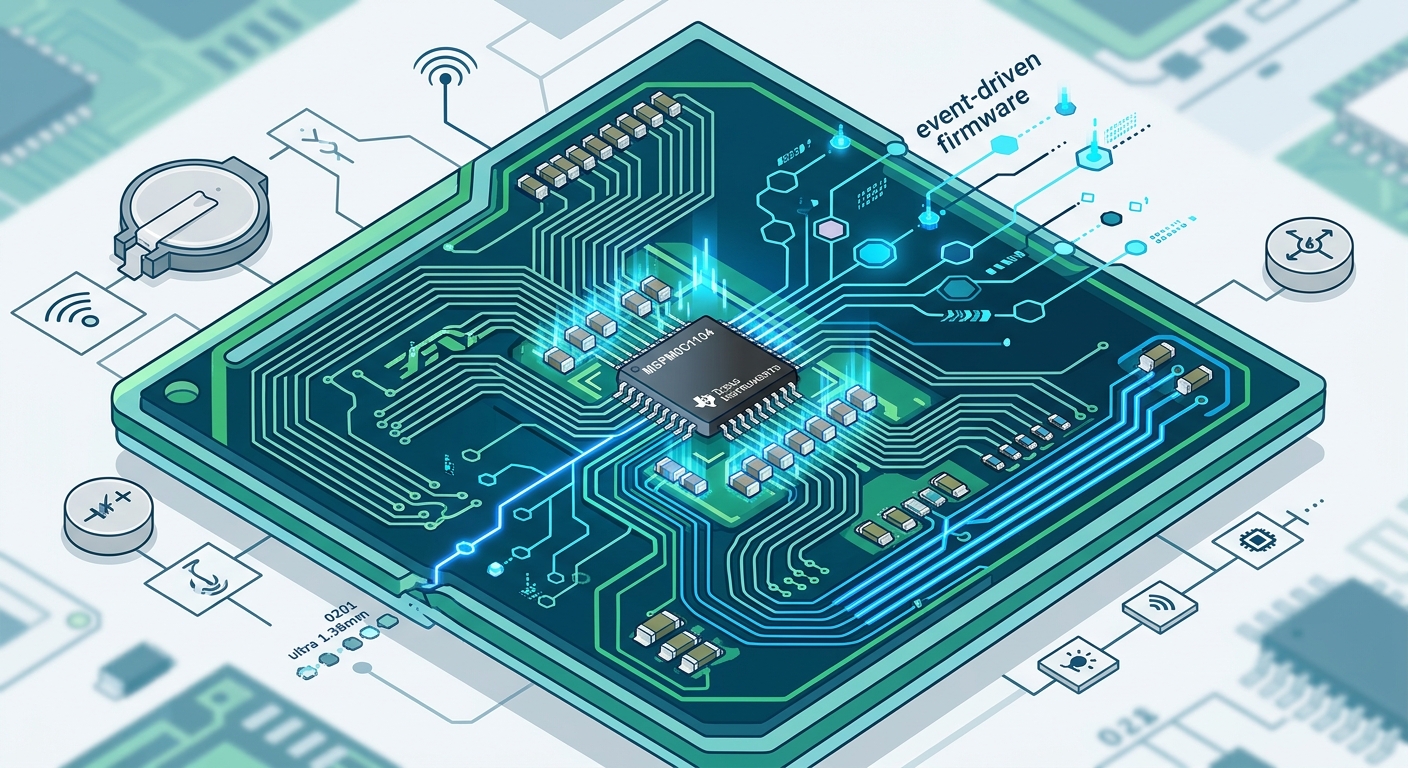
Introduction
“Small” in embedded design used to mean “a compact package.” But with ultra-compact microcontrollers, small also means less board area, tighter routing, and different trade-offs across power, peripherals, and firmware architecture.
TI’s MSPM0C1104 is an example of a modern, space-efficient microcontroller designed for cost-sensitive, size-constrained applications—where the hardware budget is tight and firmware must be disciplined.
In this post, we’ll explore how to think about a 1.38 mm-class microcontroller design from a practical engineering perspective: what changes when your MCU is physically tiny, how to plan power and I/O, and how to structure firmware so it remains robust under real-world constraints.
Note: The “1.38 mm” phrasing is typically associated with the device’s package/footprint class. The engineering principles below apply regardless of exact mechanical dimensions.
Why package size matters (beyond just fitting)
When the MCU footprint shrinks, you quickly discover that board design constraints shift:
- Routing becomes harder: Fewer millimeters can force shorter traces, constrained via placement, and careful layer strategy.
- Thermal behavior changes: Smaller packages often have different thermal paths, impacting peak current handling and sustained power dissipation.
- I/O pin planning gets stricter: You may not have the “luxury” of dedicating pins to debug, LEDs, or redundant signals.
- Decoupling and layout discipline are non-negotiable: Tiny packages magnify the importance of proper placement of bulk and high-frequency capacitors.
Practical takeaway
Design your system as if signal integrity and power integrity are first-class requirements, not afterthoughts.
Power design: make it predictable at small scale
Tiny boards often run on tight power budgets (battery, energy harvesting, or low-power rails). With a small MCU, the biggest risks are usually:
- Brownouts due to insufficient decoupling
- Noise coupling into analog inputs
- Unexpected wake-up behavior from GPIO or peripheral interrupts
A recommended decoupling pattern
Even if your schematic is correct, layout can break it. Consider:
- Place a high-frequency capacitor (e.g., 0.1 µF to 1 µF) as close as possible to the MCU’s supply pins.
- Add a bulk capacitor (e.g., 1 µF to 10 µF) near the power entry or regulator output.
- Keep the power loop area small: minimize trace length between regulator → capacitor → MCU.
Example (conceptual):
Regulator/VIN
   |
   +--- Cbulk ---+--- MCU VDD
   |              |
   +--- Chf -----+
                 (short, tight loops)
GND: use a solid return plane or a tightly coupled ground trace
Firmware-side power control
Hardware helps, but firmware decides how long you stay awake.
- Use the MCU’s low-power modes appropriately.
- Ensure wake sources are intentional (GPIO interrupts, timers, communication events).
- Avoid periodic “busy loops” that keep the core active.
A simple pattern:
while (1) {
    // Prepare peripherals
    // ...

    // Enter low-power state
    enter_sleep();

    // Wake-up happens via interrupt
    // Handle event
    handle_event();
}
Peripheral planning: fewer pins means smarter multiplexing
Ultra-compact MCUs often have limited pin count. That means you must think in terms of peripheral multiplexing and functional grouping.
Common strategies
- Consolidate signals: If possible, share one pin for multiple functions across time (e.g., UART TX used as a debug-only line during manufacturing).
- Use serial buses: I2C/SPI can reduce pin usage versus parallel interfaces.
- Plan analog carefully: If you use ADC inputs, keep them away from high-switching digital signals.
Example: LED + sensor + comms
Suppose you need:
- 1 status LED
- 1 analog sensor input
- 1 communication interface
A typical approach is:
- LED on a GPIO (with PWM only when needed)
- Sensor on ADC channel
- Communication on UART/I2C
If pin pressure is severe:
- Use a single line for LED drive (blink patterns) and disable it during ADC sampling.
- Schedule ADC reads during quiet digital windows.
Firmware architecture for constrained hardware
On a tiny microcontroller, code is not just about correctness—it’s about predictability.
Use an event-driven style
Event-driven code reduces wasted CPU time and makes power management easier.
A common structure:
- ISRs (interrupt service routines) do minimal work
- ISRs set flags or push events
- Main loop processes events and decides next sleep state
Skeleton:
volatile uint32_t events;

void GPIO_IRQHandler(void) {
    events |= EVT_BUTTON;
}

void TIMER_IRQHandler(void) {
    events |= EVT_TICK;
}

int main(void) {
    init();
    for (;;) {
        if (events == 0) {
            enter_sleep();
        }
        uint32_t e = events;
        events = 0;
        if (e & EVT_BUTTON) handle_button();
        if (e & EVT_TICK) handle_tick();
    }
}
Deterministic timing
Smaller boards often mean less shielding and more noise, so timing matters:
- Debounce inputs in software using timers.
- Avoid long blocking delays that prevent timely handling.
- For communication protocols, honor interrupt-driven or DMA-driven timing where available.
PCB layout considerations that make or break tiny MCUs
Even without knowing your exact schematic, the layout “rules of thumb” are consistent.
High-impact checklist
- Keep the clock path short (if external clock is used).
- Return current should have a clear path (solid ground plane or careful ground routing).
- Avoid routing analog traces under fast digital edges.
- Place decoupling capacitors close and connect to a low-impedance ground.
- Use test pads strategically: with tiny footprints, debugging headers may be impossible.
Debugging and manufacturing: plan for reality
With tiny packages, debugging can be harder. Practical steps:
- Provide a programming/debug interface footprint even if it’s not populated in production.
- Add test points for critical signals (power rail, reset, clock, UART TX).
- Use firmware “escape hatches” like a bootloader command or a GPIO strap sampled at reset.
Putting it together: a design workflow
Here’s a workflow that works well when your MCU is physically tiny and your board is space-constrained:
- Start with power requirements: peak current, average current, and acceptable brownout margin.
- Map peripherals to pins: identify which signals can be multiplexed over time.
- Choose an event-driven firmware skeleton: make sleep/wake explicit.
- Draft layout early: place decoupling caps and power entry before routing everything else.
- Validate with measurements: scope supply ripple during high-current events.
- Stress test: run at temperature extremes and with worst-case input noise.
Conclusion
A “1.38 mm-class” microcontroller mindset is really about disciplined engineering: tight layout, careful power integrity, and firmware that respects sleep, timing, and limited I/O.
If you approach the design as a system—hardware constraints informing firmware architecture—you can build tiny embedded products that are not only functional, but reliable.
If you share your application requirements (power source, peripherals needed, communication type), I can suggest a concrete pin/peripheral plan and an event-driven firmware template tailored to the constraints.
Comments (0)
No comments yet. Be the first to respond!
Leave a Comment
Your comment will be visible after review.