A coral handshake can restart a bleached neighbor
 by ahsan
October 18, 2026
5 min read
by ahsan
October 18, 2026
5 min read
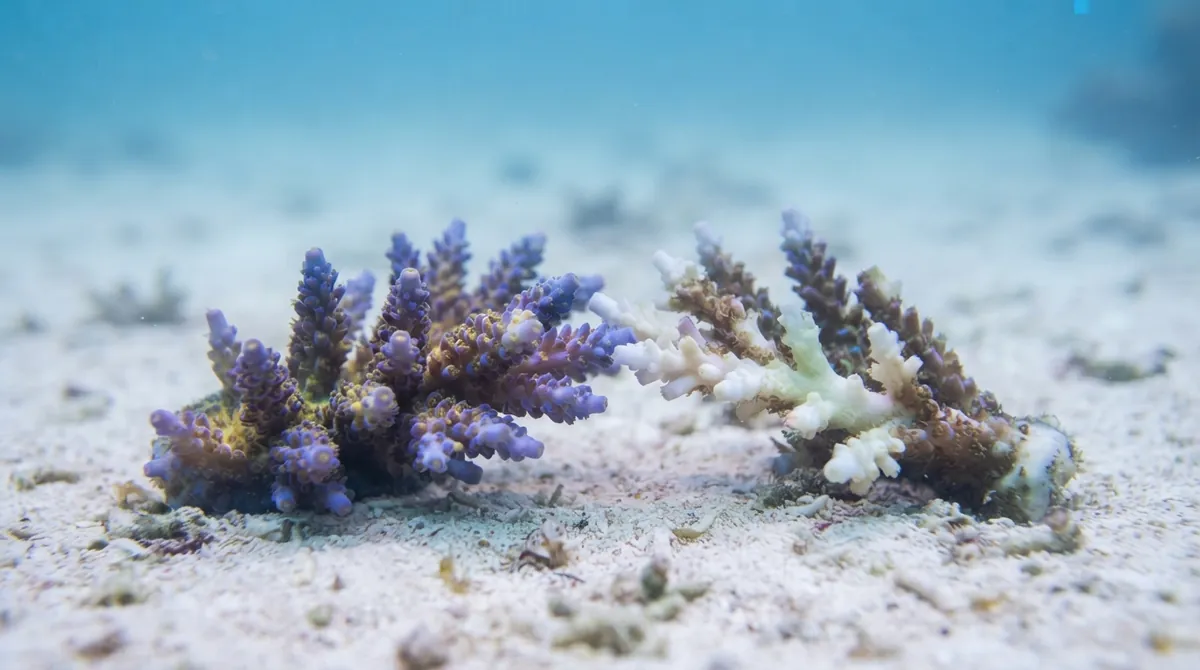
Picture a small branch of coral under laboratory lights: one side vivid with color, the other pale enough to reveal the white skeleton beneath. The two fragments touch. Over the following days, the bleached branch begins receiving tiny living partners from its healthy neighbor, and over the next several weeks, its color and energy return.
A study published in Science Advances in October 2026 shows that direct contact can trigger remarkably fast coral bleaching recovery. The result is hopeful, but it is not a ready-made reef repair kit. The experiments used small coral fragments in tanks, and the rescue worked only when the fragments were genetically compatible. Even so, the discovery reveals a natural form of symbiont transfer that scientists had not recognized before.
Bleaching is a partnership under stress
A coral colony is built from thousands of tiny animals called polyps. Each polyp can house microscopic algae inside its tissues. These algae belong to a group of photosynthetic dinoflagellates called Symbiodiniaceae. Photosynthetic organisms use light to make food, and the algae pass much of that food to the coral. In return, the coral provides shelter and access to useful nutrients.
This close, mutually beneficial relationship is called symbiosis. When seawater becomes unusually warm, the partnership can break down. The coral expels many of its algae, causing the tissue to turn transparent and making the pale skeleton visible. That is coral bleaching.
Bleaching does not mean a coral is already dead. A colony may recover if the heat stress eases and it can regain its algae. But without its main food-producing partners, the coral is running on limited reserves. Prolonged or repeated bleaching can slow growth, weaken reproduction, increase disease risk, and eventually kill the colony.
The accident in the tank
The discovery began with an accidental arrangement. In early 2025, marine scientist Stephen Palumbi noticed that a healthy coral fragment and a bleached fragment in a laboratory tank had come into contact. The pale piece began to regain color near the point where the two branches met.
Danny Collins and colleagues then tested the observation using ten pairs of Pocillopora damicornis fragments. Each pair came from the same original coral, with one healthy fragment and one bleached fragment. Five pairs were placed in direct contact. The other five were kept a few millimeters apart, close enough to share water but not to touch.
The difference was striking. The touching bleached fragments recovered within eight weeks, while the separated fragments eventually died after about twenty weeks. The handoff itself happened much earlier than the final change in appearance. By the second week, the symbiont population in recovering tissue was doubling roughly every four days. In some tests, as little as three days of contact provided enough algae to begin sustained recovery.
The sequence looked something like this:
healthy coral tissue
 │
 │ direct contact
 ▼
living tissue bridge forms
 │
 ▼
symbionts enter bleached tissue
 │
 ▼
photosynthesis resumes and the coral regains color
The bridge is not a metaphorical pipeline. It is a living connection formed when compatible coral tissues merge. Through that connection, symbionts can move from the healthy fragment into the bleached one. After about a week of contact, a bleached branch could continue recovering even after researchers separated it from its donor.
The coral has to recognize its neighbor
The most important limitation appeared when the researchers changed the genetic pairing. A genet is a group of fragments that came from the same original colony and therefore share the same genetic identity. Fragments from the same genet fused and supported recovery. Fragments from different animals, even when they belonged to the same species, did not form the same helpful bridge. Different species also failed to merge.
Corals are not passive pieces of living rock. Their tissues can recognize biological differences and respond defensively. In mismatched pairings, the fragments showed antagonistic interactions rather than cooperating. That makes the treatment more complicated than placing any healthy coral beside any bleached coral.
The researchers also observed a slower form of transfer in which coral polyps took up symbionts after contact. That process could occur in genetically mixed pairings, but it was not efficient enough by itself to restore the bleached colony. The rapid recovery depended on tissue fusion between compatible fragments.
What this could mean for coral restoration
Coral restoration programs often grow fragments in nurseries before placing them on damaged reefs. The new finding suggests that a nursery might one day use short periods of contact between healthy and bleached fragments to start recovery, provided the genetic identities are known and the surrounding conditions are safe.
There is another possibility. Instead of moving whole coral fragments together, scientists could investigate ways to collect, grow, and reintroduce the symbionts themselves. That approach might avoid the need for coral tissues to recognize one another, although it would bring its own technical and ecological challenges.
Much remains unresolved. The experiment involved a single coral species, small laboratory fragments, and carefully controlled conditions. Researchers still need to test whether the same process works in larger colonies, in open-water nurseries, and during the shifting temperatures and diseases found on real reefs. A healthy donor would also need to be protected from damage, and the method could not rescue tissue that has already died.
Most importantly, contact-based recovery does not remove the cause of mass bleaching. It cannot cool a warming ocean. The approach may help corals survive a dangerous interval, but long-term reef survival still depends on reducing heat stress and protecting local water quality.
Bleaching is often described as a story of loss: heat drives the algae away, and the coral waits for them to return. This research adds a more intimate possibility. Under the right conditions, a healthy neighbor can become a living source of recovery, passing along the partners that make coral life possible. A narrow tissue bridge in a laboratory tank may not rebuild an entire reef, but it shows that coral recovery can begin with contact rather than waiting alone.
Comments (0)
No comments yet. Be the first to respond!
Leave a Comment
Your comment will be visible after review.