Claude Sonnet 5: A Practical Guide to “Agentic” AI in Coding & Tools
 by ahsan
June 30, 2026
7 min read
by ahsan
June 30, 2026
7 min read
The day “the model that plans” stopped being a gimmick
Imagine this: your team has a bug report, a messy repository full of edge cases, and a never-ending list of small fixes that somehow never finish. You ask an AI coding assistant for help, and it writes a snippet—then stops. No follow-through. No verification. No check that the change didn’t break something else.
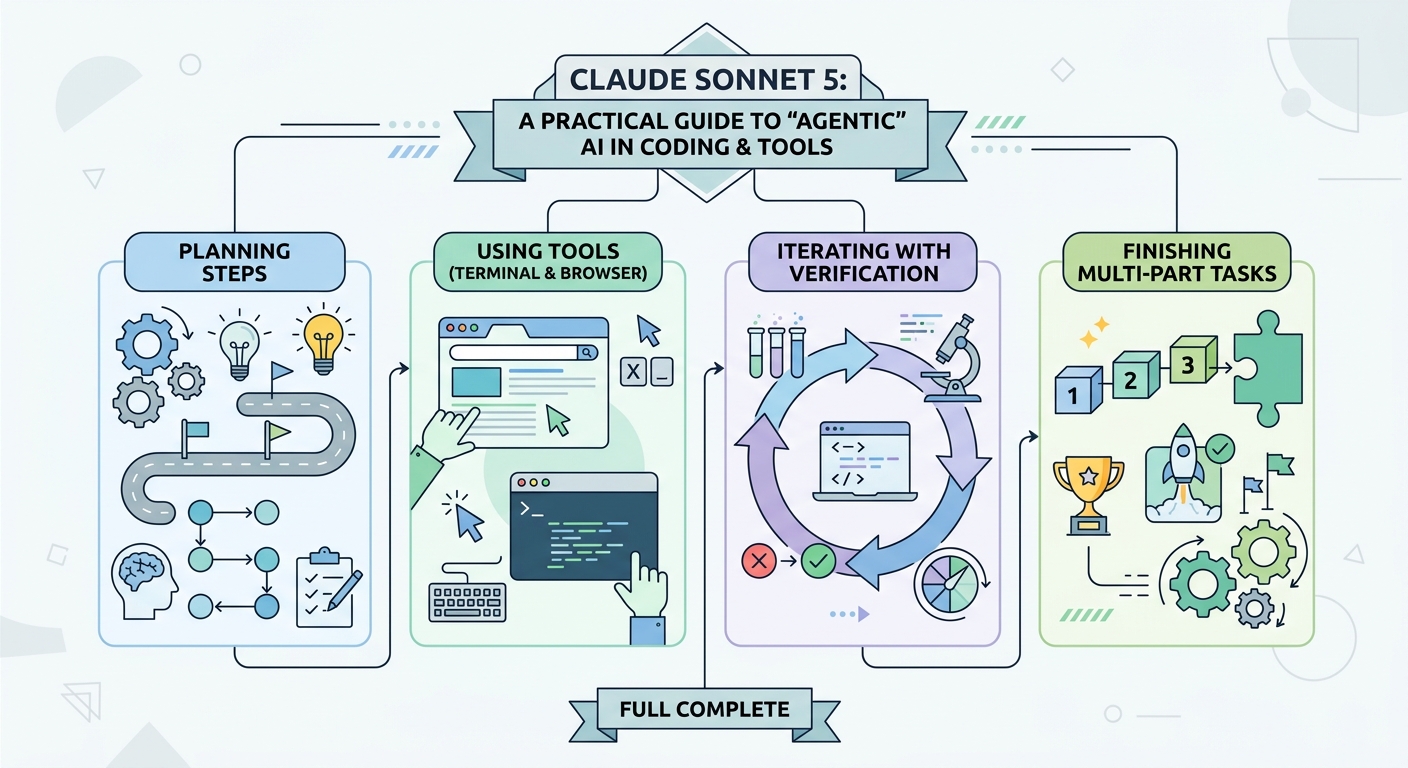
That gap is exactly what “agentic” AI tries to close: instead of generating a single response, the model behaves like a worker that can plan steps, use tools (like a browser or terminal), and carry work forward across multiple steps. Claude Sonnet 5 is positioned as a more agentic Sonnet model that can do that kind of multi-step execution more reliably and at lower cost than previous Sonnet generations.
So what does “agentic” actually mean in practice, and why should developers care? Let’s walk through the mechanics, the tradeoffs, and the kind of workflows where Sonnet 5 is likely to feel meaningfully different.
What “agentic” means—without hand-waving
“Agentic AI” is a term that describes systems that do more than answer questions. An agent (a self-directed program) can decide what to do next based on the task state—often by breaking a goal into steps.
When someone says a model is agentic, they usually mean it can:
- Plan: outline intermediate steps rather than jumping straight to an output.
- Act with tools: call external capabilities like a browser (to fetch web pages) or a terminal (to run commands, tests, scripts, and code).
- Iterate: observe results (like a failing test), adjust, and try again.
- Sustain execution: keep going until the goal is done, instead of stopping after the first draft.
In other words, an agentic model is less like a chatbot that answers, and more like a junior engineer that can run commands, look things up, and correct course when reality disagrees with the plan.
Why Sonnet 5 is framed as a “step change”
Claude Sonnet 5 is described as narrowing the gap to a higher-end model family (Opus-class models) while remaining in a Sonnet-class price/performance sweet spot.
Technically, the shift isn’t just “better text.” It’s about improved execution behavior in tool-using settings and more consistent reasoning across multi-step tasks. The underlying implication is that the model is more likely to:
- choose the right next action (tool call vs. continue reasoning),
- complete multi-part workflows end-to-end,
- verify outputs without being explicitly told,
- and avoid getting stuck midway.
A useful mental model is: earlier Sonnet versions were often competent at writing code but less reliable at running the full loop (write → test → debug → confirm). Sonnet 5 is presented as stronger at that full loop—especially in the “agent execution layer,” where you need steady progress across many small decisions.
Tool use: the practical difference between “code” and “software work”
Tool use is where agentic systems start to look real.
- A browser tool can retrieve information from the web (documentation, examples, error explanations).
- A terminal tool can run commands locally in a sandbox or controlled environment (unit tests, linters, builds, scripts).
In a typical automation workflow, the model’s output becomes part of a loop:
- Generate or modify code.
- Run tests or a build step in the terminal.
- Read the output (error logs, stack traces).
- Decide what to change next.
- Repeat until the task is satisfied.
Without this loop, the model can’t “ground” itself in what the computer actually does. With it, you get feedback-driven iteration.
Sonnet 5 is positioned as better at these loops—stronger reasoning for agentic tasks, stronger tool use, and improved coding and “knowledge work” behaviors.
Effort levels: a knob that trades cost for thoroughness
One of the most practical developer concepts in agentic systems is effort level.
An effort level controls how much work the model attempts before it returns results. Higher effort typically means more deliberation, more intermediate steps, and sometimes more tool calls. Lower effort can be faster and cheaper but may stop short on difficult problems.
This matters because agentic workloads can be bursty: some tasks are straightforward (“format this code”), while others are messy (“stabilize a flaky test and trace the real cause”). A single model that can scale effort gives you a way to tune reliability versus cost.
Claude Sonnet 5 and its companion options are described with cost-performance curves across effort levels. The developer takeaway is straightforward:
- Use lower effort for routine steps.
- Increase effort for tasks that require deeper debugging or more verification.
- When accuracy requirements spike, you may still want a higher-end model—but Sonnet 5 aims to cover a wide middle ground.
Autonomy without chaos: the “stays on plan” problem
Agentic models don’t just need power; they need discipline.
In real workflows, the failure mode is often: the model starts strong, then wanders—missing steps, skipping verification, or producing work that looks plausible but doesn’t meet the actual goal. That’s why the article highlights behaviors like:
- finishes complex tasks where previous models would stop short,
- checks its own output without being asked,
- and handles multi-step changes end-to-end.
This kind of execution stability is subtle. It’s not obvious from a single prompt. It shows up when you give the system a job with multiple deliverables, intermediate checkpoints, or constraints.
In engineering terms, the model is acting more like it has a task graph (a sequence of steps with dependencies) rather than a single response target.
A concrete example pattern: the “two-part job” that actually finishes
A two-part automation task is a good litmus test for agentic behavior.
Consider a scenario like:
- Update account tiers in a system (data change).
- Send a launch announcement to enterprise contacts (communication).
This resembles a workflow with a prerequisite: communication depends on the update being correct. Non-agentic systems often accomplish the first part and then stall, or they produce both parts without verifying that the first part truly completed.
Sonnet 5 is described by early testers as completing jobs that previously stalled halfway—suggesting improved orchestration of multiple steps and better follow-through.
Safety in agentic contexts: why “refuse correctly” matters
Agentic capability increases the impact radius of the model. When a system can run tools and take actions over multiple steps, safety behavior becomes more important, not less.
The article frames safety assessments as finding a lower rate of undesirable behaviors than the previous Sonnet version, and generally safer use in agentic contexts. It also notes evaluations showing a much lower ability to perform cybersecurity tasks than the highest-end model family.
For developers, the practical takeaway isn’t “trust the model blindly.” It’s that agentic systems need predictable boundaries: when a request is unsafe, the model should refuse cleanly and consistently rather than partially comply and then drift.
Pricing and deployment: what changes for developers today
Sonnet 5 is positioned as the default model for Free and Pro plans, and available across broader plan tiers. That matters because it lowers friction: more developers can try agentic workflows without paying the “premium model” tax.
On the platform side, the model can be accessed through the Claude API (with the model identifier shown as claude-sonnet-5). It also appears in tools like Claude Code and on the Claude Platform.
Pricing is described using token-based rates—input tokens for what you send, and output tokens for what the model generates. The article also mentions introductory pricing through August 31, 2026, which effectively reduces early costs.
The important engineering implication is that agentic workflows often involve more steps than a one-shot response. Even if the model is cheaper than higher-end options, tool-using loops can still accumulate cost—so effort-level tuning becomes part of real deployment strategy.
Where Sonnet 5 is likely to shine
From the described behaviors and examples, Sonnet 5 appears tuned for tasks with multiple rounds of work and real verification:
- Sustained coding: implementing changes across files, not just drafting a function.
- Debugging: tracing failures to root causes rather than patching symptoms.
- Tool-grounded knowledge work: using browsing or execution to reduce guesswork.
- Automation pipelines: multi-step jobs with end-to-end completion requirements.
A particularly telling phrase in the article is that it performs well on “brownfield” code—codebases that already exist and contain the sort of hidden complexity that causes flaky tests, race conditions, and subtle failures. Those are exactly the scenarios where agentic execution and verification loops pay off.
The big idea to carry forward
Claude Sonnet 5 represents a maturing step in agentic AI: not just smarter text generation, but improved planning, tool use, iterative execution, and safer behavior when operating autonomously.
When you’re building developer workflows, the real question isn’t “can the model write code?” It’s “can the model run the full engineering loop?” Sonnet 5 is presented as moving that loop closer to something developers can depend on at a practical cost—especially when paired with effort-level control.
Conclusion
Agentic AI turns an LLM from a conversational assistant into an execution-capable worker: plan steps, use tools, iterate based on results, and complete the job instead of stopping early. Claude Sonnet 5 is positioned to deliver that behavior more reliably than prior Sonnet models, with performance near higher-end options and a developer-friendly price profile.
In day-to-day terms, that means fewer half-finished tasks, better verification during coding and debugging, and more consistent multi-step automation—exactly the ingredients you need to move from demos to software that actually ships.
Comments (0)
No comments yet. Be the first to respond!
Leave a Comment
Your comment will be visible after review.