DeepSeek Open-Sources DeepInfer: What Its Inference Engine Actually Does
 by ahsan
October 20, 2026
6 min read
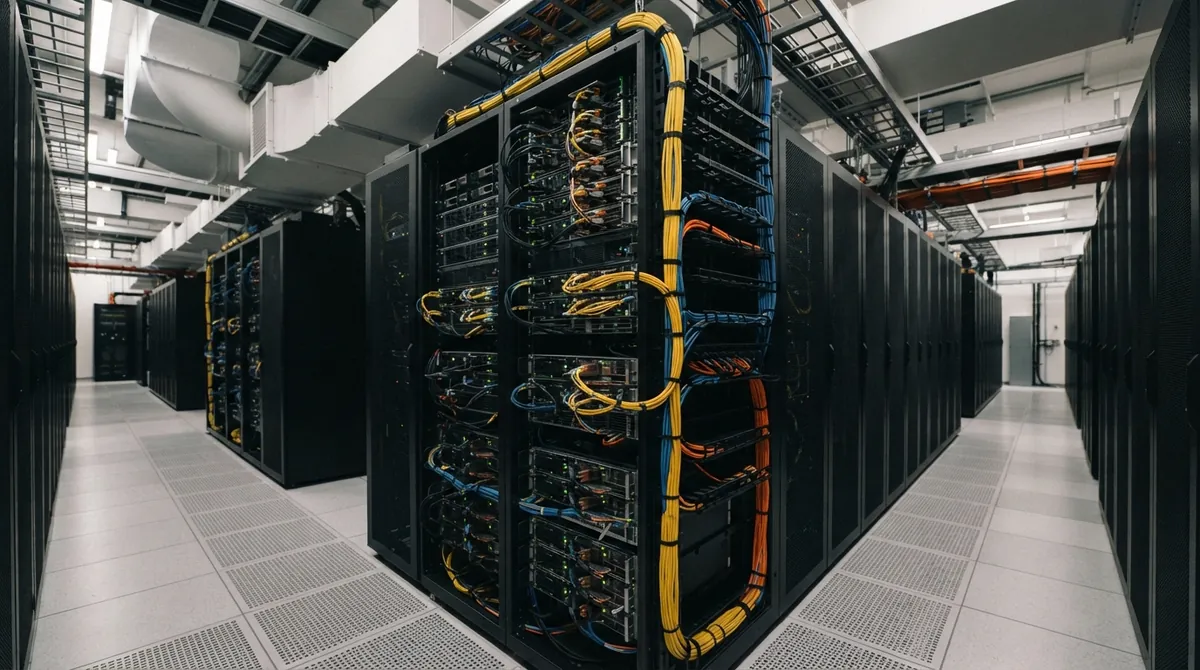
Imagine opening an artificial intelligence repository and finding not a chatbot, but the backstage machinery behind one: GPU kernels, schedulers, distributed execution, and cache management. That is the interesting part of DeepSeek’s DeepInfer release.
Inference means running a trained model to produce an answer. An inference engine is the runtime that decides how that work is split, queued, cached, and executed. On October 20, 2026, DeepSeek published DeepInfer as the engine behind its large-scale DeepSeek V4.1 Flash service. The public release is focused, though. It offers offline inference and core serving machinery, not a complete public application programming interface (API) service. (github.com)
Inference is the part after training
Training creates the model’s weights. Inference is what happens every time someone sends a prompt and waits for the model to generate a response, one small piece of text at a time. Those pieces are called tokens.
A modern inference request usually has two acts. During prefill, the engine reads the prompt and builds the internal attention state needed to understand it. During decode, it produces new tokens one step at a time. The hard engineering problem is keeping expensive accelerators busy while moving data, scheduling requests, and avoiding work that has already been done.
That is why an inference engine matters even when the model itself stays unchanged. DeepSeek’s deployment documentation describes the system as an interaction between computation, communication, scheduling, and storage rather than as a single program that runs on one machine.
DeepInfer has a narrow public boundary
DeepInfer currently lists DeepSeek-V4.1-Flash as its supported model. Its default checkpoint, meaning a saved copy of the model weights, is deepseek-ai/DeepSeek-V4.1-Flash-1017.
The hardware list is equally specific: NVIDIA SM100-class graphics processing units (GPUs) and Huawei Ascend 950 neural processing units (NPUs). That is a much narrower target than a general serving framework designed to cover many model families and generations of consumer hardware.
Inside that boundary, there is a lot of serious machinery. A kernel is a low-level routine written to perform a particular operation efficiently on an accelerator. DeepInfer includes or connects to optimized components such as FlashMLA, DeepGEMM, DeepEP, TileKernels, DeepSelect, and custom TileLang kernels.
The engine also supports mixture-of-experts (MoE) execution. Instead of sending every token through every part of a huge model, an MoE model routes each token to a smaller group of specialist subnetworks called experts. Expert parallelism spreads those experts across devices, while expert-parallel load balancing keeps popular experts from becoming bottlenecks.
Other features are aimed at production behavior: batch-invariant inference, deterministic sampling on NVIDIA hardware, and structured outputs. Structured output means constraining generation to a format such as JavaScript Object Notation (JSON), a regular expression, or an Extended Backus-Naur Form (EBNF) grammar.
The repository metadata describes the project as version 0.1.0 and marks it as beta. DeepInfer is released under the Apache 2.0 license.
Trying the offline runner
The setup tells you a great deal about the project’s intended audience. DeepInfer expects Linux, Python 3.12, GCC 13 or newer, and either CUDA 13 for NVIDIA hardware or CANN 9.2 for Ascend hardware. CUDA and CANN are the software stacks used to program those two accelerator families.
A NVIDIA build follows the basic shape below:
export DEEPINFER_ACCELERATOR=nvidia
./build.sh
python examples/offline_inference.py
The repository asks you to create an empty Python 3.12 environment first. On an Ascend system, the accelerator setting changes to ascend. The first offline run downloads the default model into the local Hugging Face cache unless a local model directory is supplied. (github.com)
This is not a laptop-friendly quickstart. The published support matrix is a boundary, not a suggestion that an older gaming GPU will work. DeepInfer is aimed at teams that already have the listed accelerators and want to study or run this particular model.
Where the speed comes from
One of the most interesting techniques is speculative decoding. A draft model proposes several likely next tokens, then the main model checks those guesses. It is a little like letting a junior editor prepare a sentence while a senior editor approves the useful parts instead of writing every word from scratch.
DeepSeek’s DSpark system adds a confidence head, a component that estimates how likely each proposed token is to be accepted. Rather than verifying a fixed number of draft tokens every time, the scheduler gives priority to proposals with the best expected payoff. The deployment Q&A says the production draft length is five tokens and reports roughly 4–7 percent more throughput at its stated operating point, while verifying fewer draft tokens on average. Those figures come from DeepSeek’s own configuration and should not be treated as a universal benchmark.
The scheduler also tries to keep the accelerator from sitting idle. In a conventional decode loop, the central processing unit (CPU) may be arranging the next batch while the GPU waits for the current result to return. DeepInfer overlaps those tasks: while the GPU handles one forward pass, the CPU prepares and launches work for the next step. The model does not need to change for this to help; the pipeline is rearranged so the hardware spends less time waiting.
Long prompts bring a different problem: repeating too much prefill work. DeepInfer uses a bounded replay strategy around sliding-window attention, or SWA, which focuses on a recent portion of the sequence. Its documented V4.1 approach can recompute a bounded 128-token region instead of rebuilding a much larger decoder state, reducing the amount of work needed when cached context is reused.
An open engine is not a complete service
The biggest caveat is the key-value cache, usually called a KV cache. It stores intermediate attention data from earlier tokens so the system does not need to recalculate the entire conversation for every new token.
DeepInfer’s README explicitly says that a complete service still needs a KV cache system, separation between the vision encoder, prefill, and decode stages, and load balancing across data-parallel replicas. Load balancing means distributing requests so that one device or worker does not become overloaded while others are underused.
DeepSeek’s deployment documentation describes those missing pieces in detail. Its production architecture separates stages across machines, uses dedicated storage for cached context, and routes requests according to both workload and cache length. That is the difference between an engine that can run an offline workload and an online service that must absorb unpredictable traffic, recover from failures, and keep response times steady.
This focused release also fits DeepSeek’s earlier explanation that its internal inference system was tightly connected to private cluster-management infrastructure and difficult to maintain as a general public project. DeepInfer exposes a useful, portable portion of that machinery without pretending the entire production control plane has been packaged for everyone.
Who should pay attention?
DeepInfer is most useful for infrastructure teams with SM100 or Ascend 950 hardware, researchers studying large-scale model serving, and engineers who want to inspect techniques such as speculative decoding, asynchronous scheduling, and cache-aware replay.
For everyone else, the practical takeaway is more measured. A developer with a consumer GPU or a need to serve many unrelated models will probably find the current hardware and model scope restrictive. DeepInfer is better understood as a focused reference implementation and a foundation for specialized deployments than as a universal replacement for existing serving frameworks. DeepSeek says the project was built primarily on vLLM, with additional inspiration from SGLang and TensorRT-LLM, which makes that relationship especially clear.
DeepInfer matters because it opens the layer that model releases often leave hidden: the scheduling, caching, communication, and low-level execution needed to turn model weights into a responsive service. It is not a boxed appliance, and it is not the whole DeepSeek API stack. It is a real piece of production machinery placed on the workbench, with enough of the surrounding design exposed to show where modern inference performance actually comes from.
Comments (0)
No comments yet. Be the first to respond!
Leave a Comment
Your comment will be visible after review.