From $120k Bowling Gear to ESP32 Lane Nodes
 by ahsan
July 20, 2026
7 min read
by ahsan
July 20, 2026
7 min read
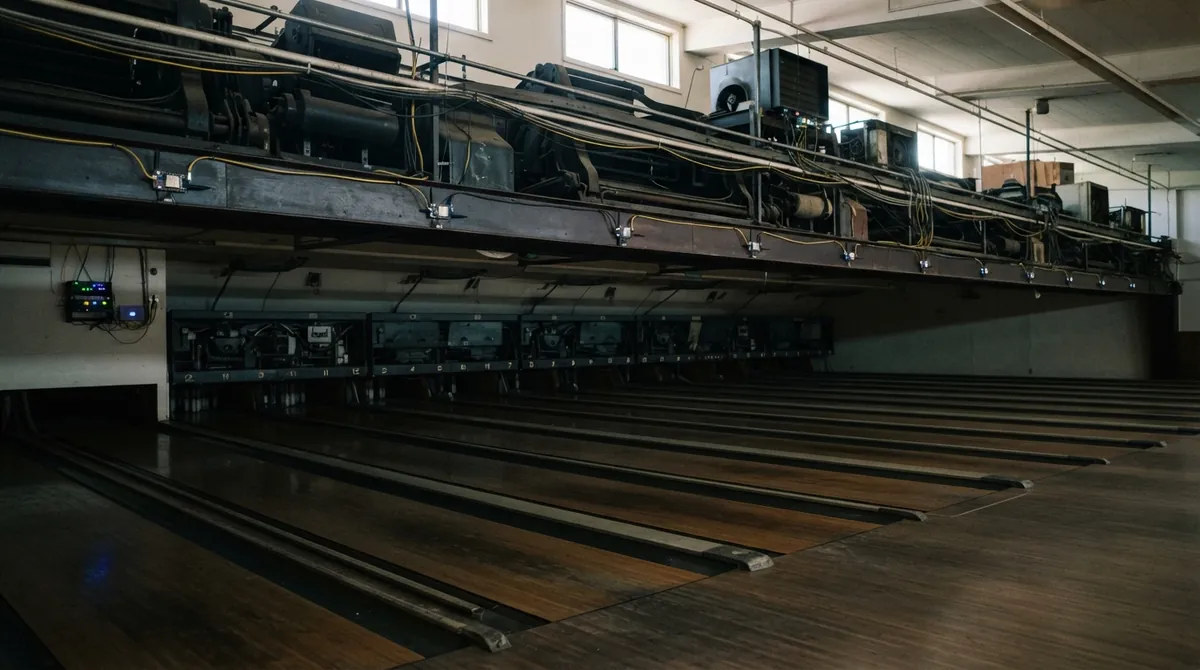
The day a bowling center invoice broke the spell
The bowling center started as a family project: buy an abandoned 8-lane place in the rural Midwest, fix what’s broken, and give kids (and grown-ups) somewhere local to go that isn’t “drive 45 minutes for fun.”
Then the score system—installed around 2008—showed up in the budget like a haunted mirror. The roof leaked, the electrical system had a mind of its own, and the old machines didn’t always cooperate. But the scoring hardware was the real villain: the kind of system that calculates ball speed and trajectory, detects pin state using cameras, drives animations, and orchestrates the pinsetter machine. All of that, plus the “fancy” parts inside it that make vendors expensive.
Why would anyone replace a $120k bowling center system? Because the replacement quote doesn’t just feel big—it feels per-lane-pair big, and it comes with the scariest kind of tax: ongoing dependency. No upgrades or service contracts included. No “own your data.” Just a new black box and a fresh round of invoices.
So the project changed shape. Instead of paying for a replacement, it became a build-your-own scoring pipeline.
The core insight: most of the machine is mechanical
Here’s the trick that makes DIY scoring systems feel suddenly possible: even when the score display looks modern, a lot of bowling lane-pinning orchestration is still mechanical underneath.
In this setup, replacing the scoring “brain” didn’t mean replacing 70-year-old bowling machines. It meant matching a few critical control signals and reading a few critical sensor signals.
The most important pattern was almost boring:
- Detect state changes (ball launched, ball received, fouls, pin outcome)
- Actuate a small set of control outputs (often reducible to switching relays)
- Stream events to a “lane computer” that decides what the user should see
Once that clicked, the problem stopped being “build a computer-vision pinsetter.” It became “build a reliable event interface between dumb sensors/relays and a modern real-time UI.”
Why ESP32 fits this kind of industrial-adjacent job
At the center of the approach are ESP32 microcontrollers. A microcontroller is a tiny computer designed for real-time control. It’s not a full laptop; it’s closer to an always-on brain that can read sensors and flip outputs.
The key features that make ESP32 a good match here are:
- Plenty of I/O to wire sensors (digital inputs/interrupts) and actuators (digital outputs)
- Wireless ability to move events off a lane-pair without running a full network cable
- A software ecosystem that supports fast iteration
But the real star is ESP-NOW.
ESP-NOW in plain language
ESP-NOW is a Wi‑Fi-based protocol by Espressif that lets compatible ESP chips send small messages directly to each other without joining a typical Wi‑Fi network with a normal router/access point.
Think of it as a low-latency “radio mailbox” for microcontrollers. In a bowling center, the messages you care about are small and frequent: “ball present,” “foul detected,” “pinsetter cycle finished,” “ready for next frame.”
The architecture described in the original idea uses an ESP-NOW star-like layout: each lane node talks to a gateway node, and the gateway talks to a Raspberry Pi (or similar Linux computer).
That division of labor is what keeps the microcontroller firmware from becoming a full operating system.
The hardware layer: relays, optocouplers, and sensors
Real-world wiring is where prototypes go to die, so the hardware choices matter.
The safest approach is typically:
- Relays for switching higher-voltage or mechanical loads.
- Optocouplers (also called opto-isolators) to protect the ESP32 from electrical noise or voltage differences by transferring signals using light.
- Simple sensors like IR break-beam detectors to produce crisp “something is here / something is not here” events.
A break-beam sensor is a light-emitter and a receiver pair. When an object blocks the light beam, the sensor toggles a digital signal. That digital signal is perfect for microcontrollers, because they can treat it like an event: rising edge = “ball received,” falling edge = “beam cleared.”
This is why the build avoids heavy computer-vision on the ESP32 itself. You don’t need a camera if you can detect the right transitions.
Designing the “event stream” so the UI can be fun
Once sensors and relays get wired, the scoring system becomes a software problem that looks like modern messaging.
The pattern is:
- Each lane-pair node emits events.
- The gateway translates those packets into a consistent internal format.
- Events land in a central state store and message bus.
- The UI subscribes and renders animations.
A clean mental model is an append-only log of gameplay facts. Every ball triggers a handful of events; the game state updates based on those facts.
Redis as the lane computer brain
Redis is an in-memory key-value store. In this style of architecture it’s used both as:
- A place to store the current state (like frame number, ball count, current pin status)
- A pub/sub system for broadcasting events to the UI
Pub/sub (publish/subscribe) is a messaging pattern where producers publish messages to a channel, and consumers subscribe to channels to receive updates. In this system, the lane computer publishes events, and a web UI listens.
Why this matters: it decouples “hardware timing” from “display timing.” Your ESP32 nodes can push events quickly; the React UI can animate at its own pace while still showing the latest state.
The fallback nobody wants to think about: RS-485
Wireless is convenient, but bowling alleys are not quiet RF environments. Cables, motors, switchgear, and all the ugly electrical reality in a building can make radio packets disappear.
So the design includes a wired fallback using RS-485.
RS-485 is a differential signaling standard over twisted-pair wiring. Differential signaling means each bit is represented by the voltage difference between two lines, which greatly improves noise immunity in electrically noisy places.
In other words: RS-485 is what you use when you want reliable bits in the real world, even when the environment tries to sabotage you.
From a system-design perspective, it’s not a replacement for ESP-NOW—it’s a backup path so the scoring doesn’t randomly hiccup.
A practical message format (the part that makes it maintainable)
The firmware hard part isn’t “sending bytes.” It’s agreeing on what bytes mean.
A simple, robust event payload might look like:
{
  "lane": 3,
  "type": "ball_received",
  "t_ms": 1721472300123,
  "seq": 98124
}
Where:
laneidentifies the physical lane-pairtypeis the event namet_msis the timestamp so the gateway can order eventsseqis a monotonic sequence number so the UI can detect drops or out-of-order delivery
A question that shows up in search often is: What would it take to score a bowling game without a vendor? The answer is less glamorous than you’d expect: define events, handle ordering, and build a state machine that turns events into a game.
Once that message contract is stable, every layer becomes easier to debug.
Repairs become fast because the system is modular
The best part of moving from a monolithic vendor system to lane-pair nodes isn’t only cost. It’s uptime.
If a controller firmware bug appears, you swap a node. If a sensor fails, you replace the sensor. If a relay output dies, you replace the driver.
Commodity ESP32 boards with pre-flashed firmware in a drawer turns debugging from “wait for a vendor” into “fix it before the bowling league ends.”
And because the data pipeline lands in Redis and then in the UI, you can own logs, replay events, and improve the game logic without waiting for an approval cycle.
A human scale for a surprisingly serious engineering problem
The original spark was frustration at vendor lock-in: paying to replace a system whose “advanced” parts mainly reduce to controlling relays while the rest of the bowling machine stays mechanical.
So the new approach treats lane scoring like modern distributed systems engineering, but with microcontroller hardware:
- event-driven sensing
- wireless or wired transport
- a gateway that normalizes packets
- a state store plus pub/sub
- a UI that renders animations based on the stream
That mix is why an idea that sounds like tinkering can actually become a working replacement.
Conclusion: owning the scoring story
A bowling center score system isn’t magic. It’s orchestration: turning physical state changes into consistent digital events, then turning events into what people see on screen.
By swapping a $120k replacement for a network of ESP32 lane nodes, the project traded “buy a black box” for “own the pipeline.” The result is cheaper hardware, faster repairs, and a platform that can grow into new features—like themes, new animations, or tighter integration—without waiting for a vendor to bless the next change.
Comments (0)
No comments yet. Be the first to respond!
Leave a Comment
Your comment will be visible after review.