GPT‑5.6 “Sol Ultra” in Codex: What It Means for Code Workflows
 by ahsan
July 06, 2026
6 min read
by ahsan
July 06, 2026
6 min read
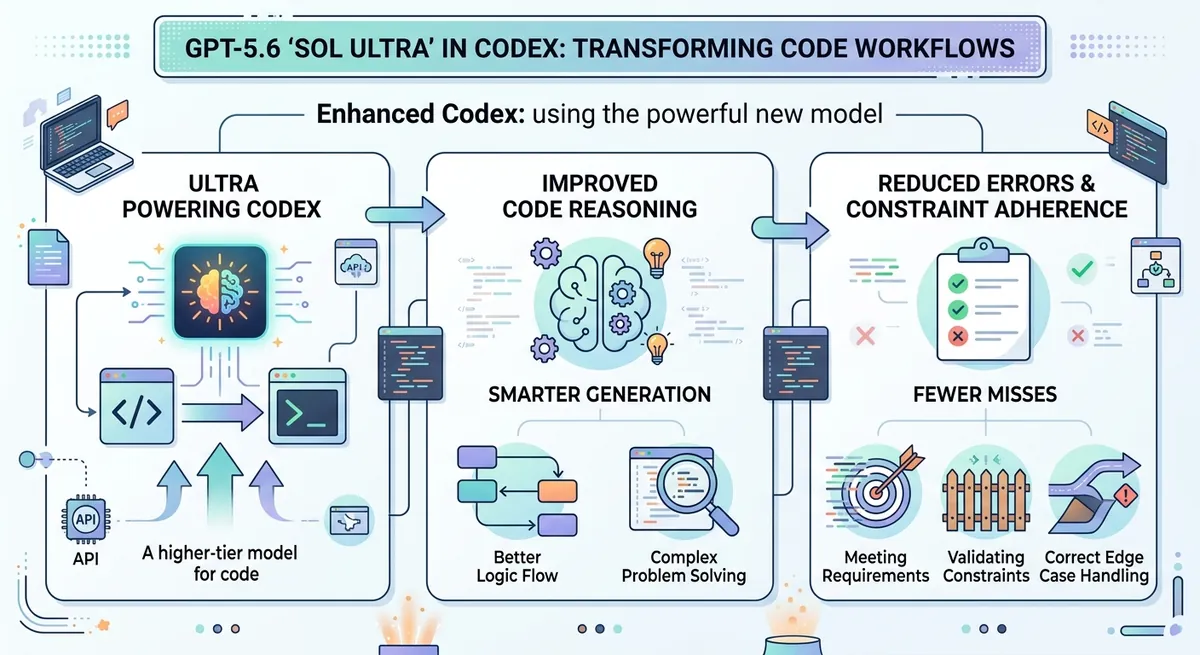
You’re in the middle of a coding session, and Codex is doing what it does best: turning your intent into code. Then you hit a familiar friction point—maybe it’s speed, maybe it’s reasoning depth, maybe it’s context length. That nagging feeling shows up in the same place every time: the model tier you want isn’t the one you’re using.
A simple announcement—“Ultra will be in codex”—lands like good news because it suggests an upgrade to the model behind your coding assistant. In this post, we’ll unpack what “Ultra,” “Sol,” “Codex,” and “context length” mean in practical terms, and what kinds of improvements you should expect when a stronger model tier moves into your coding workflow.
The cast of characters: Codex, “Ultra,” and “Sol”
Let’s start by translating the buzzwords into plain language.
Codex is a product line focused on software development tasks: generating code, editing files, writing scripts, and helping with debugging. In most setups, Codex is the “coding interface,” while the underlying model is the “brain” producing the output.
A model tier like “Ultra” usually refers to a stronger, more capable version of a model—one that tends to reason more carefully, follow instructions better, and produce higher-quality code. In practice, higher tiers often cost more and may be tuned for better performance on harder tasks.
“Sol” is likely a specific variant family or optimization label for a model line. The interesting part isn’t the marketing shorthand; it’s that “Sol Ultra” suggests an Ultra-class model that’s optimized for the way code-oriented systems operate.
When someone says “Ultra will be in codex,” the core technical implication is straightforward: the coding assistant interface will start using the Ultra-class reasoning model for its coding steps.
Why model tier differences feel dramatic in coding
Code generation doesn’t fail like a normal text chatbot. It fails in sharper, more expensive ways: wrong function signatures, subtle edge-case bugs, incorrect API usage, and formatting mistakes that break builds.
A stronger model tier helps in several specific ways:
- Better instruction following. Coding assistants often have to respect constraints like “don’t change public APIs” or “keep this file formatting.” Higher tiers generally do better at maintaining those rules across multiple steps.
- More reliable multi-step reasoning. Refactors, migrations, and debugging require a chain of small decisions. Stronger models are typically better at keeping that chain coherent.
- Less brittle output. You’ve likely seen code that compiles but fails tests because a hidden assumption slipped in. Higher tiers reduce that kind of “almost correct” behavior.
So “Ultra in Codex” matters because Codex workflows are multi-step by nature. Even if you only asked for “implement feature X,” Codex usually stitches together planning, code edits, and iterative correction.
Context length: the part people argue about
One comment around this announcement focuses on context length—specifically whether the Ultra-tier model will support something like a 1 million token context.
Let’s define that.
Context length is the maximum amount of text (and code) the model can consider at once. A token is a chunk of text; it’s not exactly a word, but it’s close enough to think of tokens as the model’s internal “units” of input.
Why does context length matter for software?
Because real projects aren’t small. A coding session might involve:
- a few related files,
- configuration and build scripts,
- existing helper functions,
- documentation stubs,
- and error logs.
With a short context window, the system may omit older relevant details, forcing you into a loop of “paste the file again.” With a larger context window, the assistant can hold more of the codebase in mind while reasoning, which often improves accuracy.
However, the story is tricky: comments mention differences between the API and Codex behavior, and mention “compaction loops.”
A compaction loop is what happens when the system tries to fit too much information into limited context. It may compress earlier material—sometimes aggressively—so the assistant can continue. Compression can preserve meaning, but it can also lose nuance, especially for code. Bigger context limits reduce the need for compaction, which can reduce those accuracy dips.
So the question many developers search for is: will Ultra in Codex also bring the larger context that developers want?
Even without confirming the exact number, the direction is clear: developers care because context affects both correctness and workflow friction.
Performance: “Ultrafast” and the feel of interaction
Another comment references “750 tps” and “Ultra,” with the idea that you’ll get faster throughput.
TPS stands for tokens per second—a measure of how quickly the model outputs tokens. Higher TPS generally means the response feels more responsive. In coding, this can change the experience in subtle ways:
- You iterate faster while debugging.
- You can handle longer outputs without waiting as long.
- Multi-step code generation feels less like a series of pauses.
There’s an important technical nuance here: speed isn’t the same as quality. A model can be fast and wrong, or slower and precise. “Ultra in Codex” implies both: Ultra-class reasoning paired with a system designed for interactive coding.
What changes in your day-to-day coding workflow
When the Ultra model tier lands in Codex, the most noticeable improvements usually show up in places where developers routinely “nudge” assistants.
Consider common scenarios:
Refactors across multiple files
Refactors require consistency. The model must keep track of what changed and update all related call sites. Ultra-tier reasoning tends to reduce missed updates.
Debugging with long error traces
Stack traces and logs can be huge. With more context available, Codex can correlate earlier failures with later symptoms instead of treating each log line as isolated noise.
Code review style tasks
Asking for “find bugs,” “improve readability,” or “harden error handling” forces the assistant to balance correctness with style. Stronger models tend to produce more grounded changes and fewer cosmetic churns.
In all these cases, the model is juggling constraints, not just writing code. That’s exactly where “Ultra” tends to pay off.
The realistic limitation: integration, not just the model
There’s a temptation to treat this as a pure swap: Ultra replaces a previous model tier and everything improves.
Reality is more nuanced. Codex is an orchestrated system. Even if Ultra is available, the user experience depends on:
- how Codex selects what to include in context,
- how it summarizes or compresses prior messages,
- how it chunks large code edits,
- and how it verifies or iterates on outputs.
So the best mental model is: Ultra raises the ceiling, but the surrounding workflow still determines how often you reach that ceiling.
That said, the community reaction makes sense. Developers don’t only want better text generation—they want fewer dead ends and fewer retries.
What to watch for after the rollout
As Ultra becomes available in Codex, the biggest practical signals will be measurable in day-to-day outcomes rather than in model names.
You’ll likely see improvements like:
- fewer times you need to re-paste files because the assistant “forgot,”
- more consistent compliance with “do not change X” constraints,
- better handling of edge cases in generated code,
- and faster iteration when exploring alternatives.
The context question will remain the headline because it directly affects whether Codex can understand large projects in one pass. If Ultra also brings the larger effective context window—whether full size or reliably retained content—that would be a workflow revolution for anyone working with big repositories.
Conclusion: Ultra in Codex is about closing the gap
“Ultra will be in codex” is more than a one-line update. Technically, it points to the coding assistant being powered by a stronger Ultra-tier model (and likely an optimized variant family), which should improve multi-step reasoning, constraint adherence, and overall code reliability.
For developers, the real promise is reduced friction: fewer retries, fewer dropped details from long sessions, and a smoother path from intent to correct code. Model tiers matter because software work is not one-shot generation—it’s an iterative process of keeping many details aligned. Ultra in Codex suggests that Codex is ready to play that game at a higher level.
Comments (0)
No comments yet. Be the first to respond!
Leave a Comment
Your comment will be visible after review.