Half-Baked Product: How Premature “Prototypes” Turn into Unscalable Failure
 by ahsan
July 03, 2026
8 min read
by ahsan
July 03, 2026
8 min read
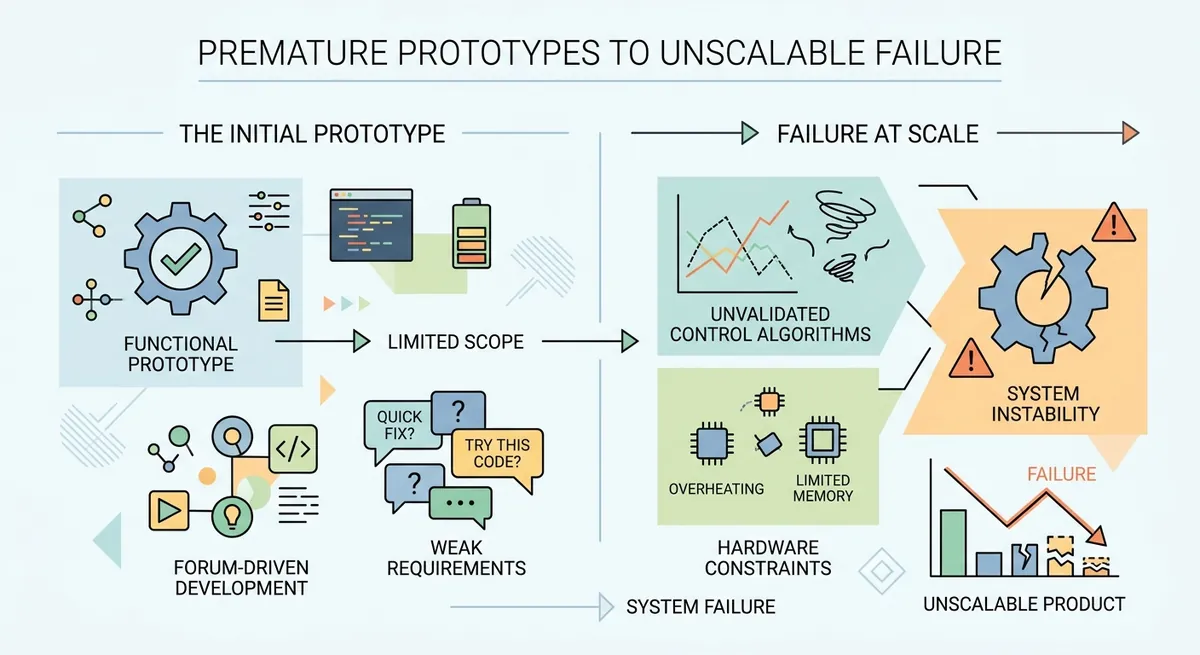
The story where “it works” becomes a marketing problem
Picture this: you and your team build a brand-new product and celebrate because the first version does something. Maybe it works one out of three times. Maybe it’s “good enough for an MVP.” That celebration feels earned—until customers start using it for real work, not demos.
That’s the core tragedy in the “Half-Baked Product” story: the company treats a fragile prototype like proof of a scalable product. They raise money on spreadsheet-shaped optimism, patch engineering gaps with forum opinions, and sell promises rather than reliability. The result isn’t just a broken oven—it’s a broken feedback loop.
This article breaks down the technical and product-engineering mechanics behind that failure, using ovens as an easy-to-remember metaphor. Along the way, we’ll define the key concepts so you can recognize the same patterns in software, hardware, and any “complex system” product.
MVP isn’t a magic spell—what it really means
An MVP (Minimum Viable Product) is the smallest version of a product that can be shipped to learn from real use. The important word is learn. Learning requires truth: what fails, for whom, under what conditions, and what the failure looks like.
In the story, the MVP oven has one meaningful improvement: an automated stopping mechanism based on flour, yeast, and water input. But in practice it’s inconsistent—bread burns, cakes are raw, pizzas burn—so the automation is not trustworthy.
Technical insight: an MVP can be “working” in the engineering sense (it runs), while still being “non-viable” in the product sense (users can’t depend on it). Dependability is not a feature; it’s the baseline requirement for products embedded in time-sensitive workflows like baking.
A common question beginners search for—“Is this MVP or already a product?”—gets answered by one measurable reality: would a customer keep using it after the novelty wears off? In the story, nobody checks repeat purchase. That’s where the technical risk hides.
Why baking controls are secretly hard (and why algorithms wobble)
The oven’s automation is essentially a control system: it observes inputs (ingredients and likely conditions inside the oven), estimates cooking progress, and decides when to stop.
A control system is a system that uses measurements and rules to keep behavior within desired limits—like a thermostat that turns heat on/off to reach a target temperature. In baking, the “target” is doneness, which doesn’t map perfectly to time or temperature for every dough.
The story says the algorithm is “unstable” and failure rate drops from two thirds to one third, but each improvement costs twice as much. That pattern usually appears when:
- You’re tuning a model to cover a large variety of cases with limited data.
- The system has nonlinear behavior (small changes create large outcomes).
- You’re patching symptoms rather than fixing the core uncertainty.
In plain terms: every dough is its own universe. Without sensors that capture what matters (often internal temperature, moisture, airflow, or dough state), the system makes educated guesses—and educated guesses break under real variation.
Even worse, the story later shows a key constraint: if the oven tries to be great at bread and cake and pizza, the failure rate might spike. That leads to a classic product-engineering tradeoff:
- One model for three tasks increases complexity and error surface.
- Specialize per task reduces uncertainty but narrows the market.
The engineer proposes sacrificing one market for a product that works. The founder hears the spreadsheet promise: capture “all of Spain.” This is how technical reality collides with investor narratives.
“Forum truth” is not system validation
In software and hardware, validation means confirming that the system performs reliably for its intended use cases. Forum discussions can provide hypotheses (“convection helps,” “refractory stone matters”), but they are not validation.
The story replaces experimentation with authority: two Italian users (Mario and Luigi) allegedly know oven truth because they argue well on forums. That can feel persuasive, but it misses the engineering requirement: measurable performance under defined conditions.
Technical term to hold onto: requirements are explicit statements of what the product must do. Requirements include accuracy, tolerance, reliability targets, input ranges, and constraints.
Forum opinions rarely specify the requirements that would let an engineer verify correctness. As a result, the team repeatedly drives engineering decisions without closing the loop with real tests.
Sales can’t sell reliability they don’t have
At first, sales fails because the product’s value is mostly theoretical—an efficiency gain of 15% on paper. In everyday business decisions, customers often buy for risk reduction, not optimization.
A baker’s decision is shaped by a brutal reality: if the new oven fails today, the bakery loses customers tomorrow. That means the true customer requirement is predictability—not improved averages.
In technical terms, reliability matters in a way that average metrics hide. A model can have decent average performance but still have frequent catastrophic failures. Bakers don’t experience “one third perfect.” They experience burnt bread whenever they happen to use it.
This is why enterprise sales behaves differently: it can involve pilots, contracts, and internal risk absorption. But even in enterprise settings, the handshake-first approach in the story delays the discovery of constraints until late—when engineering has already committed.
The Mallorca moment: when requirements arrive after decisions
The story’s Mallorca segment is a textbook “scope shock.” The company signs a deal for 500 ovens with custom dimensions and a rotating base. Those details become hard requirements—meaning the product must meet them to ship.
This is where engineering complexity shows up as physical reality.
Why CAD dimension changes aren’t “just numbers”
CAD (Computer-Aided Design) is software used to create precise digital models of physical objects. In engineering, changing a dimension can affect:
- Thermal distribution (how heat flows through the oven)
- Insulation and material placement
- Airflow and convection patterns
- Control loop tuning (how the algorithm should stop)
- Power electronics constraints (the inverter sizing and behavior)
A rotating base adds another coupling: it changes how food sits relative to airflow and heat transfer over time. Even if the rotation seems mechanical, the thermal and control systems must be redesigned so the algorithm still stops at the correct doneness.
That’s why the engineer argues that changing dimensions breaks the thermal design and forces inverter redesign. The founder’s “just changing a number” assumption is exactly the kind of thinking that kills advanced products.
Engineering debt: why progress becomes nonlinear
When the story says failure rate drops from two thirds to one third, but improvements later cost twice as much per point, it’s describing diminishing returns—and often engineering debt.
Engineering debt is the gap between the system’s current state and what it should be for long-term maintainability and performance. Debt accrues when teams optimize for speed of shipping, leaving architectural or data gaps.
In control problems, debt often appears as:
- A model trained on narrow conditions that fails on broader inputs
- Control logic that assumes a fixed geometry that later changes
- Tuning parameters that were never revalidated after hardware revisions
This debt doesn’t disappear—it resurfaces whenever the product moves from prototype territory into production constraints.
“Three weeks instead of five months”: the cost of compromise
The “Miracle” prototype is delivered in three weeks, not five months. That happens when teams compromise on what they promised.
They meet the dimensions, but the rotating base doesn’t exist yet. They also keep the algorithm imperfect. Compromises are not automatically bad; they become dangerous when the sales promise implies full capability.
This is the “half-baked” part: the product ships with partial fulfillment, and the business logic assumes those missing pieces will arrive in the future.
Technical lesson: integration debt—the work needed to combine hardware and software correctly—can’t be wished away. A rotating base isn’t a future add-on if the control algorithm and thermal design were never validated with rotation.
The candle button: a product UX symptom of deeper system failure
The story ends with “The Candle Button,” which hints at a common failure mode: adding a feature that makes people feel in control, while masking instability.
In many systems, when the core behavior isn’t reliable, teams compensate with workarounds—manual controls, “help buttons,” calibration modes, or guided steps that shift complexity onto users.
A “candle button” is likely a UI mechanism that helps users recover from poor automation, such as extending or adjusting bake time. That can reduce immediate pain, but it also signals that the automation layer is not meeting its requirements.
As a technical product matures, the goal isn’t to reduce user effort; it’s to reduce failure. If the user needs to babysit the system, the system’s reliability story is incomplete.
What this means for real-world products (software included)
Ovens are physical, but the failure pattern transfers cleanly to software.
A “half-baked product” often looks like this:
- A feature is demonstrated under ideal conditions, but not validated under real variability.
- Metrics focus on what’s impressive (one improvement, a promising demo) rather than what’s stable (repeatability, uptime, error rates).
- Sales commitments arrive before requirements lock down.
- Engineering invests heavily in new scope rather than revalidating core behavior.
The rescue attempts—more engineers, more promises, more tuning—can work temporarily. But if the foundational loop isn’t rebuilt (requirements → validation → measurement → iteration), the product remains fragile.
Conclusion: the real ingredient is closed-loop truth
The story of the half-baked oven isn’t really about ovens. It’s about a recurring engineering and product trap: treating prototype performance as if it generalizes, treating forum arguments as validation, and treating sales promises as a substitute for requirements.
Technical systems—especially those with complex physics or nonlinear behavior—demand closed-loop truth: you define requirements, validate with real data, measure reliability under the real range of conditions, and iterate until the product is dependable.
When that loop breaks, the company doesn’t just ship a flawed oven. It builds a business around optimism instead of accuracy—until the “half-baked” version can’t support scaling anymore.
Comments (0)
No comments yet. Be the first to respond!
Leave a Comment
Your comment will be visible after review.