Holography Didn’t Disappear. It Changed Jobs.
 by ahsan
October 12, 2026
6 min read
by ahsan
October 12, 2026
6 min read
Holography Didn’t Disappear. It Changed Jobs.
Take a banknote and tilt it under a lamp. A portrait seems to slide across a silvery strip, as if the paper has a tiny window into another dimension. For a moment, it resembles the future promised by old science-fiction magazines. Yet that feature is not a miniature movie projector, and the holographic person in a stage show is often a clever reflection or projection. So what happened to holograms? The technology moved from the center of the spectacle to the machinery behind useful instruments. (ecb.europa.eu)
Start with the wave
Holography is a method for recording and reconstructing light. Physicist Dennis Gabor developed the basic method in 1948 and later received the 1971 Nobel Prize in Physics for his work on holography. The important word is not three-dimensional. It is wave. A hologram stores enough information about a wavefront, the shape and direction of a light wave, to recreate how light from an object would reach your eyes. (nobelprize.org)
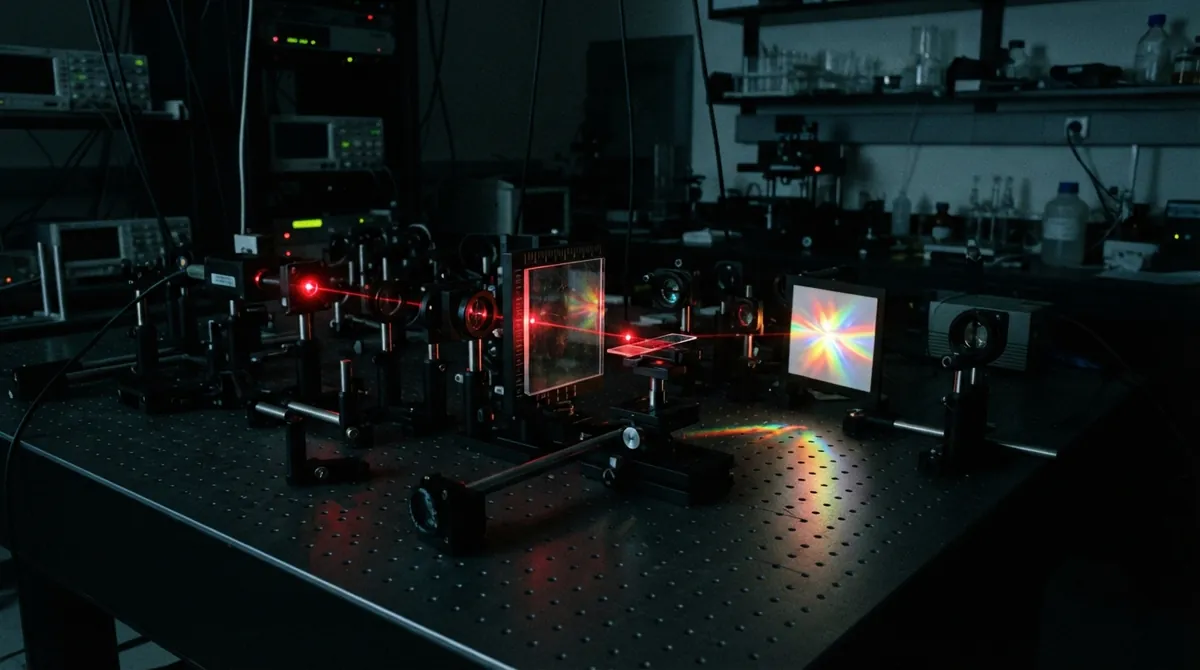
A conventional photograph records intensity, meaning how bright each point is. Holography also needs phase, which describes where a light wave is in its repeating cycle. Film or a camera sensor cannot read phase directly, so classic holography combines two beams of coherent light, meaning light waves with a stable relationship. One beam reflects from the object; the other, called the reference beam, travels along a known path. Where they overlap, interference—waves combining to make a pattern of bright and dark fringes—encodes the object beam.
object beam --------\\
 > interference pattern -> recorded hologram
reference beam ------/

recorded hologram + readout light -> reconstructed wavefront -> eye
Read the pattern with suitable light and diffraction, the spreading and redirection of light by fine structures, rebuilds the wavefront. Your eye receives light with many of the same directions it would have received from the original object. That is why a real hologram can change with viewing angle and reveal parallax, the apparent shift of nearby parts as you move your head. (nobelprize.org)
This explanation clears up a common misunderstanding. A hologram does not have to be a glowing object suspended in empty air. It can be a film, a microscopic pattern on a banknote, a camera recording processed by a computer, or a programmable optical display. The family resemblance is in the control of light, not in the dramatic appearance.
Why the holographic television stalled
The dream of a living-room holographic television ran into a pile of physical constraints. A dynamic holographic display must control the phase of light across a very large number of tiny points, and it must do that fast enough for moving images. Smaller pixels can steer light through wider angles, but they are harder to manufacture and drive. Increase the image size and viewing angle, and the system has to manage far more optical information. (nature.com)
Then there is speckle, the grainy shimmer produced when coherent laser light interferes with itself. Color, brightness, heat, power consumption, calibration, and the need to let several people see a convincing image from different positions add another layer of difficulty. A stereoscopic display can send a slightly different flat picture to each eye; a holographic display tries to reproduce the directions and timing of light reaching the eye. That is a much more demanding job.
Many public demonstrations also use the word hologram loosely. A volumetric display creates light or scattering at physical locations throughout a volume. A stage illusion may bounce a two-dimensional image off a transparent surface. Both can look three-dimensional, but neither is automatically holography. The distinction matters because it explains why spectacular demos arrived before practical, room-scale holographic screens.
The first quiet success: security
Holography found a home where angle-dependent light is an advantage. On current euro banknotes, the portrait hologram changes as you tilt the note, while the €100 and €200 notes also include satellite holograms. These features are designed to be checked by touch, sight, and motion, while their fine optical structure makes ordinary copying much less useful to counterfeiters. It is not a science-fiction communicator, but it is a mass-produced optical security device. (ecb.europa.eu)
The same lesson applies to labels, identity documents, and product packaging. Here, holography succeeds because the goal is not to show a perfect 3D scene to a crowd. The goal is to make a small patch of material respond to light in a difficult-to-forge way.
The second success: seeing transparent biology
The more surprising destination is the microscope. Digital holographic microscopy uses a camera to record an interference pattern and a computer to reconstruct it. In this context, label-free means the cells do not need fluorescent dyes or other stains. Quantitative phase imaging measures how much the specimen delays the light wave, turning a faint transparent cell into data about its shape and optical thickness.
That makes holography useful for watching living cells over time rather than freezing a sample in a single stained snapshot. Researchers can follow cell growth, motion, division, or responses to treatment. In 2024, a lensless off-axis system was demonstrated for time-resolved imaging of living cells and cells moving through a microfluidic channel, a tiny channel used to guide fluids and cells, pointing toward smaller instruments for flow analysis and near-patient testing. (pubmed.ncbi.nlm.nih.gov)
Here the hologram may never be shown to a human as a floating image. It is an intermediate measurement, like a raw audio waveform before software turns it into music. The useful product is the reconstructed phase map and the biological information extracted from it.
The comeback is wearing glasses
One of the most active display directions is augmented reality (AR), where digital imagery is overlaid on the real world. A spatial light modulator (SLM)—a programmable panel that changes how light is delayed or redirected—can display a computer-generated hologram. A waveguide, a thin optical path that steers light through glass, carries that image toward the eye. Nanoscale surface structures called metasurfaces help perform optical work that once required bulky lenses.
The hard part is not producing one sharp image in a laboratory. It is producing a wide field of view, a large eyebox—the region in which the eye can move without losing the image—and convincing depth cues in a compact device. Researchers often group those requirements under étendue, a measure of how much area and angular spread an optical system can support. In July 2025, a Stanford and Meta research team reported an ultra-thin mixed-reality design combining waveguide holography with artificial intelligence (AI)-based reconstruction and calibration, meaning correction for hardware imperfections. The work was a prototype, not a finished consumer product, but it shows where the field is concentrating its effort. (ee.stanford.edu)
AI helps with the calculations and the imperfections of real optics, but it does not repeal diffraction. The glass still has to guide light, the modulator still has finite pixels, and the viewer still moves. The future display may therefore look less like a glowing object in the middle of a room and more like ordinary eyewear quietly shaping the light that reaches your eyes.
What became of holography?
It became less visible and more useful. The grand public promise was a universal 3D screen; the working reality is a toolkit for encoding wavefronts, measuring transparent specimens, authenticating documents, and shrinking optical systems.
That is not a failed future. It is a change in scale. Holography did not vanish when holographic television failed to arrive on schedule. It escaped the demo stage and settled into places where controlling light solves a real problem. The shortest answer is also the most accurate: holography is not the art of making things float. It is the art of reconstructing light.
Comments (0)
No comments yet. Be the first to respond!
Leave a Comment
Your comment will be visible after review.