How 80-meter tropical trees move water upward without “breaking”
 by ahsan
July 04, 2026
7 min read
by ahsan
July 04, 2026
7 min read
The moment you wonder: can water really climb that high?
Picture a rainforest where the tallest tropical trees tower over the canopy like living skyscrapers. Now imagine what those trees must do every day: pull water from deep in the ground up to leaves near the top, where sunlight drives photosynthesis (the process plants use to turn light energy into chemical energy).
A common intuition says height should make this harder. Gravity (the downward pull of Earth) acts against any upward movement, so taller trees should struggle more—especially during drought. That idea is so widespread that many climate models expect tall trees to be more vulnerable.
But new field research on the world’s tallest tropical flowering trees—Dipterocarps (a plant family dominating Southeast Asian rainforests)—suggests a different story: these trees appear to “design around” the challenges of height.
The core problem: moving water through tiny pipes
To understand why tall trees face trouble, we need the tree’s water delivery system.
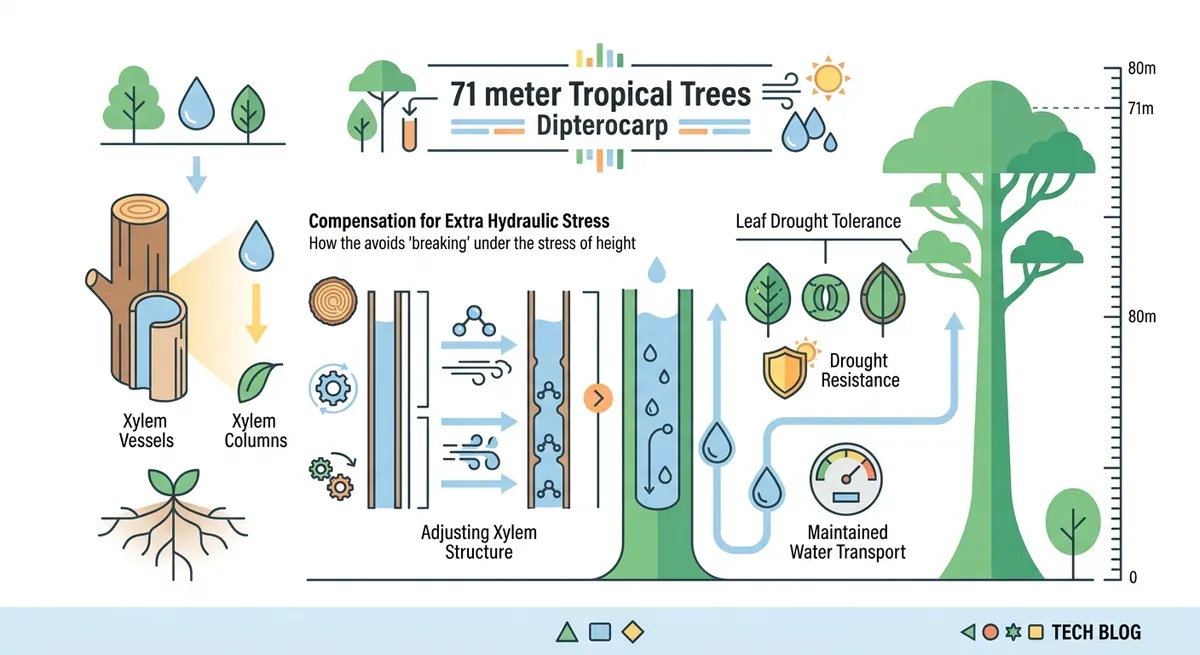
Inside a tree, water travels through microscopic, hollow tubes that run through the trunk. In trees these tubes are called xylem (think of xylem as the plant’s plumbing made of long, hollow conduits). Water moves mainly because of pressure differences created by evaporation from leaves.
Here’s the key player: leaf transpiration. Transpiration is the loss of water vapor from leaf surfaces into the air, driven by heat and airflow. When water evaporates from leaf tissues, it pulls water upward through the xylem, much like how sipping a drink pulls liquid through a straw.
Negative pressure: water can be “stretched” rather than pushed
One tricky concept is that trees don’t push water up from the roots like a pump. Instead, the top of the tree is under low pressure—often described as negative pressure, meaning pressure below atmospheric level (the pressure of the air around us).
In plain terms: the water column inside xylem is under tension, like a rope being pulled upward. For the tallest trees, that tension becomes more extreme because the water column is longer.
So the obvious question shows up again: Why doesn’t the system fail when the tree gets taller? Many accepted theories predict that height should worsen transport, reducing growth and increasing drought risk.
What “hydraulic failure” looks like in tall trees
Trees don’t just move water; they must also prevent the water from switching from liquid to gas inside the xylem.
When xylem pressure becomes too negative, water can form embolisms. An embolism is an air bubble that blocks a tube, preventing water flow. It’s a bit like a bubble of air trapped in a garden hose—water can’t pass through the blocked segment.
Because taller trees require stronger tension to lift water higher, conventional thinking says they accumulate more risk for embolisms as they grow. If too many tubes become blocked, less water reaches leaves, stomata (leaf pores controlling gas exchange) close, and photosynthesis drops. Over time, that limits growth and increases drought vulnerability.
The new finding: height-related stress gets “fully compensated”
The study focused on Dipterocarp trees ranging from about 7 to 71 meters tall in Malaysian Borneo. Researchers didn’t treat all trees as identical silhouettes; they measured traits at multiple positions along each tree’s length.
Their central conclusion was striking: taller Dipterocarps show hydraulic adjustments that fully compensate for the expected disadvantages of height.
That means the tree’s water transport system doesn’t become progressively worse at the top just because the tree is taller. Instead, the system seems tuned so that flow performance remains comparable across different heights under similar conditions.
How compensation works: changing the “pipes” and the “load”
Trees can respond to height in at least two broad ways: improve the xylem’s ability to carry water and reduce the demands placed on the transport system.
1) Wider vessels near the ground
One adjustment the researchers highlighted involves the size and shape of the xylem conduits—often described as vessels in vessel-bearing hardwood trees like Dipterocarps.
Larger vessels can carry more water and are less sensitive to flow limitations. In other words, the tree can build a more capable base so that the system entering the higher sections is strong enough to withstand the added tension.
A key detail matters for beginners: the tree doesn’t necessarily distribute pipe properties uniformly. In many plants, xylem structure varies with height, creating a gradient rather than a single “diameter everywhere” design.
2) Leaves that tolerate more water stress before wilting
The other side of the problem is demand. Even if water transport is functioning, leaves can still suffer drought stress.
The study found that leaves in taller trees show adaptations to withstand greater water stress before wilting. Water stress is the condition where the tree has less available water in its tissues, causing stomata to behave more conservatively and reducing growth.
Think of it as changing the thermostat. If leaves “act sooner” during stress, they reduce transpiration early, which can protect the system—but it also reduces photosynthesis and slows growth. If leaves tolerate stress longer, they can keep carbon gain going longer while still avoiding system collapse.
3) An integrated hydraulic system, not one magic trick
Crucially, compensation wasn’t framed as a single feature. It was a whole-system strategy: vessel dimensions, mechanical and hydraulic behavior, and leaf behavior all interact.
That matters because water transport failure isn’t governed by one knob. It emerges from the balance between water tension (which increases with height), resistance to flow (affected by tube geometry), and vulnerability to embolism (influenced by pressure thresholds and safety margins).
Tall Dipterocarps appear to manage that balance so the top does not become an ever-more fragile weak point.
What about drought? The trees kept growing
Measurement of structure is one thing. Real-world drought resistance is another.
The researchers tracked trunk growth rates before, during, and after the strong El Niño drought period of 2023–2024. El Niño is a climate pattern that can alter rainfall and intensify drought conditions in parts of the tropics.
If taller trees had a height-impaired hydraulic system, the expected pattern would look like this: as drought intensifies, taller trees should lose growth sooner or more strongly than shorter ones.
Instead, the study found no height-related loss in growth tied to being taller. That supports the idea that the hydraulic adjustments observed structurally translated into preserved function during an extreme dry period.
Why this matters beyond tree biology
At first, it might seem like an academic detail—tropical trees finding ways to survive. But the implications reach into how we model climate impacts.
A small fraction of the tallest trees—often described as the upper 1% by height—store a disproportionate amount of above-ground carbon. Above-ground carbon is carbon contained in living biomass above the soil, like trunks and branches.
If tall trees were more likely to die during drought, forests could lose carbon-storing capacity faster than expected. That would amplify climate change feedbacks: less living biomass means less carbon drawdown and potentially more carbon release.
Some current models assume tall trees have weaker hydraulic safety at greater height. This new evidence suggests that assumption may not hold for Dipterocarps.
The researchers also emphasized that more studies are needed across other tall tree species, because the hydraulic architecture of different tree types can vary.
A beginner-friendly mental model: the tree as a safety-engineered network
A helpful way to visualize what’s happening is to imagine a building’s water distribution system.
- As you go higher in a building, you need more pressure to reach the top floors.
- But stronger pressure increases stress on pipes and the risk of failures.
- A well-engineered building doesn’t accept failure risk increasing with height; it upgrades the system—larger pipes at key points, materials that tolerate tension, and controls that reduce demand under stress.
Dipterocarps appear to do something analogous. Their “network” is adjusted across height: the transport conduits and leaf water-use strategy work together so the system stays functional even when the topmost branches face the greatest challenge.
Conclusion: tall trees aren’t doomed—at least not like the old theory predicted
The big takeaway is that tree height does not automatically translate into higher hydraulic vulnerability. In Dipterocarps, hydraulic traits and leaf behavior appear to compensate for the physical penalties of height, and field measurements during a major drought showed no height-linked growth loss.
This doesn’t mean all tall trees are safe in all climates. It does mean the relationship between height, hydraulic transport, and drought risk is more nuanced than a simple “gravity makes everything worse” rule.
Nature’s engineering lesson is clear: when stakes rise, systems evolve coordinated adjustments—so the top of the tree can keep receiving the water it needs to live and grow.
Comments (0)
No comments yet. Be the first to respond!
Leave a Comment
Your comment will be visible after review.