How a Nasal Spray Could Reverse Brain Aging (and the Science Behind It)
 by ahsan
July 05, 2026
7 min read
by ahsan
July 05, 2026
7 min read
A moment of worry: “Is my brain just getting weaker with time?”
Picture a friend who starts forgetting small things—where they left their keys, names they used to know instantly, or how to focus for long stretches. The pattern feels familiar, and it carries a quiet anxiety: is this just normal aging, or something more?
In 2026, a study highlighted a surprising direction—treating brain aging by targeting inflammation and cellular energy, using a nasal spray rather than brain surgery. The work centers on a therapy built from extracellular vesicles (EVs), tiny biological parcels that can deliver gene-regulating molecules called microRNAs deep into the brain.
That combination—non-invasive delivery plus molecular control of inflammation and cell power—is what makes this topic worth understanding.
The “slow burn” theory: neuroinflammaging
A key concept in this research is neuroinflammaging. That term means the slow, chronic inflammation that builds up in the brain as we age.
Inflammation is often thought of as an injury response—something that flares up and then resolves. Neuroinflammaging is different: it’s more like a persistent smolder. Over time, that smolder can make the brain less efficient at handling normal tasks, contributing to brain fog, worse learning, and changes in memory.
What makes neuroinflammaging especially relevant is that inflammation is not only linked to cognitive slowdown, but also to higher risk of neurodegenerative conditions such as Alzheimer’s disease. So if inflammation can be reduced in the right place and at the right molecular drivers, the idea is that cognition might improve.
Why inflammation in aging is so stubborn
To understand how researchers attack neuroinflammaging, it helps to meet two molecular villains mentioned in the work: the NLRP3 inflammasome and the cGAS–STING signaling pathway.
- The NLRP3 inflammasome is a cellular complex—think of it as an inflammation “alarm system”—that can activate immune responses inside the brain.
- The cGAS–STING pathway is another internal signaling route that can detect abnormal genetic material and trigger immune-like inflammation.
In aging brains, these systems can become overactive, contributing to the persistent inflammatory environment. And persistent inflammation is a problem because it doesn’t just cause discomfort—it can damage cellular function, including the brain’s ability to store and process information.
That’s where the therapy’s cargo and delivery method become crucial.
Extracellular vesicles: the body’s own delivery trucks
The therapy is built around extracellular vesicles (EVs). EVs are tiny membrane-bound particles released by cells. In plain terms, they’re like microscopic “mail packages” that carry biological instructions from one cell to another.
A major reason EVs matter is that they can protect their contents from being degraded too quickly. In this approach, EVs are packed with microRNAs.
- MicroRNAs are short strands of RNA (a molecule related to DNA) that help regulate gene expression.
- “Regulate” means they can reduce or fine-tune how strongly certain genes are turned on.
- Because genes coordinate many cell processes, microRNAs can act like master switches affecting inflammation, stress responses, and cellular metabolism.
So EVs provide the delivery vehicle; microRNAs provide the instructions.
The delivery trick: why a nasal spray can reach the brain
One of the most striking claims from the study is that the treatment works after two doses and that the effects show up within weeks.
The delivery method is the centerpiece: intranasal delivery, meaning the spray is administered through the nose.
To make sense of why that helps, imagine the nose as a hallway that connects to structures close to the brain. While the brain has protective barriers (the main one is sometimes discussed as part of the blood–brain barrier), intranasal routes can enable therapeutic materials to travel toward brain tissue more directly than bloodstream-only approaches.
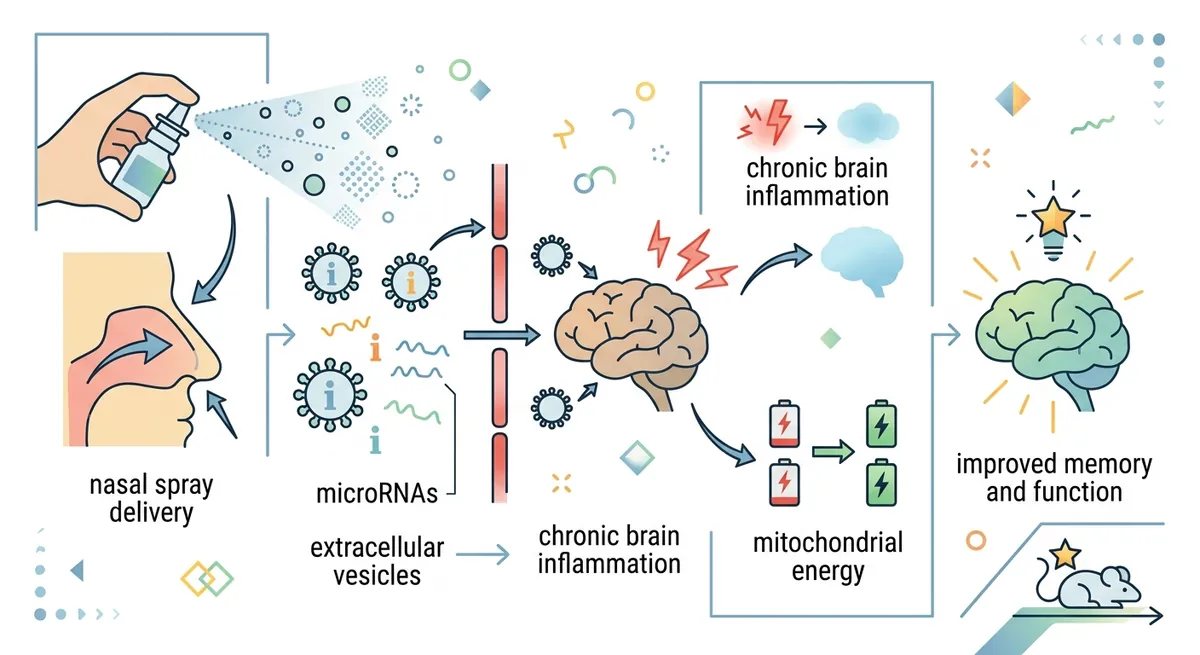
In the reported mechanism, EVs delivered intranasally are absorbed into brain-resident immune cells (the brain has immune-like cells that help manage inflammation). Once inside, the microRNAs can suppress inflammatory signaling—particularly pathways associated with chronic activation like NLRP3 and cGAS–STING.
This “bypass invasive procedures” angle is why the nasal spray matters so much for future brain age-related therapies. It’s not that spraying into the nose is magical; it’s that the therapy is engineered so EVs have a route to the target region.
Restoring the brain’s cellular power plants: mitochondria
Inflammation is only half the story. The other half is cellular energy.
The study reports that the treatment recharged neuronal mitochondria. A mitochondrion (plural: mitochondria) is the cell’s energy-producing structure—often described as the “power plant.” Neurons rely heavily on mitochondria to maintain electrical signaling and support learning-related processes.
Aging and chronic inflammatory stress can increase oxidative stress. Oxidative stress means there’s an imbalance between damaging reactive molecules and the cell’s ability to neutralize them. When oxidative stress rises, mitochondria can become less efficient.
When the nasal-spray therapy reduces inflammatory drivers and oxidative stress, mitochondria can regain function. The reported result is not only reduced brain fog but also improved cognitive performance in animal models.
In narrative terms, researchers describe it as giving neurons “their spark back.” Mechanistically, that “spark” is better energy metabolism plus a calmer inflammatory environment.
What cognitive improvement looked like in animal models
The study notes behavioral tests in models treated with the nasal spray, showing improvements in tasks involving recognition and detecting changes in the environment.
Here’s why that kind of testing is meaningful. Memory and attention are not single switches—they involve networks across the brain. If inflammation and mitochondrial function improve, performance on tasks requiring learning and memory should shift compared with untreated controls.
So the storyline becomes:
1) Nasal spray delivers EVs and microRNAs toward brain tissue.
2) microRNAs suppress inflammatory pathways (including NLRP3 inflammasome and cGAS–STING-related signaling).
3) Reduced inflammation and oxidative stress improve mitochondrial function.
4) Better cellular energy and less inflammatory disruption support cognition.
That chain is the heart of the “reverse brain aging” claim.
Why reversing aging is such a bold claim
A therapy reversing aspects of brain aging is bold because aging is normally treated as cumulative and slow—more “damage accrues” than “systems reset.”
That’s why this work has generated excitement: it suggests that at least some age-related decline may be driven by modifiable biological processes, not only permanent structural loss.
Still, it’s important to hold both ideas at once. The study provides compelling biological and behavioral signals, but translating EV-based microRNA therapies to humans requires careful work: dosing safety, immune responses, long-term effects, and reproducibility across diverse populations.
Notably, the report also emphasizes outcomes consistent across both sexes in the studied context. In biomedical research, sex differences can be common, so consistency increases confidence that the mechanism isn’t limited to only one group.
What makes this approach different from typical treatments
Traditional interventions for brain disorders often face a problem: delivery.
Many drug candidates don’t reach brain tissue well enough to work, or they require invasive delivery methods. An EV-and-microRNA nasal strategy aims to solve delivery while addressing specific molecular drivers of neuroinflammation.
This is not about replacing all medications. Instead, it presents a new category of brain-directed regenerative and anti-inflammatory therapy—one where the body’s own packaging system (EVs) carries gene-regulating instructions (microRNAs) to influence inflammation and cellular metabolism.
That’s why the study’s “two-dose nasal spray” framing is so attention-grabbing: it suggests the intervention could be lower-risk than invasive procedures and potentially easier to administer.
The bigger implication: redefining brain aging therapies
Beyond the immediate results, the work points to a more general scientific shift: treating brain aging not as an unstoppable decline, but as a set of biological states that can be nudged.
If neuroinflammaging contributes to cognitive decline through specific pathways—and if those pathways can be shut down while mitochondria recover—then “brain age” becomes more dynamic.
That dynamic view matters for the future of therapy development. It suggests researchers can test interventions that target both immune-like inflammatory signaling and neuronal energy metabolism, rather than focusing on memory alone.
Even the question “Can cognitive aging be reversed?” becomes less abstract, because the mechanism is testable. In this case, inflammation suppression and mitochondrial restoration provide measurable targets that connect biology to behavior.
Conclusion: a nasal route, EV cargo, and a possible reset
The science in this research weaves together three powerful ideas: neuroinflammaging fuels age-related brain fog, extracellular vesicles can deliver microRNAs that modulate gene signaling, and improving mitochondria helps neurons regain energy for learning and memory.
The nasal spray serves as the practical delivery method that brings this molecular cargo toward brain tissue without invasive surgery. Whether future trials confirm the full potential in humans, the approach demonstrates a promising direction: treating brain aging as something biology can correct, not only something that accumulates.
Comments (0)
No comments yet. Be the first to respond!
Leave a Comment
Your comment will be visible after review.