How Fable 5.1 Found the Key Inside Urquhart’s Book
 by ahsan
September 14, 2026
6 min read
by ahsan
September 14, 2026
6 min read
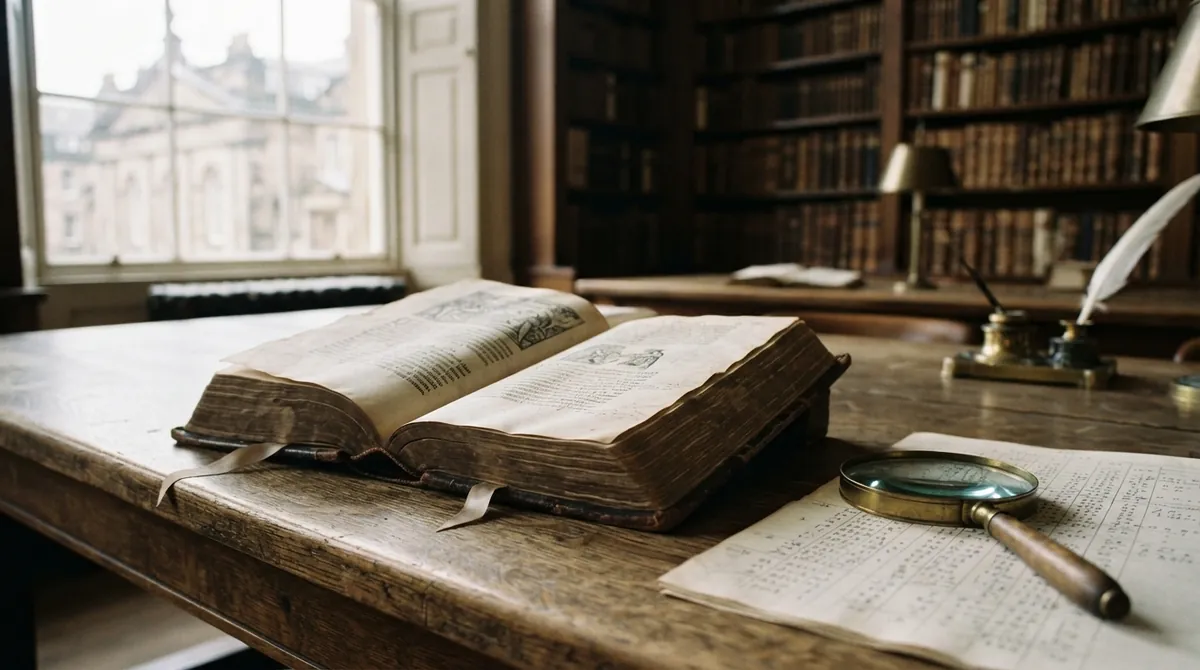
At first glance, the Cyphral Distich looks like a number sequence someone dropped from a ledger: 64 values separated by periods, no alphabet, no instructions, and no obvious pattern. It was associated with Sir Thomas Urquhart’s Logopandecteision, a 1653 work about a proposed universal language. The puzzle dates to 1653, so in September 2026 it is 373 years old, although the original report rounded that age to 370.
In August 2026, Vals AI reported that Claude Fable 5.1, a language model built to work through long text problems, had found a plausible solution. The striking part was not a complicated mathematical trick. The key was sitting in the book’s layout.
The clue was the layout
A cryptogram is a message deliberately transformed so that its meaning is hidden until you discover the rule behind it. Urquhart’s cryptogram contains two lines of 32 numbers:
5.3.27.38.32.14.21.8.66.8.70.39.5.9.12.18.2.3.56.5.1.7.3.2.13.19.3.25.9.3.16.6.
25.15.13.6.11.20.5.1.2.12.1.20.20.49.20.20.35.33.4.6.8.35.5.33.5.5.18.10.3.11.32.42.
The numbers appear after 32 numbered sections called Proquiritations. A Proquiritation is a short request or petition. Urquhart draws unusual attention to the number 32, and the poem surrounding the cipher talks about discovering the reader’s “heart’s wishes” and the author’s mind.
That combination creates a strong structural hint: 32 sections, followed by two lines containing 32 numbers each, with the surrounding text repeatedly discussing wishes and desires.
The numbers were not meant to be translated directly into letters. They were instructions for looking something up.
A book cipher, not a letter cipher
Many traditional codebreaking attempts begin with a substitution cipher. In that kind of system, one symbol stands for a letter. Frequency analysis, the practice of counting how often symbols appear, can reveal likely substitutes because common letters such as E and T appear frequently in English.
A homophonic substitution cipher complicates that approach by allowing several symbols to represent the same letter. Both strategies treat the ciphertext as a standalone object. The Cyphral Distich does not work that way.
It is a book cipher, a method in which numbers act as addresses into a shared text. The first number points somewhere in the first section, the second number points somewhere in the second section, and so on. The selected word contributes its first letter.
In pseudocode, the rule looks like this:
for position i from 1 to 32:
 section = Proquiritation[i]
 word = section[numbers[i]]
 output += first_letter(word)
The indexing is one-based, meaning that the first word counts as word 1 rather than word 0. For a miniature example, if the number is 2 and the second word in the relevant section is “silver,” the output letter is S.
That sounds tidy on a modern transcript. Working with a seventeenth-century text is less tidy. Punctuation, hyphenated words, abbreviations, Latin phrases, and inconsistent spelling can all change what counts as a word. Even one counting decision can move every later lookup by one position.
The hidden prayer
Applying the proposed rule produces this two-line message:
O GOD UPHOLD KING CHARLS THE SECOND AND
MAKE HIM THE SUPREME RULER OF THIS LAND
The spelling “Charls” reflects the period rather than a modern typo. The result also checks itself in several ways. Each line contains exactly 32 letters, matching the 32 numbers used to create it. The lines end with “and” and “land,” forming a compact rhyming couplet called a distich.
The meaning fits Urquhart’s life as well. He was a Royalist, meaning a supporter of the monarchy, and Charles II was the royal figure his political sympathies favored. A hidden prayer asking God to uphold Charles therefore makes historical sense instead of looking like a random English sentence assembled after the fact.
No single clue proves a decipherment. Together, the matching counts, poetic form, word-level rule, and historical context make the proposed solution unusually persuasive.
Why the cipher stayed hidden
The solution feels obvious only after the correct question has been asked. Earlier attempts treated the numbers as if they belonged to an external cipher alphabet. That encouraged searches for letter substitutions, numerical patterns, or statistical regularities inside the 64 values themselves.
The useful information was outside the ciphertext. Its position in the book mattered more than the numbers’ frequency. Once the surrounding Proquiritations became the key, a value such as 70 stopped being mysterious. It meant “take the seventieth word from this particular section.”
This is a familiar problem in historical research. The necessary clue may exist in plain sight, but finding it requires reading the obscure material around the puzzle, noticing an oddly repeated number, and testing an interpretation that initially seems too simple. People can do that, but the work is slow and easy to abandon.
The larger Octastich
Urquhart left another numerical poem in The Jewel, published in 1652. The Cyphral Octastich contains 285 numbers rather than 64. The proposed solution uses the same basic idea, but replaces sections with pages: the kth number becomes a word index into page k, and the first letter of that word is extracted.
The result is an eight-line royalist prayer written in ottava rima, a poetic form with eight lines and the rhyme pattern ABABABCC. A concluding ten-line addendum, called a decagram, completes the message.
That second result is more tentative than the Distich. Nine letters in one line remain unreadable in the available transcription, and a page offset appears later in the sequence. The proposed explanation involves printing errors, transcription differences, or a repeated page reference. Public updates in September 2026 confirmed that the cipher leaves are physically present in a surviving Glasgow copy of The Jewel, but coordinate-by-coordinate verification was still incomplete.
The Distich has a similar bibliographic wrinkle. Not every surviving copy of the 1653 Logopandecteision appears to contain the numerical poem in the same place. A surviving National Library of Scotland copy documents the cipher, while other digitized witnesses omit it. That may reflect variant states of the printed book rather than a failure of the decoding rule.
It is a useful reminder that historical cryptanalysis has two layers: solving the mechanism and proving which physical text the mechanism was designed to use.
What Fable 5.1 actually contributed
According to the report, Fable 5.1 spent 44 minutes and processed about 176,000 tokens, which are the small pieces of text language models use internally. The model worked without human interjections during the run.
The achievement was less about inventing a new form of cryptography than about sustained search. Fable considered several approaches, recognized that the 32-by-32 structure was unusually promising, connected the poem’s language to the Proquiritations, and continued testing the idea until the output became readable.
That does not remove the need for human scholarship. Researchers still have to compare editions, inspect physical copies, decide how to count historical word forms, and document every coordinate. The model can propose a path through a tangled archive; verification determines whether that path reaches the right destination.
The Cyphral Distich’s lasting lesson is beautifully modest. The code was not hiding behind an impenetrable wall of mathematics. It was hiding in the relationship between a text and the numbers printed beside it. Once the book became the key, 373 years of mystery turned into a careful exercise in reading what had been there all along.
Comments (0)
No comments yet. Be the first to respond!
Leave a Comment
Your comment will be visible after review.