How Scientists Built a Synthetic Cell That Grows and Divides
 by ahsan
July 01, 2026
7 min read
by ahsan
July 01, 2026
7 min read
The moment a “molecule bag” starts acting like a cell
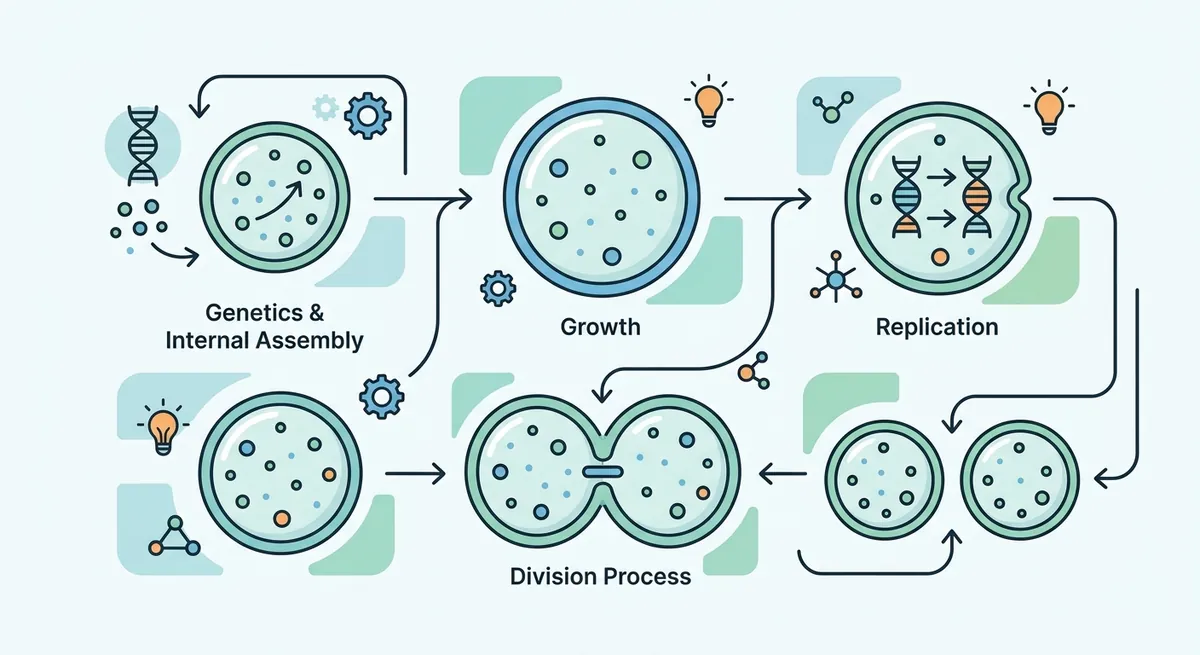
Picture a clear, walled container—part experiment, part attempt at recreating life. Inside it sits a crowd of nonliving components: DNA, enzymes (protein machines), and the chemical machinery to turn genetic instructions into proteins. For a long time, researchers could make these parts perform tasks on their own. The leap now is watching them cooperate inside a membrane and then go through something resembling a cell cycle: growth, copying DNA, and division.
This is what a new synthetic biology study reports: a lab-made cell-like system that can replicate its DNA and divide into daughter compartments. It’s a powerful “proof of concept” toward building cells from scratch—but it is also not a fully alive organism. There’s no long-term survival without constant supplies, and the system lacks many features we associate with real biology. Still, the technical milestone matters: it demonstrates a path from nonlife to life-like behavior.
So what does “built from scratch” really mean here? Let’s unpack the ingredients, the logic, and the bottlenecks.
From protocells to synthetic cells: what counts as “cell-like”?
Life on Earth depends on cells—tiny compartments that maintain internal chemistry, store genetic information, and reproduce. Long before modern cells, theories propose that early “protocells” formed when simple molecules organized themselves into membrane-like structures that could keep reacting and dividing. Even without real genes, that kind of compartmentalization could make chemical processes persist and multiply.
Modern synthetic cell research tries to accelerate that story by engineering systems in the lab. The goal isn’t to recreate every detail of natural life. Instead, researchers aim to satisfy key functions in an experimental setup:
- A boundary (typically a lipid membrane) that separates internal chemistry from the outside.
- Genetic information (DNA or RNA) that can be copied.
- A translation system that converts genetic code into proteins.
- A cycle of growth and division so the compartment splits into new compartments.
In the study, scientists assemble these capabilities from lab components rather than borrowing an intact living bacterium as a starting point. That shift—from modifying cells to building cell behavior—changes what researchers can test and how precisely they can control the system.
The core challenge: coordination beats chemistry
Making enzymes work in a test tube is one thing. Getting a whole “cell” to coordinate multiple processes at once is another.
A real cell juggles at least three big jobs:
- Replicate genetic material so information can be passed along.
- Produce proteins so the machinery for replication and other functions exists in time.
- Divide so the copied information ends up in new compartments.
Each job depends on the others. DNA replication typically requires the right enzymes and chemical conditions. Protein production requires an RNA intermediate and ribosome-like machinery (ribosomes are molecular complexes that translate RNA into proteins). Division requires a physical mechanism that partitions contents into two daughter compartments.
What makes this tricky is timing and scaling. A system can copy DNA but fail to divide. Or it can form smaller compartments but not replicate its genetic program. Or it can grow but not sustain the chemistry long enough to complete a cycle.
The reported advance focuses on integrating these pieces into one membrane-enclosed system where DNA replication and division can occur.
Liposomes: the “container” for building life-like behavior
A key technical ingredient is a liposome.
A liposome is a tiny spherical vesicle formed from lipid molecules (lipids are fats that spontaneously assemble into membranes in water). In lab settings, liposomes can trap molecules inside them, creating an enclosed microreactor—essentially a reusable “cell-like bag.”
In this kind of synthetic cell experiment, scientists mix components that must act together—DNA replication elements, gene-reading and protein-making machinery, and any other necessary factors—then place them inside liposomes. Those vesicles serve as the boundary that lets internal chemistry proceed without instantly washing out.
This boundary is also important for function: when replication produces more DNA, and translation makes proteins, you need those products to remain inside the same compartment long enough to help drive the next steps of the cycle.
A minimal genome and an engineered replication pipeline
The next crucial piece is the genome and its expression and replication strategy.
A genome is the complete set of genetic instructions. In a living cell, a genome encodes metabolism, regulation, and many structural functions. In the synthetic system, the genome is intentionally small and minimal, focusing on the core cycle-related behaviors rather than producing everything a natural cell needs to live independently.
Scientists then rely on two kinds of molecular work:
- DNA replication: copying DNA into new DNA strands.
- Transcription and translation: transcribing DNA into RNA (RNA is a chemical cousin of DNA that often carries instructions for protein synthesis) and translating RNA into proteins.
The study describes using an engineered DNA replication system and pairing it with a protein-making toolkit. This toolkit includes enzyme packs that can read genetic information and perform the biochemical steps that turn encoded instructions into proteins.
The technical achievement isn’t just choosing parts; it’s getting them to “agree” with each other. For example, if DNA replication enzymes operate best under certain conditions, those conditions must also allow gene expression and protein synthesis to proceed. If protein production requires different concentrations or timing, the replication setup must be compatible.
That’s why synthetic teams often spend significant effort optimizing concentrations and swapping genes in and out. The result is a tuned chemical environment where the genetic program can run and propagate.
Growth and division: what does “divide” mean in a liposome world?
In natural biology, cell division is a complex choreography: the cell grows, duplicates its components, positions genetic material, and then constricts a dividing structure. In liposome-based synthetic systems, division is usually interpreted in a more constrained, experimental sense.
Here’s the practical idea: for a membrane compartment to produce daughter compartments, it needs a mechanism that redistributes contents so the system effectively splits into smaller or separate vesicles. In many membrane systems, changes in membrane composition, internal pressure, or chemical reactions can promote budding and splitting.
When the synthetic system “divides,” the key evidence is that daughter compartments inherit genetic material and relevant molecular machinery and that the cycle can repeat—meaning the system exhibits at least a rudimentary, cell-like loop.
This is genuinely the heart of the milestone. Replication alone could happen in bulk solution. Division alone could occur through purely physical vesicle instability. The meaningful claim is their coupling: a membrane-enclosed system that undergoes something like a cell cycle, not just isolated reactions.
Why this isn’t full life (yet)
It’s tempting to read “synthetic cell grows and divides” as “living organism.” The study’s own framing, and the broader commentary around it, emphasize an important distinction.
A synthetic cell in this sense is cell-like, not fully alive, because it lacks many homeostatic and survival capabilities. For example:
- It cannot indefinitely maintain itself without external supplies.
- It lacks robust waste removal and defense mechanisms.
- It doesn’t evolve freely in the way living populations do over long timescales.
In other words, the system demonstrates critical functions of a cell cycle without meeting all the criteria we associate with independent life.
That boundary matters scientifically. It tells researchers what’s been achieved (functional integration) and what remains (durability, regulation, metabolism, and evolutionary robustness).
“Blueprint chemistry”: why synthetic cells are a different kind of science
One of the most exciting implications is control. Because the components are crafted and assembled in the lab, scientists can treat the system like a modular machine.
Instead of inheriting complexity from a living organism, researchers can swap parts:
- replace enzymes
- adjust genetic components
- change concentrations and timing
- test alternative molecular designs
This “ingredient list” approach turns biological questions into engineering questions. It also makes comparisons sharper: when a system fails to divide, the failure mode can be traced toward particular components or coordination steps rather than unknown cellular complexity.
Over time, that opens routes toward new capabilities: experimenting with minimal requirements for cellular life, exploring how alternative genetic chemistries might work, and building chassis for applications like bio-based production.
The big takeaway: life is a systems problem
Watching a synthetic, membrane-enclosed mixture grow, replicate its DNA, and divide doesn’t prove that life is a single trick. It supports a broader view: life-like behavior emerges when multiple processes are coordinated inside a boundary, supported by genetic instruction.
The milestone here is not that scientists created a creature. It’s that they created a system where the feedback loop between genetic instructions, protein production, and compartment splitting begins to function.
That’s why this experiment lands so strongly in the field: it brings the “minimum ingredients of life” question out of purely theoretical territory and into the laboratory—one membrane, one genome, and one chemical cycle at a time.
Conclusion
Building a synthetic cell that grows and divides is a systems engineering achievement as much as a biology breakthrough. By enclosing a minimal genetic program and the molecular machinery needed to express and replicate it inside liposomes, researchers have demonstrated a cell-like cycle where DNA copying and compartment division are coupled. The result is not fully alive and not yet self-sustaining, but it marks a major step toward understanding what “the minimum for life” could mean—and how far careful molecular design can carry biology beyond nature’s starting point.
Comments (0)
No comments yet. Be the first to respond!
Leave a Comment
Your comment will be visible after review.