How the Nokia Design Archive Turns Design History Into Data
 by ahsan
September 24, 2026
5 min read
by ahsan
September 24, 2026
5 min read
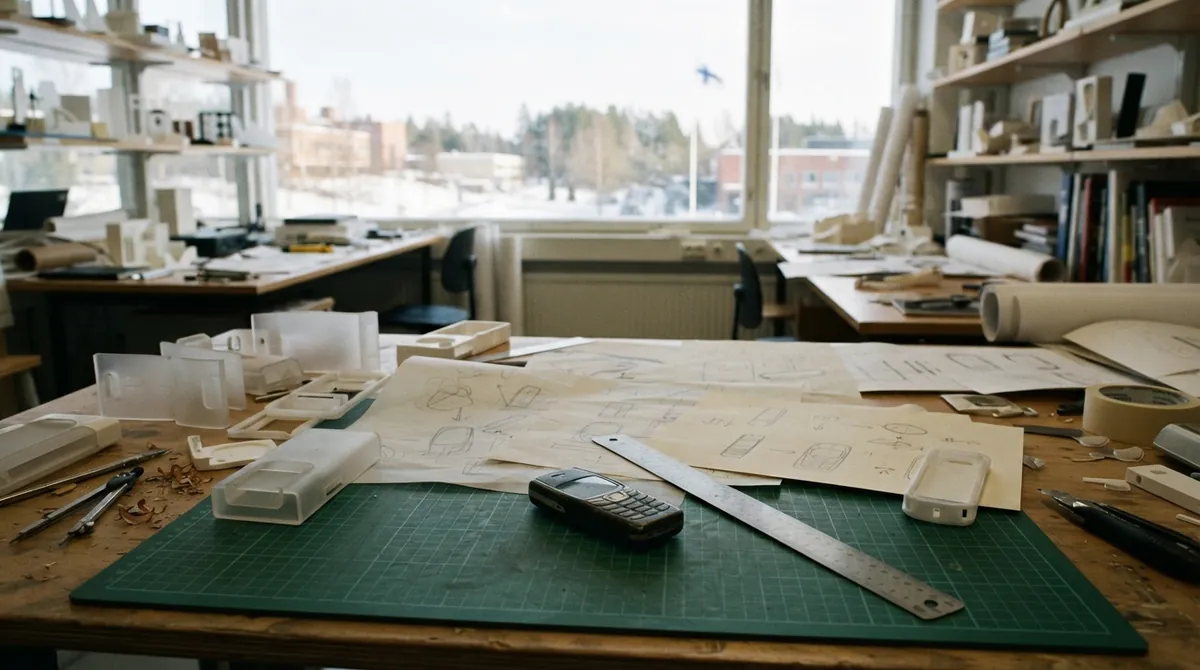
Put an old mobile phone on a desk and the story seems finished: plastic shell, keypad, screen, perhaps a few scratches. But the object is only the last frame of a much longer film. Before a product reaches a shop, teams make hundreds of guesses about shape, materials, users, color, software, and what technology might become.
How do you study the design of products that never reached a store shelf? The Nokia Design Archive offers a compelling answer. Aalto University opened its public digital portal on January 15, 2025, with sketches, photographs, videos, interviews, and other material spanning roughly the mid-1990s to 2017. It is not organized as a static gallery; it is built as an interactive map of ideas, people, and decisions. (aalto.fi)
The archive starts with a rescue story
The archive's technical story begins with physical boxes. In 2016, as Nokia's mobile-phone headquarters in Keilaniemi, Espoo, were being cleared after Microsoft's acquisition, Anna Valtonen, who had helped establish Nokia's design archive during her time there, had a short window to save the material. Papers, prototypes, USB drives, photographs, and sketches eventually went to Aalto's Otaniemi campus. Researchers spent years sorting it; an interactive platform began taking shape in 2022.
This matters because digitization is often mistaken for scanning. Scanning creates images; archival work creates structure. The team grouped material by themes, identified relationships, added dates where known, and recorded designer stories. The result is a curated public layer of more than 700 entries, while the larger collection contains more than 20,000 uncurated items and roughly 1 terabyte of born-digital files.
Think in entries, collections, and stories
The website's vocabulary quietly reveals its data model. An entry is one archival unit: a presentation, object, report, photograph, drawing, or video. A collection groups related entries around a theme. A story adds the human layer, such as an anecdote, interview, or record of a designer's years at Nokia. Metadata—the descriptive information attached to an item—connects these pieces through dates, topics, names, and links. (nokiadesignarchive.aalto.fi)
A conceptual record might look like this:
title: concept device
year: null
topics:
 - products
 - design process
type: physical model
people:
 - designer
related:
 - user research
 - future scenario
This is not the archive's public application programming interface. It is a sketch of the thinking behind the interface. Notice the null year: an undated item is not necessarily a useless item. Preserving uncertainty is better than inventing precision.
Two views, two ways to explore
The Network view treats the archive as a graph. In graph terminology, a node is a thing—an entry, collection, or person—and an edge is a meaningful relationship between two things. Click through one concept and you may move toward a product family, a design strategy, a material experiment, or a designer's account of the work. The point is not to guess the one correct path; it is to make unexpected paths visible. The archive describes this view as organizing entries by thematic collections and their relationships. (nokiadesignarchive.aalto.fi)
The Timeline view changes the question. Instead of asking what belongs together, you ask what happened alongside what, and who was present at the time. It follows more than 300 designers who worked at Nokia Design; around 250 contributed anecdotes, interviews, or other material. The timeline therefore treats design history as a social process, not a parade of model numbers.
Behind the filters is a small but important interaction pattern. A simplified version of the logic could be:
const visibleEntries = entries.filter((entry) => {
 const topicMatch =
 topic === 'all' || entry.topics.includes(topic);

 const dateMatch =
 includeUndated || entry.year!== null;

 return topicMatch && dateMatch;
});
The code is ordinary. The design decision is not. The interface lets people browse visually, search by keyword, narrow by topic, or keep undated material in view. Good archive software supports both the researcher who arrives with a precise term and the curious visitor who has no plan.
The most interesting material is often unfinished
Finished products encourage a tidy story: problem, solution, launch. The archive pushes back against that sequence. Its material includes prototypes, physical models, sketches, fashion-related work, future scenarios, and concepts that never became everyday products.
One example is a 1999 3G concept video imagining a video call between London and Shanghai while the participants discuss what to order for dinner. That vision looks ordinary now, but it shows how design teams used speculative media to make a distant networked future feel concrete. Other predictions, such as self-shaping nanomaterials discussed around 2007 and 2008, did not arrive in daily life. Both outcomes belong in the archive: prediction and disappointment are evidence of how teams reasoned. (aalto.fi)
The human records sharpen the picture. Aalto's researchers tracked down roughly 500 former designers and contacted about 200, collecting interviews, video clips, résumés, artwork, and informal photographs. A product archive can tell you what was made; these stories help explain how decisions felt from inside the room.
Curation is part of the technology
A searchable archive can create the illusion that everything important has been included. The Nokia Design Archive is more honest than that. Its public portal is a selected interpretation of a much larger physical and digital collection, and its own documentation warns that the chosen entries are not representative of every item or every designer. Around 40 percent of designers from the period have an entry in the portal. (nokiadesignarchive.aalto.fi)
That limitation is not a flaw to hide. It is a piece of metadata about the archive itself. For developers, the lesson is useful: keep the raw collection, the curated view, and the researcher's interpretation distinct. Make missing dates visible. Show where a record came from. Let people move from a friendly overview to deeper archival material without pretending the overview is the whole past.
There is also a practical boundary around reuse. The portal's materials are marked Creative Commons Attribution–NonCommercial–NoDerivatives 4.0, commonly shortened to CC BY-NC-ND 4.0. That allows sharing with credit, but it does not allow commercial use or distribution of modified versions. The license is part of the interface's meaning, not an afterthought for the footer.
What the archive teaches beyond Nokia
The Nokia Design Archive is valuable because it turns industrial design into something you can inspect as a system. Products connect to people. People connect to methods. Methods connect to cultural assumptions, business strategy, materials, and imagined futures. Once those relationships are visible, a phone stops looking like an isolated object and starts looking like the outcome of a large, imperfect conversation.
That is the deeper technical idea. A good digital archive does not flatten history into a database table or a slideshow. It gives you several ways to approach the same evidence, preserves uncertainty, and leaves enough connective tissue for new interpretations. The old phone on the desk is still interesting. The network of decisions behind it is the real archive.
Comments (0)
No comments yet. Be the first to respond!
Leave a Comment
Your comment will be visible after review.