I Turned Security Cameras Into a Backyard Bird Observatory
 by ahsan
August 31, 2026
5 min read
by ahsan
August 31, 2026
5 min read
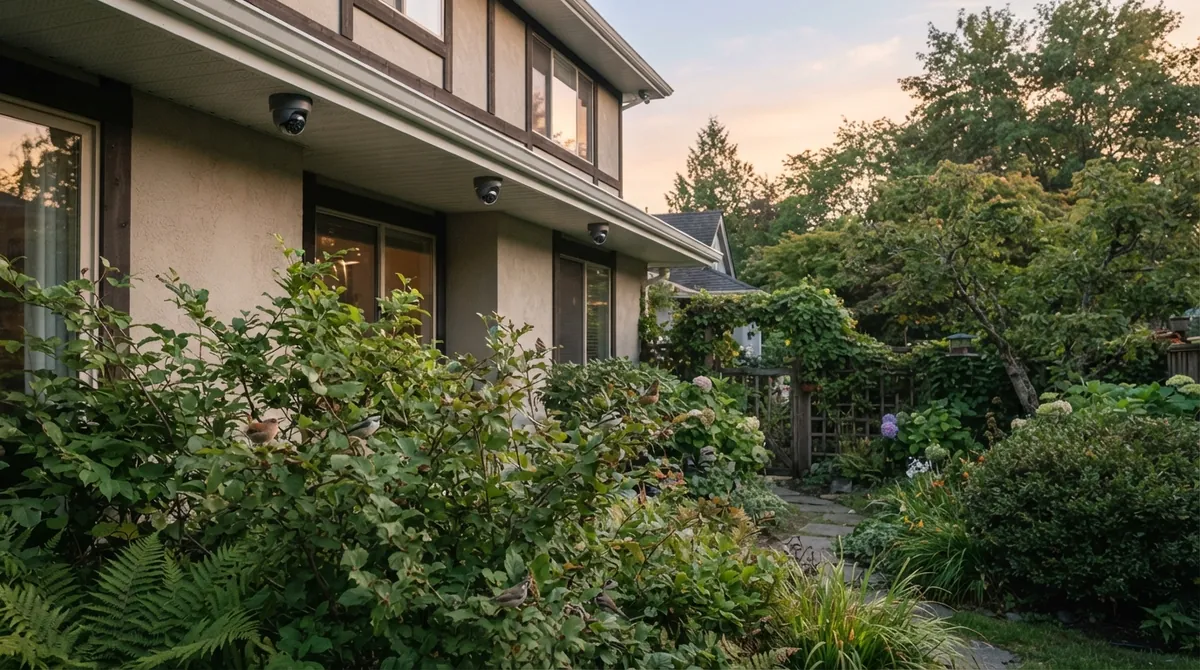
At 6:12 a.m., the backyard was already busy. Something was calling from the hedge, another bird answered from the roof, and the security cameras were quietly recording the whole exchange. The useful part was not the video. It was the microphones.
That became the starting point for an automatic bird identification system built from hardware already mounted around the house. BirdNET-Go, a self-hosted application that runs on your own computer or Raspberry Pi, listened to the camera audio and turned those background sounds into species detections. No one had to stand outside with a phone. The yard could keep its own listening diary.
The microphone was already hanging outside
Can a security camera identify birds by sound? Yes, provided the camera exposes an audio stream and the microphone is good enough to capture the call clearly.
The bridge between the cameras and BirdNET-Go is RTSP, short for Real Time Streaming Protocol. It is a common way for network cameras to deliver live media to another device. RTSPS is the secured version. BirdNET-Go can read the audio track from multiple RTSP or RTSPS sources, so each camera can become a separate listening post.
A typical configuration has the general shape below:
realtime:
 rtsp:
 transport: tcp
 urls:
 - <camera-stream-1>
 - <camera-stream-2>
 - <camera-stream-3>
The exact stream address depends on the camera, and the camera’s microphone may need to be enabled in its settings. Use the direct media-stream address rather than a camera-discovery address such as ONVIF, which is a separate protocol used to find and manage network cameras. Testing one camera at a time saves a surprising amount of frustration.
What happens to a bird call
BirdNET-Go does not listen for a sentence like “that is a cardinal.” It collects short sections of audio, usually around three seconds, and examines the shape of the sound. The software converts each section into a spectrogram, which is an image showing how frequencies change over time. Think of it as sheet music for sound, except the vertical direction represents pitch and the brightness shows energy.
A neural network, meaning a trained pattern-recognition model, studies that representation and returns possible species with confidence scores. A confidence score is useful evidence, not a guarantee. Wind, lawn equipment, traffic, overlapping songs, and a distant microphone can all produce convincing wrong answers.
BirdNET-Go currently includes BirdNET v2.4 as its lightweight default model, listed at more than 6,500 bird species. Its model gallery also includes Google Perch v2, a larger model covering 14,795 classes across birds and other animals such as insects, amphibians, and mammals. That wider model explains why a backyard setup may begin reporting frogs or other wildlife alongside birds.
The larger number is a catalog size, not a promise that every species will be identified perfectly. Location still matters. BirdNET-Go can apply a range filter using latitude, longitude, and time of year, which removes many species that would be unlikely in your area. Running more than one model can also help: when two models agree, the detection deserves more trust; when they disagree, the recording is worth reviewing.
Docker keeps the server side manageable
Docker is a system for packaging an application with the pieces it needs to run. Instead of installing every library directly on the host machine, you run BirdNET-Go in a container, an isolated process with its own filesystem and dependencies.
For an RTSP-only setup, the useful pattern looks like this:
docker run -d \
 --name birdnet-go \
 -p 8080:8080 \
 -v./config:/config \
 -v./data:/data \
 birdnet-go-image
The important lines are the mounted folders. The configuration folder stores settings, while the data folder holds the database, recordings, and other persistent files. Without those mounts, replacing the container could also erase the history that makes the project interesting.
A small home server or 64-bit Raspberry Pi can handle the default model, although several cameras and additional models increase the workload. Start with one stream, confirm that the audio is arriving, then add cameras gradually. A flat audio meter usually means the stream contains no usable audio. A meter that never settles may point to an air conditioner, wind, or a gain setting that is too high.
Alerts turn detections into a habit
A dashboard full of observations is fun for a few days. Alerts are what make the system part of daily life.
BirdNET-Go can match detections against a species list. That makes it possible to receive a message when a favorite bird appears, when a rare visitor is detected, or when something outside the usual yard list turns up. The novelty tracker can also distinguish a first-ever species from one that is merely new for the current year, turning a quiet suburban yard into a small biodiversity scoreboard.
Discord works well for a shared household channel because every detection can arrive with a name, timestamp, confidence score, and recording. MQTT, short for Message Queuing Telemetry Transport, is another useful route. It is a lightweight publish-and-subscribe protocol often used by smart-home devices. With MQTT enabled, Home Assistant, an open-source home automation platform, can discover BirdNET-Go sensors and use detections in dashboards or automations.
BirdWeather is an optional community service for sharing observations with a wider network of bird-monitoring stations. That can be valuable for citizen science, but it is a deliberate choice rather than a requirement for local identification.
Local AI still needs a privacy boundary
Local inference means the model runs on your own hardware instead of sending every recording to a cloud service. For the core analysis, the camera audio can stay inside the home network, and there is no per-detection API bill.
That does not mean the application can never communicate outside the house. BirdWeather, MQTT brokers, weather services, image lookups, backups, and remote-access tunnels all create different network paths. Enable only the integrations you need, and remember that a tunnel protects the connection but does not replace authentication. A public dashboard should still have a strong login and careful access rules.
The tuning lessons that matter most
- Place the microphone away from constant noise. An outdoor camera beside an air-conditioning unit may spend all day listening to machinery. Wind protection helps too.
- Set the location accurately. Range filtering is one of the best ways to reduce implausible detections.
- Treat confidence as a clue. Repeat-confirmation and false-positive filters can wait briefly for a call to appear again before recording it as a real sighting.
- Do not assume bird hardware can detect bats. Bat classifiers need ultrasonic audio. A 48 kHz microphone can represent frequencies only up to roughly 24 kHz, while many bat calls are higher. A bat-focused setup usually needs an ultrasonic-capable microphone and a 96 kHz or 192 kHz audio path.
The most satisfying part of this project is not the species list. It is the change in perspective. A security camera stops being a device that records an empty patio and becomes a small environmental sensor, quietly noticing what shares the yard with you. That is the kind of homelab project that earns its place: local, practical, and a little magical every morning.
Comments (0)
No comments yet. Be the first to respond!
Leave a Comment
Your comment will be visible after review.