Iceland’s EU Referendum Is a Two-Stage Decision
 by ahsan
August 29, 2026
5 min read
by ahsan
August 29, 2026
5 min read
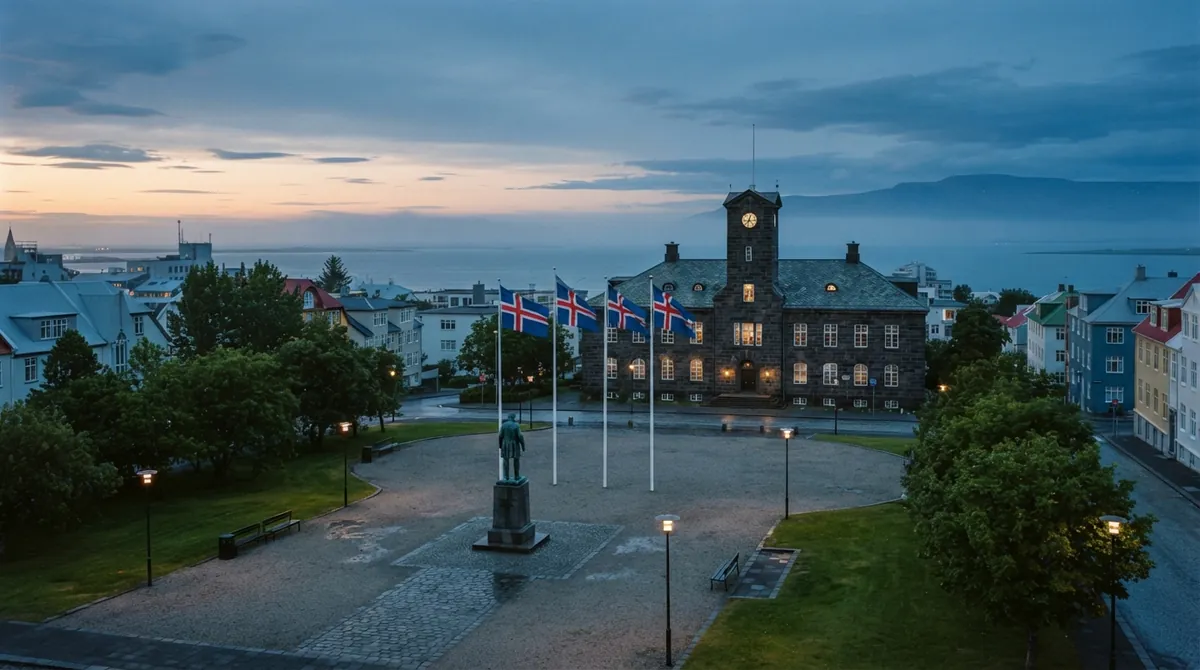
At first glance, Iceland’s referendum looks like a light switch: EU membership or independence. The ballot is closer to a button labeled “open the negotiation file.” On August 29, 2026, voters are answering: “Should Iceland resume accession negotiations with the European Union?” Accession means the formal process a country follows before it can become a member. A Yes vote would reopen that process, not complete it. If negotiations eventually produce a deal, Icelanders would vote again on whether to accept membership. (mfa.is)
Think of the referendum as a state machine
A useful technical analogy is a state machine: a system that moves through defined stages when an event occurs. Iceland’s EU question can be sketched like this:
Talks paused
 |
 Yes
 v
Domestic mandate → EU accession talks → possible treaty → second referendum
 |
 No
 v
No restart now; the current European relationship remains
That diagram removes some of the fog around the campaign. A referendum on talks gives the Icelandic government permission to investigate the terms of membership, including fisheries rules, financial arrangements, transition periods, and safeguards. It does not let the government promise a favorable outcome in advance. The government says it would first update its negotiating objectives through a broad domestic consultation and submit them to Alþingi, Iceland’s parliament. (ministryoftransport.is)
The European Union would also have its own procedure. Accession talks are divided into policy areas known as chapters. The European Commission examines how closely a country’s laws match EU rules, while EU member states agree on the framework and benchmarks used in the negotiations. Chapters can be provisionally closed, but the overall deal is not final until every area has been settled. (enlargement.ec.europa.eu)
Iceland is already close to Europe
Iceland is not starting from a blank page. It applied for EU membership in July 2009, began negotiations in July 2010, and put them on hold in December 2013. Of the 35 negotiating chapters, 27 were opened and 11 were provisionally closed before the process stopped. That old work could provide a head start, but it is not a signed agreement waiting to be activated. (consilium.europa.eu)
The country is already part of the European Economic Area, or EEA. This agreement extends the EU single market to Iceland, Liechtenstein, and Norway. A single market is a shared economic area where goods, services, capital, and people can move under common rules. Iceland also participates in the Schengen Area, the passport-free travel zone covering much of Europe. (efta.int)
That arrangement creates an unusual halfway position. Iceland receives broad access to the European market and adopts many EU rules, but it does not have representatives voting inside the EU institutions that make those rules. Membership would change the architecture by bringing Iceland into the EU customs union, which uses shared customs rules for goods entering the bloc, and by giving it a formal seat in European decision-making. The referendum itself would not change Iceland’s currency or introduce the euro. (apnews.com)
Fish is the hard gate
What exactly would a Yes vote change? The most difficult answer probably involves the sea.
The EU’s Common Fisheries Policy is a shared system for managing fishing resources, including quotas, access, and conservation rules. For Iceland, fisheries are not a small technical chapter buried in a long treaty. They are tied to export earnings, coastal communities, national identity, and memories of earlier disputes over control of North Atlantic waters.
Iceland’s government has said it would not accept EU membership without full control over fisheries management. The European Commission has acknowledged that fisheries would be central to any talks, but it has not pre-negotiated a final exemption for Iceland. Supporters of a Yes vote therefore describe negotiations as a way to discover what protections might be available. Opponents see the same process as opening the door to pressure over the country’s most valuable natural resource. (audiovisual.ec.europa.eu)
This is why the referendum is more than a broad argument about being “pro-Europe” or “anti-Europe.” Iceland already cooperates deeply with Europe. The sharper dispute is over who gets the final word when shared rules collide with control over local resources.
Security adds urgency, but not a new alliance
Iceland is a founding member of the North Atlantic Treaty Organization, or NATO, the collective-defense alliance linking North American and European countries. It has no standing army, but it contributes through its Coast Guard, air-surveillance systems, infrastructure, and support for allied operations. A long-standing defense agreement with the United States also remains part of Iceland’s security framework. (nato.int)
EU membership would not replace NATO. Instead, supporters present closer ties with the EU as an additional political and economic anchor during a period of uncertainty in the North Atlantic. Recent tensions surrounding Greenland and wider questions about the reliability of old security assumptions helped move the referendum forward, even though fisheries and sovereignty have remained the campaign’s practical center of gravity.
The distinction matters. Icelanders are not choosing between two rival defense systems. They are deciding whether to add another layer of shared institutions to a system they already use.
What a close result would really tell us
Recent surveys have placed the Yes and No camps within a few percentage points of one another, with leads changing between polls. That makes confident predictions unreliable. One reasonable interpretation is that the country is divided between two kinds of caution: the Yes side wants the option to inspect a possible deal, while the No side wants to protect decision-making authority before Brussels can influence the terms. That is an interpretation of the campaign rather than a prediction of the result. (euronews.com)
A Yes result would begin a long chain of administrative and political steps: updated Icelandic objectives, renewed discussions with EU institutions, detailed review of the 35 chapters, and eventually a possible accession treaty. That treaty would still require approval through European and Icelandic procedures, including a later referendum on membership. A No result would block an immediate restart, but it would not permanently prevent a future government from raising the issue again. (mfa.is)
The cleanest mental model is not a membership switch but a controlled experiment. Iceland is deciding whether the possible terms of EU membership are worth investigating before making the final choice. On August 29, the first decision is not “join the European Union?” It is “are the terms worth finding out?”
Comments (0)
No comments yet. Be the first to respond!
Leave a Comment
Your comment will be visible after review.