Knuth Reward Check: The $2.56 Lesson in Precision
 by ahsan
October 10, 2026
5 min read
by ahsan
October 10, 2026
5 min read

Imagine finding a defect in a famous technical book and having the author agree with you. Not after a conference debate or a comment thread, but by mailing a signed check. That is the charm of the Knuth reward check.
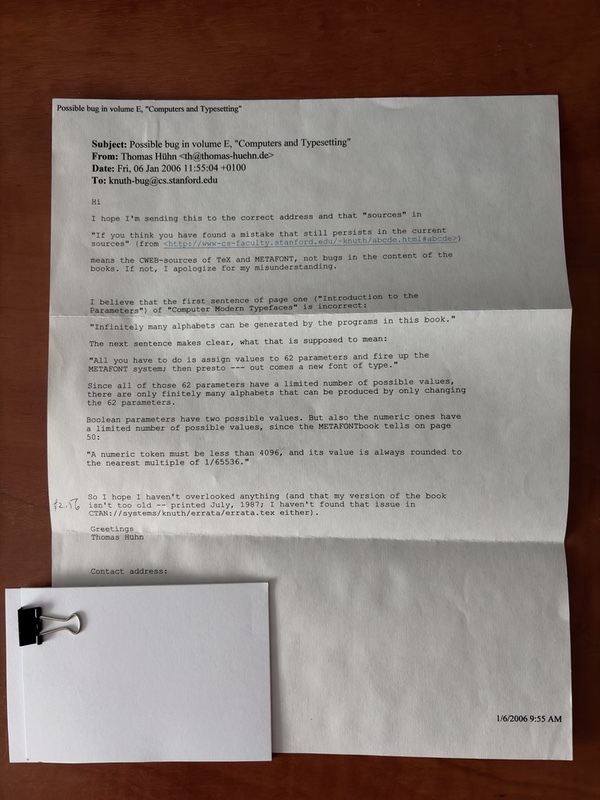
On January 6, 2006, Thomas Hühn sent Donald Knuth a cautious report about Computer Modern Typefaces, a book devoted to digital type design. The suspected mistake appeared on printed page 1, in the first paragraph, in the very first word. Knuth confirmed the report and sent Hühn a reward check dated May 25, 2006. The amount was modest. The recognition was enormous. (thomas-huehn.com)
The story is useful beyond typography. A bug is a defect in software, documentation, or another technical artifact that makes its behavior or explanation wrong. Bugs often survive because readers see what the author meant rather than what the page actually says. Hühn did not trust his first impression. He reread the surrounding material, checked the relevant edition, and waited before reporting. That hesitation became the verification step that turned a suspicion into evidence.
The word that was too strong
Computer Modern Typefaces explains how Computer Modern fonts are built. A typeface is a coordinated design for letters and symbols. Typesetting is the process of arranging those characters into readable pages. Knuth’s METAFONT system, a programming language and tool for designing typefaces, describes characters through adjustable values called parameters. The opening chapter discusses 62 of them, covering details such as letter height, stroke weight, spacing, and serif shape. (api.pageplace.de)
The original opening sentence began with Infinitely many alphabets can be generated.... The problem was the word Infinitely. The next sentence described assigning values to 62 parameters and running METAFONT, which made the statement about a concrete computer program rather than an abstract mathematical possibility. A computer works with finite representation, meaning a bounded collection of values it can store and process. The original wording made a stronger claim than that implementation could support.
The official correction changed the first word to Zillions: still playful, still conveying extraordinary variety, but no longer making a literal claim about infinity. The correction appears in the errata for Volume E, page 1. It is a wonderful example of a technical error that does not crash a program or distort a printed glyph. Instead, it teaches the reader a subtly incorrect idea. (ctan.math.illinois.edu)
That kind of mistake deserves attention. Documentation is part of a system’s interface, and an inaccurate sentence can mislead every person who relies on it. In modern software, the equivalent might be a misleading API comment, a boundary condition described incorrectly, or an example that quietly contradicts the code.
Why the report earned a check
A useful error report does more than announce that something feels wrong. It gives another person enough information to reproduce the problem, meaning they can inspect the same location and reach the same conclusion. Hühn’s report followed that pattern:
Location: Computer Modern Typefaces, Volume E, page 1
Observed: the first sentence begins with “Infinitely”
Context: the paragraph describes 62 adjustable parameters
Reason: the wording claims more than the implementation supports
Suggested correction: replace the overly strong wording
The E1 memo notation on the check identifies Volume E and page 1. That small label is a reminder that precision is not decoration. A vague report creates more work for the author; a precise report lets the author investigate the claim instead of guessing what the reader saw.
Knuth’s reward policy made this exchange unusually memorable. The first person to report a genuine, previously unknown error in one of his books could receive at least 0x$1.00, equal to $2.56 in ordinary currency. Significant suggestions for improving the text could earn 0x$0.20, or 32 cents. The system rewarded not only finding defects, but also making the work clearer for the next reader. (cs.stanford.edu)
Why the reward is written like code
The notation is a small programming joke. Hexadecimal is a base-16 number system that uses the digits 0 through 9 and the letters A through F. In Knuth’s format, one hexadecimal dollar contains 256 ordinary cents:
def hex_dollar_to_usd(value):
 whole, fraction = value.split(".")
 cents = int(whole, 16) * 256 + int(fraction, 16)
 return cents / 100

print(hex_dollar_to_usd("1.20"))
# 2.88
So 0x$1.20 means 1 × 256 cents, plus hexadecimal 20, which is 32 decimal cents. The result is 288 cents, or $2.88. Hühn’s account reached that total through the original error reward of 0x$1.00 and a later 0x$0.20 reward for a useful suggestion. The Bank of San Serriffe ledger still listed his balance as 0x$1.20 in its June 21, 2026 snapshot. (cs.stanford.edu)
When the check became a security problem
The paper check itself eventually created a modern problem. Printed checks expose account and routing information, so Knuth explained in 2008 that he could no longer keep sending ordinary personal checks without increasing the risk to his bank. He replaced them with certificates for accounts at the fictional Bank of San Serriffe. He also noted that only 9 of the first 275 checks issued since the beginning of 2006 had actually been cashed; the rest had apparently been “cached,” a joke aimed at programmers.
That change adds another lesson to the story. A reward process can be generous and technically clever while still needing a security review. Quality includes correctness, clarity, and privacy. Even a charming tradition has to adapt when its surrounding risks change.
The money was never the central point. The check told readers that a famous author expected mistakes to exist, wanted them reported carefully, and was willing to credit the person who found one. On page one of a book about programmable fonts, a single adjective became a miniature quality-assurance process: observe, verify, report, correct, and preserve the fix in the errata.
That is why the Knuth reward check remains memorable. Its value is measured in dollars, but its real lesson is larger: precision is not pedantry when people build software, fonts, books, and ideas on top of your words.
Comments (0)
No comments yet. Be the first to respond!
Leave a Comment
Your comment will be visible after review.