Microduck: The Tiny Open-Source Robot You Can Retrain
 by ahsan
August 27, 2026
6 min read
by ahsan
August 27, 2026
6 min read
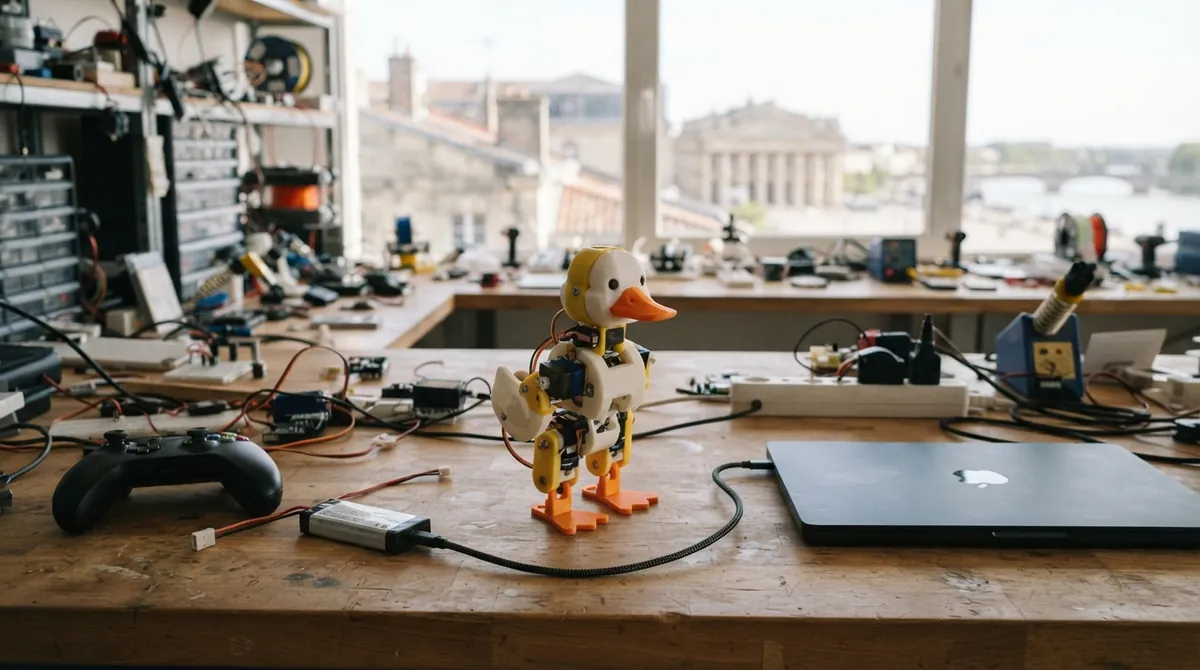
Most desk robots ask you to press a button and watch a canned animation. Microduck, a 25 cm biped from Pollen Robotics, now part of Hugging Face, begins there but does not stop there. You can drive it with the included controller, then open the simulator and training tools to change what its body can do.
That makes the duck more than a cute hardware drop. It is an open-source robot whose learned behavior is meant to be inspected, retrained, and shared. Preorders opened on August 27, 2026, at $399 before taxes and shipping, with first deliveries targeted before Christmas 2026.
The first surprise is the size
At roughly 25 cm tall and about 800 g, Microduck fits comfortably on a desk but carries a serious collection of sensors and motors. Fifteen motors coordinate its legs, head, and beak. A front camera helps it see, LiDAR uses reflected light to estimate depth, and two IMUs, or inertial measurement units, track motion and orientation.
The onboard policy loop runs at 50 Hz. In practical terms, the robot can refresh its learned movement decisions 50 times per second. That fast rhythm matters for a biped: a small change in balance cannot wait for a slow command from a laptop.
The base box includes the robot, battery, USB-C cable, and game controller. Its launch behaviors include walking, sitting and standing, kicking, scooping objects with the beak, roller skating with the right attachments, and getting back up after a fall. The shell may come in different colourways, but the interesting part is the software underneath.
The brain is a policy, not a script
A traditional robot script might say, “Move the left leg here, then move the right leg there.” That approach can work for a carefully choreographed motion, but walking across a real surface is full of small surprises.
Microduck uses reinforcement learning, usually shortened to RL. This is a training method in which software tries actions, receives numerical rewards for useful results, and gradually adjusts itself. A policy is the learned model that turns information about the robot’s current state and a desired command into movement. You can think of it as a compact coach making a new decision every control cycle.
A neural network inside that policy does not store one recording of a walk. It learns relationships between balance, joint positions, speed, body angle, and commands. When the robot is asked to move forward, the policy works out how the legs should cooperate instead of replaying a fixed animation frame by frame.
That distinction is what makes retraining possible. A new behavior is not necessarily a new pile of hand-written motor commands. It can be a new policy produced by changing the task, reward, or training conditions.
Sim-to-real is where the trick becomes real
Why train a physical robot by making it fall in a computer? Because simulation lets you run thousands of experiments without wearing out motors or waiting for a battery to recharge.
Microduck’s training stack uses MuJoCo, a physics simulator designed for modeling bodies, joints, contact, and motion. The reinforcement-learning repository trains with PPO, or Proximal Policy Optimization, an algorithm that updates a policy in controlled steps rather than changing it wildly after every trial. Its examples use thousands of simulated environments in parallel, then export the finished model for deployment.
This process is called sim-to-real: train in simulation, then transfer the result to a physical robot. The transfer is difficult because a virtual servo does not have exactly the same friction, delay, voltage response, or mechanical looseness as a real one.
The training code accounts for those mismatches with domain randomization, which means deliberately varying conditions during simulation. Battery voltage, friction, command delay, and backlash are changed across training runs. Backlash is the small amount of play inside gears before movement at the motor fully reaches the joint. By seeing many imperfect versions of the world, the policy has a better chance of coping with the imperfect world on your desk.
After training, the policy can be exported to ONNX, the Open Neural Network Exchange format. ONNX provides a portable package for the neural network, so the same learned model can move from the training environment into the robot’s runtime.
sensor readings + command
 ↓
61-value observation
 ↓
policy → 14 learned action values
 ↓
safety limits → motor targets
The numbers describe the handoff inside the control loop. Sensor readings, body orientation, joint movement, the previous action, and your command become a compact observation. The policy produces learned action values, and the runtime maps them onto the robot’s motor system while applying safety limits before anything moves.
Open source all the way down
Open source can mean many things. Sometimes it means a small software library is visible while the important hardware behavior remains sealed. Microduck takes a broader approach: the SDK, simulator, robot runtime, and full RL training stack are published together under the Apache-2.0 license. Apache-2.0 is a permissive license that allows people to study, modify, and redistribute the software with relatively few restrictions.
That gives the project a useful progression. You can start by playing with the controller. Then you can inspect the simulator, train a policy on a local machine with CUDA, NVIDIA’s platform for running calculations on a graphics processor, or send training jobs to Hugging Face’s hosted infrastructure. Once a policy works in simulation, you export it and move it onto the robot.
The intended loop looks like this:
simulate → train → export → deploy → observe → retrain
The loop is more important than any single trick. A policy becomes a file that can be compared, forked, improved, and shared with someone else who owns the same robot.
Where the hard part lives
Two-legged locomotion is unforgiving. A policy that looks graceful on a perfectly flat simulated floor may stumble on carpet, respond differently when the battery is nearly empty, or behave strangely after a motor develops extra play. That is why the details around the neural network matter as much as the network itself.
Microduck’s runtime also makes the control path visible. The robotctl monitor command can show the robot’s state, joint readings, policy information, and health. Configuration and update commands expose more of the machine than you usually get with a consumer gadget. Open source does not remove the need for care, calibration, or a safe workspace, but it gives you somewhere to look when a leg does something unexpected.
A toy, a teaching tool, or both?
What is Microduck for if you are not a robotics researcher? It is a tactile introduction to embodied AI, the field where software has to perceive the physical world and act inside it. Beginners get an immediate reward: the robot walks, kicks, rolls, and recovers. More experienced builders get a compact platform for experimenting with sensors, locomotion, policies, and sim-to-real transfer.
The remarkable part is not that a duck can perform a handful of tricks. It is that those tricks are presented as editable technical artifacts rather than sealed magic. Microduck makes the distance between “watch the robot move” and “teach the robot a new behavior” feel small enough to cross.
Comments (0)
No comments yet. Be the first to respond!
Leave a Comment
Your comment will be visible after review.