RepRapMicron: A 3D Printer That Thinks in Microns
 by ahsan
October 18, 2026
4 min read
by ahsan
October 18, 2026
4 min read
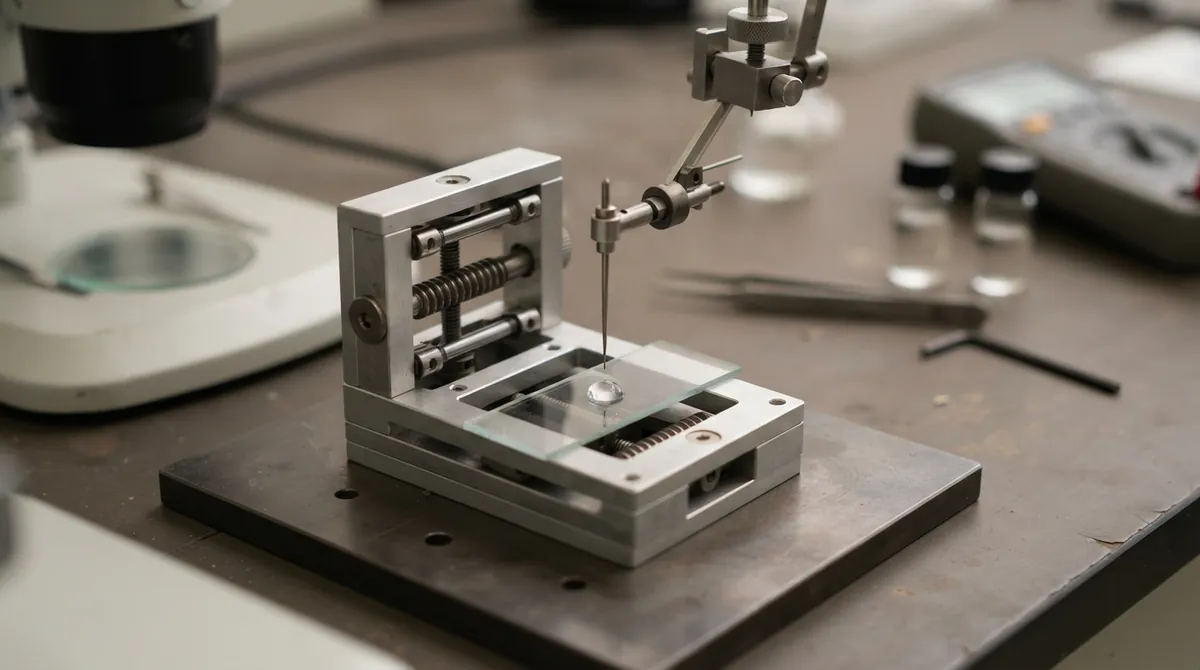
The machine that changes the meaning of 3D printer
A normal desktop 3D printer lives in millimeters. RepRapMicron moves into a scale where a micron, one-thousandth of a millimeter, becomes a meaningful unit. The project, also called μRepRap, is not a shrunken commercial printer with a microscopic plastic nozzle. It is an open-source, three-axis fabrication platform that positions a probe—a thin tool that can touch, scratch, or deposit material—inside a tiny workspace. One of its demonstrations is a miniature Benchy-style test model made with a 4 µm layer height. (github.com)
The motion comes first
The current project wiki recommends the PIKA V0.02 build, a compact computer numerical control (CNC) machine. In a CNC system, software sends movement instructions to motors while a tool performs the physical work. RepRapMicron’s documented PIKA results describe repeatable positioning of about 1 µm and reliable accuracy of roughly 10 µm or better inside an approximately 8 mm cubic volume. Repeatability means returning to the same place again and again; accuracy means landing close to the commanded place. A machine can be strong at one and weaker at the other, so both measurements matter.
That working area sounds tiny because it is. This is not a replacement for a full-size printer. The machine is closer to a microscope-guided manipulator: a small platform for engraving, placing droplets, curing resin, and testing the mechanics needed for finer fabrication.
Why printed flexures matter
The surprising mechanical choice is that RepRapMicron does not depend on miniature rails or ball bearings for every axis. Instead, it uses flexures—thin, spring-like sections that guide motion by bending. A flexure has no sliding contact at its moving joint, which reduces friction and backlash, the loose movement caused by play in gears, screws, or bearings.
That advantage comes with a trade-off. A flexure must be stiff enough to hold position but flexible enough to move, and increasing one quality usually harms the other. Travel is limited too. Earlier MAUS, short for Micron Accurate Universal System, designs served as a testbed for these mechanisms; PIKA reshaped the idea into a more practical machine. The approach draws on the OpenFlexure project, whose 3D-printed microscope stages use plastic flexures to achieve precise, low-friction motion. (openflexure.org)
PIKA turns the frame into a mechanism
PIKA stands for Printable In-place Kinematic Assembly. Its XY table—the part that moves the work left-right and front-back—is designed to print as one piece on a conventional fused filament fabrication (FFF) printer using PLA filament. FFF is the familiar process of melting plastic filament layer by layer. Here, the printed geometry becomes the guide, so the builder does not have to assemble a stack of tiny bearings and alignment parts.
The build notes describe a practical hobbyist setup: a 0.4 mm nozzle, 0.2 mm layers, plain PLA, and roughly 25 hours of printing for the listed components. The project also uses Metriccano, a modular system of parts arranged around a 10 mm grid with M3 fastener holes. That grid makes it easier to shift a motor, add a bracket, or replace a prototype part without redesigning the entire machine.
The print head is a probe, not an extruder
This is where the ordinary 3D-printer metaphor breaks. Instead of pushing a continuous strand of plastic, RepRapMicron can use a needle or a fine wire as its print head. A rough probe can scratch a test pattern into marker on a glass slide. A finer electrochemically etched wire, shaped through a controlled electrical process, can carry a very small amount of ultraviolet (UV) resin.
The liquid moves through capillary action, the tendency of a liquid to cling to a narrow surface or move through a tiny gap. The project reports UV-resin droplets as small as about 4 µm. With an optical-fibre probe, it has also cured resin lines around 9 µm wide. A UV light source travels through the fibre and hardens the resin only where the probe places it, creating a form of dip-pen writing at microscopic scale.
Familiar software, unfamiliar discipline
The software side stays close to the RepRap and hobby-CNC world. The machine can use G-code, the plain-text command language commonly used by 3D printers and CNC tools. With millimeters selected as the unit, an illustrative movement might look like this:
G21; use millimetres
G90; use absolute coordinates
G1 X0.008 Y0.003 Z0.002 F20
The final line asks for X = 8 µm, Y = 3 µm, and Z = 2 µm because 0.001 mm equals 1 µm. In practice, calibration, screw geometry, motor drivers, vibration, and the controller’s limits decide whether those commands become trustworthy motion. The syntax is familiar; making the hardware obey it consistently is the difficult part.
PIKA uses NEMA17-format stepper motors, a common motor size in hobby printers. Stepper motors move in controlled increments, and careful microstepping can divide those increments into smaller commanded movements. The project also supports GRBL, open-source firmware for CNC motion control, so builders can work with tools and concepts they may already recognize. (github.com)
A small platform with a larger ambition
Microelectronics and micro-electromechanical systems (MEMS)—tiny devices that combine electrical parts with moving mechanical structures—are usually associated with specialized fabrication equipment. RepRapMicron does not replace a semiconductor cleanroom, and its present process still depends on microscopes, calibration slides, consumable probe tips, controlled materials, and patience. The long-term ambition reaches below a micron, but the demonstrated PIKA work is better described precisely: micron-scale positioning, small-volume resin deposition, and an open platform for developing new tools.
That is what makes the project compelling. The important achievement is not only the tiny number displayed in a software command. It is getting the flexures, motors, probe, optics, material, and calibration to agree on what that number means. RepRapMicron turns micron-scale fabrication from a sealed industrial mystery into a buildable experiment, assembled from printed plastic, common motors, microscope cameras, and open-source code.
Comments (0)
No comments yet. Be the first to respond!
Leave a Comment
Your comment will be visible after review.