RobCo’s $1 Billion Valuation: Why Factory Robots Are Becoming Software Platforms
 by ahsan
October 05, 2026
6 min read
by ahsan
October 05, 2026
6 min read
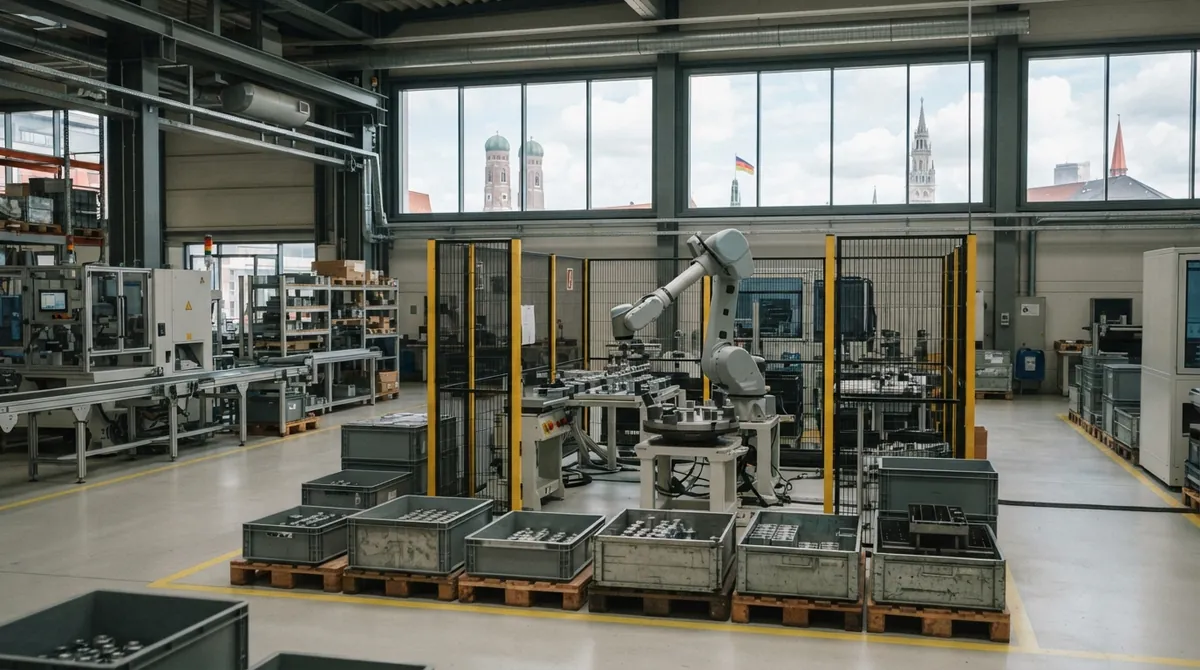
Picture a mid-sized factory on a Monday morning. The parts are familiar, but the next customer order uses a different shape, a different fixture, and a shorter production run. An industrial robot—a programmable machine that moves tools or materials through repeatable motions—can handle the work, yet the expensive part is often teaching it to cope with change.
That tension sits behind RobCo’s new milestone. On October 5, 2026, the Munich-founded company announced that it had passed a $1 billion valuation, doubling its value in nine months. A privately held startup valued at least that highly is called a unicorn. RobCo is not building a household robot; it is combining modular machines, factory software, and artificial intelligence to make industrial automation more adaptable. (rob.co)
A unicorn valuation is not a $1 billion cash pile
The financial detail matters because headlines often compress several ideas into one number. RobCo’s transaction included an employee secondary share sale. In a secondary sale, existing shareholders sell some of their shares to new buyers instead of the company issuing an entirely new batch of shares. That gives long-standing employees a chance to turn part of their paper ownership into real money.
The valuation is therefore best understood as the market’s current price for the whole company, inferred from the transaction. It does not mean RobCo received $1 billion in fresh funding. The announcement says the deal also brings new capital into the business, but the valuation and the amount invested are separate figures.
This follows a substantial financing round earlier in the year. On January 29, 2026, RobCo announced a $100 million Series C round, co-led by Lightspeed Venture Partners and Lingotto Innovation, to develop its physical artificial intelligence roadmap, expand enterprise deployments, and grow its presence in the United States.
The problem is not moving an arm
Traditional industrial robots are very good at stable, repetitive work. Give them the same part, the same fixture, and the same sequence thousands of times, and they can perform with impressive consistency. The trouble begins in a high-mix factory, where many product types pass through the same workspace in smaller batches.
Every change can trigger another engineering project. A new part may need different gripper settings, a revised movement path, fresh safety checks, and a specialist who knows the robot’s programming language. For a large automotive plant, that effort may be manageable. For a smaller manufacturer, it can make automation feel financially out of reach.
RobCo’s answer starts with modular hardware. Its robot systems can be assembled in configurations ranging from one to eight degrees of freedom. A degree of freedom is an independent direction or rotation in which a robot can move. More degrees of freedom can help a robot reach around obstacles, change its angle, or work inside a cramped production cell.
The useful idea is less about swapping parts for novelty and more about avoiding a dead-end machine. A factory can adapt the robot’s shape to a task instead of redesigning the entire production area around a fixed arm.
The software layer is where the model gets interesting
RobCo’s RobFlow software uses no-code programming, meaning operators build an automation process with visual blocks rather than typing traditional programming commands. Those blocks, called nodes, can represent actions such as moving, gripping, checking a camera image, or making a decision.
A simplified version of a factory workflow might look like this:
Detect part
 -> Pick it
 -> Inspect with camera
 -> Load machine
 -> If pass: palletize
 -> If fail: send to reject bin
This is not RobCo’s proprietary syntax. It is a mental model for what the visual flow represents. The important shift is that a production specialist can describe the work in steps without becoming an expert in robot motion code.
RobCo pairs that workflow with a digital twin, which is a software model of a physical robot and its surrounding workspace. Teams can simulate movements, check reach, and look for possible collisions before the real machine moves. That reduces the risk of discovering a bad path after installation, when every minute of downtime becomes expensive. (rob.co)
RobCo Studio extends the idea from one robot to an entire fleet. It provides tools for configuration, simulation, monitoring, maintenance planning, and over-the-air updates, which means software changes can be delivered remotely rather than installed manually at every machine. That is a familiar model from cloud software, brought into a much less forgiving environment where motors, sensors, and metal parts share the same workspace.
What physical AI adds
The phrase physical AI describes artificial intelligence connected to sensors and machines that can act in the real world. A chatbot produces text; a physical AI system must interpret its surroundings, choose an action, and move safely through space.
For RobCo, that stack includes computer vision, which is software that interprets camera images, along with motion planning. Motion planning calculates a safe path for the robot’s joints and tool while accounting for obstacles, reach, and the task itself. RobCo describes its approach as a sense-reason-act loop: perceive the environment, reason about the next step, then execute it.
That distinction is important. A robot that repeats a perfectly scripted sequence is useful, but it is not autonomous in the richer sense. An autonomous system must cope with parts that arrive slightly out of position, changing workspaces, and exceptions that were not listed when the original program was written.
Alfie is the next test
RobCo’s next chapter centers on Alfie, an autonomous industrial robot designed to combine perception, reasoning, and execution for high-mix, unstructured, and safety-critical factory work. As of October 5, 2026, Alfie had not reached its planned commercial launch; RobCo says it will unveil the system at its first annual summit in Munich on March 4, 2027.
The company is also pushing harder into the United States. Its current announcement says customer operations span more than a dozen states, supported by manufacturing and assembly operations in Austin, Texas, and a laboratory in San Francisco. That expansion gives RobCo a demanding proving ground: American manufacturers tend to have large facilities, varied equipment, and little patience for automation that needs constant specialist attention.
The hard part starts after the demo
A robotics demonstration can look magical because the environment is carefully prepared. A working factory is different. Materials arrive late. A tool wears down. A product changes halfway through the year. Safety procedures must be documented, and the robot has to keep working on an ordinary Tuesday when the original engineering team is somewhere else.
That is why the real test for RobCo will not be the valuation itself. It will be uptime, repeatable cycle times, safe behavior, maintenance costs, and whether customers can redeploy the system when their products change. Physical AI is promising, but it also introduces difficult questions around reliability, security, training data, and responsibility when an autonomous machine makes a poor decision.
RobCo’s Robotics-as-a-Service model is designed to lower the barrier to adoption. Instead of buying a large system as a capital expenditure—a major upfront purchase—customers can pay a recurring fee while RobCo provides deployment, maintenance, and ongoing software improvements. That changes how a manufacturer budgets for automation, although it does not remove the need to prove a long-term return on investment.
RobCo’s unicorn milestone is ultimately a bet on a new shape for industrial robotics. The winning system may not be the strongest arm or the cleverest model in isolation. It may be the combination that lets a real factory change direction without starting from scratch: modular hardware, visual programming, simulation, remote management, and AI that can cope with the untidy physical world.
Comments (0)
No comments yet. Be the first to respond!
Leave a Comment
Your comment will be visible after review.