Secure Suspend With LUKS: When Linux Didn’t Wipe Keys From RAM
 by ahsan
July 02, 2026
6 min read
by ahsan
July 02, 2026
6 min read
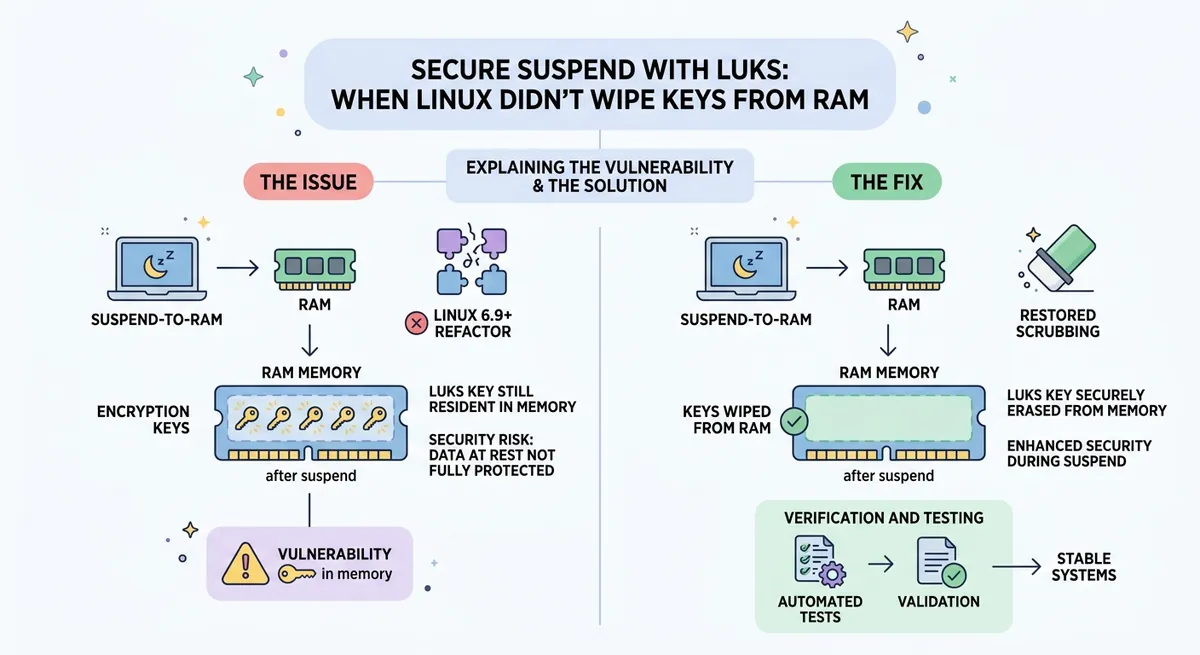
The scary moment: “full-disk encryption” but not on suspend
Picture this: your laptop is encrypted with LUKS (Linux Unified Key Setup), so if someone steals the device while it’s powered off, they still face the wall of strong cryptography. That promise is the whole point of full-disk encryption.
But then you close the lid and the machine goes into suspend-to-RAM—a power-saving mode where the screen turns off and the CPU stops working, while RAM stays powered. In that state, encryption doesn’t automatically become stronger; the system still has to decrypt the disk to keep your session usable. That means encryption secrets may remain in memory.
For a long stretch of time, this turned out to be worse than many people assumed: since Linux 6.9 (May 2024), the mechanism intended to lock and wipe encryption key material during suspend was failing silently. The result: the LUKS encryption key could remain resident in memory across suspend, reachable by an attacker who obtains RAM contents.
Quick glossary: what “key in memory” really means
To understand why this matters, we need a few concepts, in plain language.
- LUKS: A standard way on Linux to encrypt block devices (like SSDs). It uses a volume key (the symmetric key that actually encrypts the disk data).
- Suspend-to-RAM: The laptop sleeps, but RAM stays on so you can resume quickly.
- Resident in memory: The secret stays stored in RAM, not overwritten or cleared.
- Wiping keys: Overwriting or releasing key material so it can’t be recovered later.
- Cold boot attack: A class of attacks where an adversary tries to read RAM contents after power loss by exploiting how quickly bits decay.
Security engineering often comes down to a simple question: Does the system remove secrets when the threat model says it should? In this case, the answer was “not reliably,” specifically for suspend.
The mechanism that was supposed to protect us
Linux disk encryption on modern systems often involves a layered stack:
- dm-crypt: The Linux kernel device-mapper target that performs encryption/decryption for a block device.
- cryptsetup: The user-space tool that configures dm-crypt.
- Suspend handling: Coordination between the suspend process and the encryption subsystem so that keys are not kept around longer than intended.
When people say “secure suspend,” they usually mean: before sleep, remove the encryption key from RAM; on resume, reacquire it (typically with a passphrase prompt or key management service). Without that, suspend becomes a short-lived but fully decryptable window.
The unsettling part of the reported issue wasn’t that encryption was broken. It was that a “wipe on suspend” step failed. The system behaved as if it had done the right thing—quietly.
What went wrong: a small refactor with a long shadow
In software, bugs sometimes appear because of a single missing line. Other times, they appear because of a sensible refactor that changes control flow, timing, or lifetime of data.
The underlying culprit described in the debugging story was a refactoring in the kernel. Refactoring means rewriting code for cleanliness—often reorganizing functions, moving logic around, or changing how resources are acquired and freed.
The tricky part is that security properties depend on details like:
- Which execution context “owns” a secret.
- When a secret is released.
- Whether cleanup happens on every path, including suspend/hibernate transitions.
Even if the refactor is correct in isolation, it can accidentally stop triggering a cleanup step for encryption keys. That’s the “long-range interaction” problem: two pieces of code that were safe individually become unsafe when combined.
In this case, the wipe that should have happened during suspend-to-RAM didn’t happen, so the LUKS volume key stayed resident in memory.
Why “full shutdown” worked but suspend didn’t
The story also highlights an important nuance: systems often clear secrets on a full power-off shutdown, because the kernel and crypto subsystems are torn down and RAM contents are no longer preserved.
Suspend-to-RAM is different. Since RAM remains powered, any key material left behind is not automatically scrubbed by hardware. That means “works on shutdown” is not evidence that suspend is safe.
For many users, that distinction is easy to miss because both are “not running.” But security doesn’t care about your mental model of “off”; it cares about whether secrets remain retrievable.
This bug exposed that mismatch.
Why the fix could be one line—yet still matter
Security fixes sometimes look tiny compared to the impact. The reason is that cleanup logic often depends on one specific call or one missing step.
In the narrative, the corrective change is described as “exactly one line long.” In practice, one line can be the difference between:
- a key being scheduled for wipe,
- a key being wiped on the correct path,
- or a key being wiped only under certain conditions.
That also explains why failures can be silent: if the system doesn’t check that the wipe actually occurred, users only see the result indirectly—or not at all.
The bigger lesson: silence is dangerous in security
A key theme in the debugging aftermath is that the previous behavior failed without alerting anyone.
Security-sensitive operations benefit from defensive checks and tests that detect regressions. Two upgrades matter here:
- Automated detection: an integration or regression test that would fail if encryption key wiping on suspend stops working.
- Warnings instead of silent failure: when the system can’t guarantee the security property, it should loudly report that uncertainty.
These aren’t “nice to have” features. They change the security posture from “best effort” into “measurable behavior.”
How secure suspend-to-RAM should work (conceptually)
Even without diving into a specific patch, the intended behavior is a pattern:
- User-space initiates suspend.
- Kernel encryption layer prepares to stop using the disk.
- The LUKS volume key is removed from RAM (wiped and/or released).
- The system enters suspend.
- On resume, decryption keys are reacquired as part of resume—so secrets don’t remain indefinitely.
What makes this hard is concurrency and lifetimes. Keys may be stored in structures associated with threads, contexts, or internal keyrings. If code changes move cleanup responsibilities, the wipe can fall through the cracks.
Reproducing the threat model: why RAM persistence is a risk
An attacker with access to a suspended machine can attempt to extract memory. This could be done through:
- physical access attacks that try to read RAM contents before they decay,
- side channels that influence or observe memory,
- or forensic techniques after acquiring the device.
The core issue is that a volume key sitting in RAM undermines “encryption at rest” for the duration of suspend. The whole goal of wiping is to narrow the window when an attacker can realistically obtain the key.
Practical takeaway: update and validate suspend behavior
For readers running Linux 6.9+ with LUKS and relying on suspend, the actionable message is straightforward: track kernel and encryption subsystem updates that address suspend key wiping.
But security engineers don’t stop at “update.” They also validate that the intended property holds. That’s why automated tests and warnings matter—because they turn a subtle failure into something detectable.
In modern secure systems, suspend isn’t just a power management feature. It’s a security boundary.
Conclusion: secure suspend means keys don’t linger
The takeaway from this saga is sharp and memorable: full-disk encryption protects your data when the machine is powered down, but suspend-to-RAM requires extra care because RAM stays alive. Since Linux 6.9, a refactor caused LUKS suspend key wiping to fail silently, leaving the volume key resident in memory across suspend.
The fix may be small, but the lesson is large: security guarantees depend on cleanup details, and code paths like suspend are exactly where those details can drift. Reliable secure suspend comes from both correct implementation and strong regression testing that makes silent failures impossible.
Comments (0)
No comments yet. Be the first to respond!
Leave a Comment
Your comment will be visible after review.