.self: Designing a Self-Hosting TLD Around Human-Centered Webs
 by ahsan
June 30, 2026
7 min read
by ahsan
June 30, 2026
7 min read
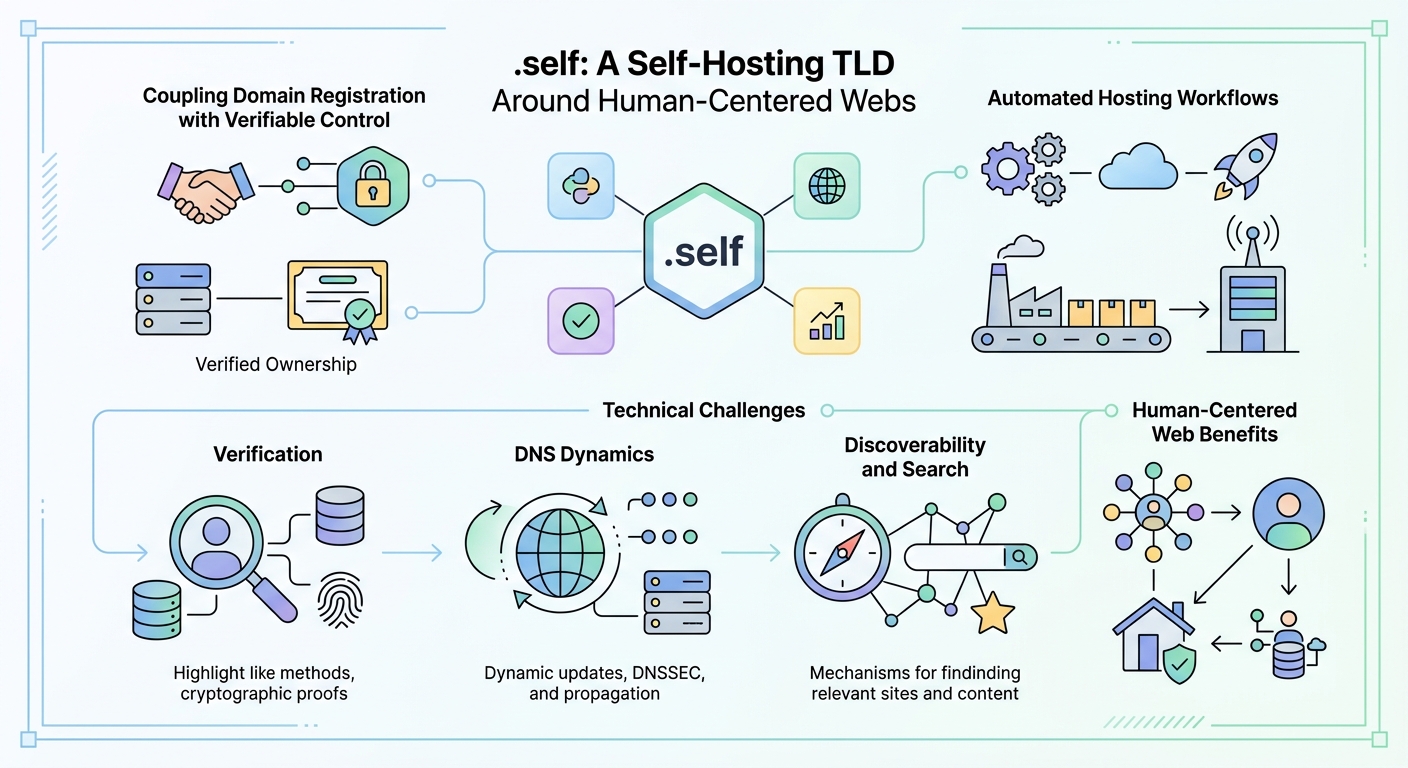
.self: Designing a Self-Hosting TLD Around Human-Centered Webs
The global Internet was engineered to move information quickly and reliably across machines. Over time, however, web infrastructure has increasingly optimized for business incentives: data extraction, attention capture, opaque tracking, and centralized control of identity and content. In that context, the idea behind a dedicated top-level domain (TLD) like .self is more than branding—it’s a technical proposal for how DNS and hosting defaults can reinforce human-centered behavior.
This post examines what it would mean, technically and operationally, for a TLD to be designed specifically to support self-hosting. It also explores the engineering constraints such a TLD would face, including verification, security, interoperability, and client software.
What a TLD can and cannot control
A TLD is the DNS layer that anchors names to the right namespace. In practical terms, a TLD can influence:
- Name availability and structure (which domains exist under the TLD)
- Registration policy (who can register and under what rules)
- Resolution behaviors and records published by registries (delegation, defaults, required glue)
- Guidelines for hosting (often implemented via registrant requirements)
But a TLD cannot directly change how browsers render pages, how browsers enforce security, or how content is served (that’s the domain’s hosting stack). A human-centered .self concept therefore needs to translate social goals into enforceable technical requirements.
The central claim—support self-hosting—implies that the TLD registry and/or clients should make “hosting one’s own presence” easier and harder to abuse.
Translating “self-hosting” into concrete requirements
“Self-hosting” can mean many things: running a web server on a home machine, using a personal VPS, hosting on-prem behind NAT with tunnels, or using a community mirror. A TLD that targets self-hosting needs a definition that is both operationally practical and enforceable.
Typical technical interpretations include:
- Direct origin hosting: the domain’s A/AAAA records map to an IP controlled by the registrant.
- Managed personal hosting: the registrant uses a hoster/vender but remains the operational owner.
- Bring-your-own-instance: a client program provisions configuration and keeps DNS aligned with the current origin.
- Portability under delegation: the domain should remain reachable across upgrades/reboots/migrations.
A crucial design decision is whether .self is a policy-only TLD (registration must meet rules) or a system TLD (clients and services coordinate to keep DNS, certificates, and hosting consistent).
Verification: proving control without turning DNS into a bureaucracy
The biggest engineering challenge for a self-hosting TLD is verification.
If the TLD intends domains to be bound to the registrant’s hosting control, it must verify something like:
- The registrant controls the domain’s DNS delegation (already common via domain ownership checks)
- The registrant controls the origin that DNS points to (not always standard)
- The registrant can maintain service reachability over time
Several verification strategies exist, each with trade-offs:
1) DNS-based validation
The registry requires that certain records (or DNS challenges) are present.
- Pros: automatable; aligns with DNS ownership mechanisms
- Cons: does not guarantee the registrant controls the server behind the IP (an attacker could point DNS to someone else’s infrastructure after registration unless ongoing verification exists)
2) Proof-of-key / proof-of-origin
Registrants might publish cryptographic material that only the “host” can demonstrate.
- Pros: more directly ties hosting identity to control
- Cons: requires application-layer changes or standardized protocols to be meaningful
3) Ongoing reachability and certificate binding
The registry (or an operator) could require evidence that the origin:
- serves a challenge over HTTP(S)
-
presents a certificate attributable to the registrant’s expected keys
-
Pros: increases assurance that self-hosting is real
- Cons: introduces uptime constraints, cost, and complexity; also interacts with the certificate issuance ecosystem
A .self system that bundles an open-source client could standardize this by keeping DNS records aligned with the validated origin and rotating keys in a predictable way.
The client software problem: self-hosting needs automation
Self-hosting fails in practice for many reasons that are not political—mainly operational complexity:
- Residential IP addresses change
- TLS certificates expire
- Reverse proxies and tunnels require correct configuration
- Monitoring and incident response are non-trivial
A dedicated TLD can partially address these by encouraging a standard client. The client would automate tasks such as:
- Creating/maintaining DNS records under .self
- Managing ACME/TLS issuance
- Performing periodic health checks and re-challenging validation
- Coordinating firewall/NAT traversal assumptions
However, this becomes a major engineering undertaking: the client must handle diverse environments (Linux, Windows, macOS), network topologies (NAT, CGNAT), and security constraints (strict outbound firewall rules).
To avoid vendor lock-in, the client should be open and interoperable. That means the TLD’s “self-hosting protocol” must be stable, versioned, and implementable by multiple parties.
Security considerations specific to a self-hosting TLD
When a TLD encourages self-hosting, it may increase exposure to:
- Misconfigured servers
- Outdated software
- Weak TLS setups
- Overbroad firewall rules
A registry can’t fix these directly, but it can require certain best practices, such as:
- Mandatory HTTPS and strong cipher suites
- Limits on record types or DNS delegation patterns
- Rate-limited DNS updates (to reduce hijack impact)
- Signed update workflows for DNS changes
One subtle risk: a self-hosting TLD may encourage new software that touches DNS and TLS. If that software is compromised or poorly implemented, the TLD becomes an attractive target.
Therefore, the secure design surface includes:
- Key storage (client secrets on disk must be protected)
- Update authentication (software supply chain security)
- DNS update authorization (protect against stolen credentials)
- Attestation or transparency logs (optional but helpful)
DNS record dynamics: keeping a name stable across moves
Self-hosting is inherently mobile: laptops change networks, servers migrate, cloud instances restart, and home connections fluctuate.
A TLD designed for self-hosting likely needs patterns for safe, frequent DNS updates. Standard DNS Update Protocols exist (and dynamic DNS is common), but a .self approach can be more integrated:
- The client could own a stable identity (keys)
- DNS updates could be authenticated and possibly rate-limited
- The system could support rapid origin switching without long TTLs
At the same time, rapid updates can conflict with caching behavior and resolver expectations. Engineering best practices usually include:
- reasonable TTL strategy (short enough for mobility, long enough for performance)
- rollback mechanisms when validation fails
- smooth transitions to avoid broken reachability during renewals
Interoperability with existing hosting and free TLDs
A common question is whether a self-hosting TLD adds functionality beyond what already exists with generic TLDs and free alternatives.
Technically, existing generic TLDs (.com/.net) already support self-hosting. Free services like dynamic DNS or DNS-only hosting also exist. The differentiation of .self would have to be systemic rather than merely available:
- Registration rules that tie domain control to self-hosted operation
- An ecosystem of client tooling that automates hosting reliability
- Protocol agreements that make “self presence” portable
- Potential incentives or constraints that reduce centralization pressures
In other words, the value isn’t the DNS namespace; it’s the operational contract attached to it.
Human-centered goals expressed in technical terms
“Human-centered” can easily become rhetoric. For a self-hosting TLD, the technical levers that align with human-centered principles include:
- User control over identity and hosting endpoints
- Transparent mechanics (auditable client and protocol behavior)
- Reduced tracking surfaces by avoiding centralized hosting monopolies
- Accessibility of tools and documentation so end users can maintain their own infrastructure
One overlooked aspect is deliverability of information: if the initiative provides technical documentation, it should be accessible in web-friendly formats. Otherwise, the tooling and protocol might be open but practically inaccessible.
A plausible architecture for .self-style self-hosting
While specific implementation details are part of any official pamphlet, a plausible architecture for a self-hosting TLD can be described generically:
- Registrant identity and keys: The user generates a key pair and stores the private key locally.
- DNS delegation under .self: The registry provides a delegation workflow.
- Client-managed origin mapping:
- The client determines the origin endpoint (public IP or tunnel endpoint)
- It requests/updates DNS records with authenticated proof. - Validation handshake:
- The client proves the endpoint is under its control via DNS challenge and/or cryptographic token. - TLS automation:
- The client issues certificates using standardized mechanisms (commonly ACME)
- It binds certificate issuance to registrant-controlled keys or workflows. - Health and renewal loop:
- Periodic checks ensure the validation remains true
- Renewal triggers re-validation and DNS consistency updates
This design shifts complexity from end users to protocol automation while maintaining ownership boundaries.
Conclusion
A TLD like .self represents an attempt to make Internet infrastructure reinforce user agency. Technically, the most important work is not DNS itself—it’s the enforceable contract between domain identity, origin control, validation, and automation. Achieving that requires careful verification design, robust client software, secure key and update handling, and an interoperability strategy that avoids recreating centralization under a new name. In that light, .self is less about a new suffix and more about engineering a more self-sovereign web operating model.
Comments (0)
No comments yet. Be the first to respond!
Leave a Comment
Your comment will be visible after review.