The $60 Gaming PC Wasn't Really $60: AMD BC-250
 by ahsan
September 05, 2026
6 min read
by ahsan
September 05, 2026
6 min read
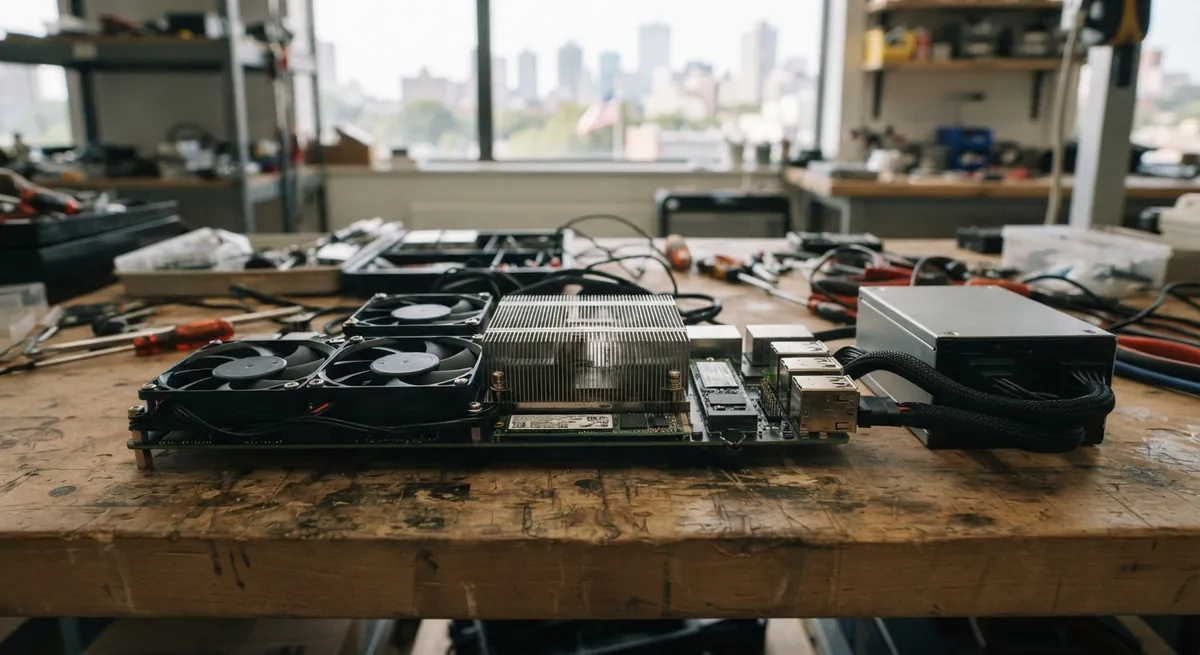
Open a listing for the AMD BC-250 and you might mistake it for a graphics card. It is long, has a chunky server heatsink, an 8-pin power connector, and almost none of the familiar motherboard furniture. There are no memory slots and no CPU socket. Yet, with the right firmware, cooling, and Linux setup, this strange board can become a surprisingly capable gaming PC.
The catch is hidden in the headline. The “$60 gaming PC” label describes a lucky board-only purchase, not a finished computer. In November 2025, used boards could appear for roughly $70–$100, with occasional lower listings. By August 11, 2026, testing reported the board closer to $175–$200, a roughly $350 working build, and $400–$500 for a system assembled from scratch. (devquasar.com)
The bargain begins with a very odd board
The BC-250 began life in cryptocurrency-mining hardware, where many identical boards could be packed into a server chassis. Its unusual centerpiece is a repurposed AMD system-on-chip, or SoC: one package containing the main processor, graphics processor, memory controllers, and other platform hardware. The silicon is closely related to the custom AMD chip used in the PlayStation 5, but the BC-250 is not a desktop PlayStation 5.
An accelerated processing unit, or APU, combines the CPU and GPU in one chip. The stock BC-250 exposes six Zen 2 CPU cores, which provide 12 processing threads, alongside 24 RDNA 2 graphics compute units. Zen 2 is the CPU architecture, while RDNA 2 is AMD’s graphics architecture. A compute unit, often shortened to CU, is a block of GPU hardware that processes shading and other graphics work.
The board also carries 16 GB of GDDR6 memory, a high-speed memory type normally associated with graphics cards. It includes a DisplayPort output, USB ports, Gigabit Ethernet, an M.2 storage slot, and two fan headers. That combination makes it a self-contained computer rather than a conventional graphics card that needs another PC to operate. (elektricm.github.io)
Shared memory changes the rules
The most important detail is that the BC-250 does not divide memory into ordinary system RAM and dedicated graphics memory. The CPU and GPU share the same 16 GB pool.
16 GB of GDDR6
├── operating system and CPU work
└── graphics data and VRAM
VRAM means video memory, the portion used to store textures, frame buffers, and other data needed to draw a game. On a normal gaming desktop, the CPU might use DDR5 memory while the graphics card has its own separate VRAM. On the BC-250, every gigabyte assigned to one side is unavailable to the other side at that moment.
That shared arrangement is one reason the BIOS matters so much. BIOS, the low-level firmware that initializes the hardware before an operating system starts, controls how the memory is presented. A poor split can leave games short of graphics memory or leave Linux struggling to run the rest of the system. The setting is not a minor optimization; it is part of making the board usable.
Why it can run modern games
The graphics hardware is the BC-250’s strong point. Even with only 24 active CUs, it has high memory bandwidth and a graphics design from the same generation as AMD’s Radeon RX 6000 cards. Community work has also revealed that many boards contain eight CPU cores and 40 graphics CUs, with the additional hardware masked by firmware or driver settings. Those unlocks are not guaranteed: one board may run all 40 CUs, another may be stable at 32 or 36, and another may need to remain at its stock 24.
That sounds like a free performance upgrade, but it is closer to a silicon lottery. The extra cores and CUs draw more power, produce more heat, and can expose defects that do not appear in light workloads. Current community documentation treats the unlocks as experiments that require testing rather than features every buyer should assume. (elektricm.github.io)
So, can the AMD BC-250 really replace a gaming PC? In a narrow but entertaining sense, yes. A carefully tuned 2026 test reached 82.2 frames per second in Cyberpunk 2077 at 1080p using a Steam Deck-style preset, and 56.5 frames per second at 1440p. Those numbers came from a system using Linux tuning, unlocked graphics hardware, and a particular board, so they are best understood as a performance window rather than a promise.
The processor creates an unusual limitation. At 1080p and 1440p, some games become CPU-bound, meaning the processor cannot prepare frames quickly enough for the GPU to display its full potential. In Forza Horizon 6, testing found the BC-250 heavily limited by its six-core, 3.5 GHz CPU at lower resolutions. Raising the resolution sometimes shifts the work toward the GPU, allowing the board to look stronger than expected, but the shared 16 GB memory ceiling remains. (tomshardware.com)
The real build is a Linux project
The hardware is only the beginning. The practical gaming route is Linux, an open-source operating system, paired with community-developed firmware and graphics fixes. The board needs a custom BIOS configuration, a compatible Linux kernel—the central part of the operating system—and software known as a GPU governor. A governor adjusts graphics clock speeds as the workload changes; without one, the GPU may remain stuck at a low fixed frequency.
Bazzite offers a more guided gaming-oriented setup, while CachyOS gives experienced users more control over kernels and low-level patches. Neither turns the BC-250 into an ordinary appliance. You may need to change memory settings, disable problematic firmware features, install community fixes, and repeat the process after a kernel update. The software has improved dramatically, but the board still depends on people reverse-engineering hardware that was never sold as a consumer gaming product.
Power and cooling deserve equal attention. The board uses a standard-looking 8-pin PCIe connector, but the wiring must match the BC-250’s pinout. A quality power supply with at least 300 watts and 20 amps available on the 12-volt rail is a sensible baseline. The original heatsink was designed for server airflow, not a quiet living-room case, so builders commonly add two high-pressure 120 mm fans or create a custom enclosure around it.
The need for airflow becomes more obvious with the 40-CU unlock. In a sustained FurMark stress test, a tuned board reached 80°C and dropped from roughly 1,850 MHz toward 1,500 MHz to control temperature. That behavior is called thermal throttling: the hardware reduces its speed to avoid overheating. The board can be fast, but it cannot ignore physics.
Who should build one?
The BC-250 makes sense for someone who enjoys Linux, used hardware, 3D-printed cases, BIOS experiments, and the satisfaction of solving problems that a normal prebuilt PC hides. It is a fascinating learning platform and a compact machine for older games, indie titles, and carefully tuned modern releases.
It is a poor choice for anyone who wants silent operation, official driver support, a warranty, effortless Windows compatibility, or a clean upgrade path. The slow PCIe 2.0 x2 M.2 storage interface and lack of built-in Wi-Fi or Bluetooth add more compromises to an already unusual system.
The AMD BC-250 matters less as the world’s cheapest gaming computer than as a lesson in hardware afterlife. A mining board can become a capable Linux game machine, but the real price is not printed on the eBay listing. It is paid in fans, firmware, troubleshooting, and time. In 2026, the honest description is a $175–$500 hobby project—one with an unexpectedly powerful story inside it.
Comments (0)
No comments yet. Be the first to respond!
Leave a Comment
Your comment will be visible after review.