The Blank Map Was Never Empty: What New Guinea’s First Contact Reveals
 by ahsan
September 15, 2026
6 min read
by ahsan
September 15, 2026
6 min read
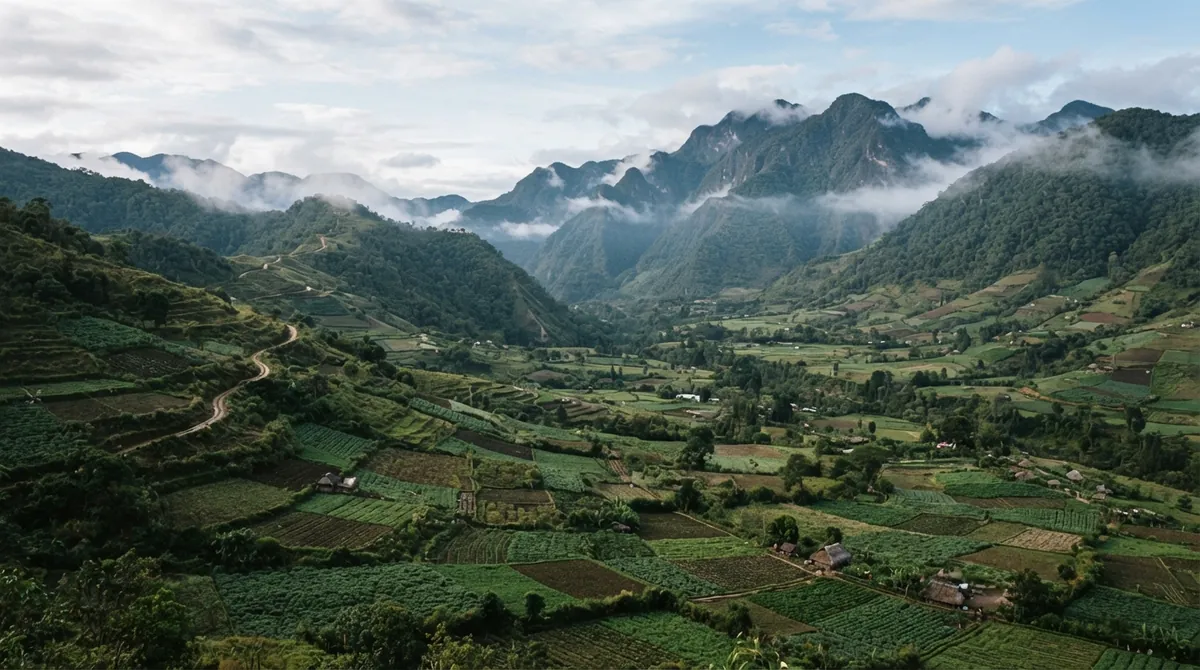
Picture a surveyor standing at the edge of a cloud-covered mountain range. The map in his hands shows jungle, rivers, and a great deal of blank space. Then the clouds lift: below are gardens, houses, paths, smoke, and thousands of people watching him back.
That image sits at the heart of the 1930s first-contact story in the New Guinea highlands. Australian gold prospectors entered valleys that colonial maps barely described and found not empty mountains, but dense communities with farms, trade networks, languages, rivalries, and long memories. The people were never missing. The outside world had a bad model.
First, separate the island from the country
Papua New Guinea is the eastern half of the island of New Guinea. The western half belongs to Indonesia and includes the regions commonly called Papua and West Papua. Those places share an island, a mountain system, and deep human histories, but they do not share the same modern borders or colonial experience. Stories about New Guinea often blur that distinction, which can make a dramatic fact sound as if it applies to the entire country.
The island itself is not one continuous jungle. A central chain of mountains runs across it, with peaks above 4,000 metres. Mount Wilhelm rises to about 4,509 metres in Papua New Guinea; across the border, Puncak Jaya reaches 4,884 metres. Between the coastal forests, swamps, and river plains are elevated basins and valleys with their own climates. From the lowlands, steep ridges and permanent cloud concealed what lay beyond them.
The blank was a failure of observation
Why were the New Guinea highlands considered unknown until the 1930s? The short answer is that maps followed the needs of the people making them. Colonial governments, mining companies, and coastal administrators had limited roads, limited survey teams, and almost no reliable way to communicate with communities beyond the mountain ranges.
In 1930, Mick Leahy and Michael Dwyer travelled inland while prospecting for gold. They entered the eastern highlands and encountered the edges of a populated landscape. Later expeditions, including Leahy’s 1933 journeys with his brother Dan, Jim Taylor, and Charles Marshall, carried European maps farther into the Wahgi Valley and around Mount Hagen. Historical estimates eventually suggested that roughly a million people lived across the wider highland region. That was not a census, but it was enough to destroy the idea that the interior was empty.
A small technical diagram captures the mistake:
no roads + no shared language + no survey = low visibility
low visibility!= no society
In systems engineering, observability means how much of an unseen system you can infer from the signals available to you. The colonial view of the highlands had poor observability. It did not reveal the valley’s population, political structures, farming systems, or knowledge of the environment. A missing signal was mistaken for a missing world.
Contact arrived with a camera—and a rifle
The photographs and film made during these expeditions are extraordinary historical records. They also need to be read carefully. The newcomers did not arrive as neutral observers. They carried guns, steel axes, cameras, gramophones, mirrors, unfamiliar clothing, and the authority of a colonial system that intended to control territory and extract resources.
A gun demonstration could look like a scientific experiment from one side and a threat from the other. In the famous footage associated with First Contact, the prospectors shot a pig to display the power of their weapons and protect their camp. Highland communities responded by watching, testing, trading, and building explanations from what they already understood. Some initially interpreted the white newcomers through ideas about ancestors or spirits. Others investigated whether these strange visitors were physically human.
That response was not foolish. It was empirical reasoning under extreme uncertainty. A mirror is mysterious until you test its relationship to movement. A gramophone is a spirit, a machine, or a trick until you learn what happens when the record stops. A rifle may seem supernatural until someone discovers its range, its ammunition, and its limits.
The encounter was also a transfer of power. Prospectors were followed by patrol officers, police, missionaries, and administrators. Roads and airstrips connected the highlands to the colonial economy. The territory later became the independent state of Papua New Guinea, but the first contact period was not a charming meeting between equal explorers. It was the beginning of rapid political and economic change imposed on communities that had not asked for it.
An old society, not a frozen one
The phrase “stone age tribe” has survived in old accounts because it was convenient for outsiders. It is also deeply misleading. The absence of steel does not mean the absence of technology. A carefully managed garden, a drainage system, a ritual exchange network, or a detailed understanding of mountain soils is technology too.
At the Kuk Early Agricultural Site in the Western Highlands, archaeologists have found evidence of cultivation and wetland management reaching back thousands of years. Some features are dated to roughly 7,000 years ago, while older drainage evidence has been debated around 9,000 to 10,000 years. The exact dates matter to archaeologists, but the larger point is plain: the highlands were not waiting for agriculture to arrive with Europeans.
Papua New Guinea also contains more than 800 known Indigenous languages, making it one of the clearest examples of how geography and history can produce extraordinary language diversity. Mountains helped separate communities, but they did not seal them off completely. People traded, married, fought, migrated, and exchanged ideas across valleys. Isolation was never absolute; it was uneven and constantly negotiated.
Sensational facts need a smaller frame
Genetics adds another layer to the story. Papuan and other Melanesian populations carry several percent Denisovan-related ancestry. Denisovans were an extinct human population known mostly through DNA and a small number of fossils. Early studies estimated around 4 to 6 percent in some populations, while later datasets often produced lower figures. The variation is a reminder that ancestry percentages are statistical models, not fixed labels stamped onto every person.
The result tells us about ancient migration and interbreeding. It does not support claims that one modern population is inherently smarter than another. The same care is needed with kuru, a fatal prion disease, meaning an illness caused by misfolded proteins. Kuru affected the Fore and neighbouring communities in the Eastern Highlands and spread through specific mortuary practices involving the deceased. It was not a national custom shared by all Papua New Guineans, and its history is better understood as a meeting point between culture, disease, and natural selection than as an exotic horror story.
The lesson for anyone who works with data
Maps are models. A model is a simplified representation of reality, useful precisely because it leaves things out. The danger begins when we forget what it omitted. A map designed for shipping will make mountains look irrelevant. A database built around roads will undercount people who live beyond roads. A dashboard with no sensor in a valley will report no events there, even while life continues below the cloud line.
That is why the New Guinea highlands remain so haunting. The central mystery is not how a million people could live beyond the edge of someone else’s knowledge. It is how easily outsiders converted their own lack of information into a theory about human absence.
The blank space was never empty. It was full of people, and the map had failed to notice.
Comments (0)
No comments yet. Be the first to respond!
Leave a Comment
Your comment will be visible after review.