The Commodore 64 at 44: Why 64 KB Mattered
 by ahsan
September 02, 2026
5 min read
by ahsan
September 02, 2026
5 min read
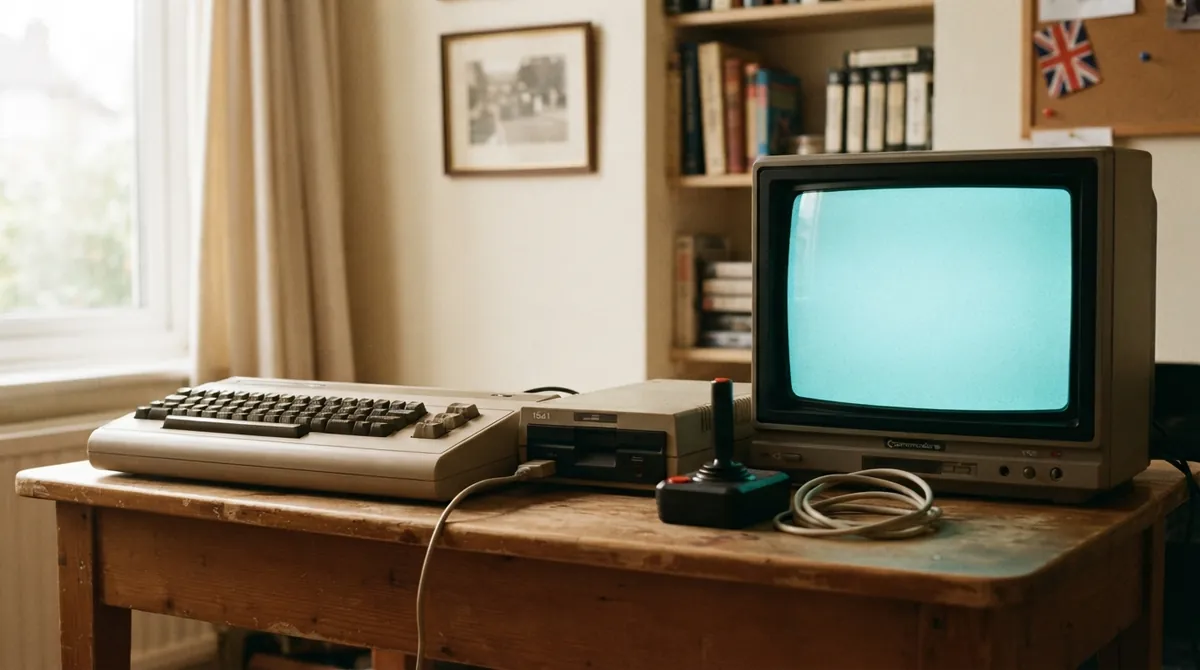
Picture a September evening in 1982. A beige keyboard sits beside the family television, its power light glowing red. You type a line of BASIC, a beginner-friendly programming language, and press Return. There is no installer, account, or app store; the computer answers at once with a blinking prompt. The Commodore 64 was a home computer, but it also felt like a game console, music box, and small electronics lab in one plastic case.
September 1, 1982 is commonly given as the C64's formal launch date. The history has a useful wrinkle: Commodore showed working prototypes at the Winter Consumer Electronics Show in Las Vegas in January 1982, large-scale shipments began in August, and contemporary launch accounts point to September 1 as the planned public release. Introduced, shipped, and available in stores were different milestones.
The launch date is a story about logistics
That distinction was not pedantry. Commodore sold through retailers, so machines had to leave the factory before a public release date. Early production also ran into quality-control trouble, and manufacturing expanded as Commodore tried to meet demand. A prototype could impress a trade-show crowd; a retail product had to survive packaging, transport, testing, and thousands of ordinary customers plugging it into televisions.
64 KB was a headline—and a puzzle
On paper, the big promise was in the name: 64 kilobytes, or about 65,536 bytes, of random-access memory (RAM). RAM is the temporary working space a computer uses while programs run; it loses its contents when the power is removed. The C64 also carried about 20 KB of read-only memory (ROM), permanent memory holding Commodore BASIC 2.0 and KERNAL, Commodore's built-in low-level system routines. A MOS 6510 central processing unit (CPU), the chip that executes instructions, ran at roughly 1 MHz.
That did not mean a BASIC program could use all 64 KB. The startup screen famously reported 38,911 BASIC bytes free because the memory map—the assignment of addresses to RAM, ROM, screen data, and input/output hardware—reserved part of the machine for other jobs. This was one of the C64's first lessons: a specification tells you what exists, not how much is available for every purpose.
A tiny program could reach directly into that map:
10 POKE 53280,0
20 POKE 53281,6
30 PRINT CHR$(147)
40 PRINT "HELLO FROM 1982"
POKE writes a number to a memory address. On the C64, addresses 53280 and 53281 control the border and background colors. CHR$(147) produces the machine's clear-screen control character. There is no graphics library hiding the hardware details here; a few typed commands change the computer's video registers directly.
The custom chips made a one-megahertz machine feel quick
The C64's real advantage was not CPU speed. It was the work performed by two custom chips, circuits designed for this particular machine.
The VIC-II handled video. It could display 40 columns by 25 lines of text, a 320×200 high-resolution picture, or a 160×200 multicolor picture, using a 16-color palette. It also offered eight hardware sprites. A sprite is a movable graphic object—often a player, enemy, or ball—that the video chip can draw without the CPU rewriting every pixel.
The SID, short for Sound Interface Device, gave the computer its famous voice. The original 6581 SID provided three independent sound voices, several basic waveforms, programmable volume changes, and a filter. A waveform is the repeating shape that gives a sound its basic tone. The volume changes form an envelope, controlling how a note begins, fades, and ends. Those controls gave programmers far more expressive sound than the simple beeps common on many competing machines.
Programmers eventually learned to change VIC-II registers while the screen was being drawn. A raster interrupt is a signal generated when the video beam reaches a chosen horizontal line. By changing colors or display modes between lines, software could create split screens, richer borders, and more sprites than a static reading of the specifications suggested. The timing was genuinely tricky, but that difficulty became part of the machine's appeal.
Why did the C64 last so long?
The initial $595 price was not pocket change, but Commodore soon pushed the price down and sold through ordinary retail channels, not only specialist computer shops. The C64 also followed the VIC-20, a cheaper color computer that had already introduced many families to home computing. Commodore had learned how to make a computer feel approachable before the C64 arrived with much stronger graphics and sound.
Then came the software feedback loop. The more machines that entered homes, the more worthwhile it became for publishers to create games and applications. The more software appeared, the easier it was to justify buying the same computer. Cartridges, cassette storage, floppy disks, joysticks, printers, and modems turned the C64 into a platform rather than a single-purpose appliance.
Like any successful product, it had flaws. Commodore BASIC 2.0 did not provide convenient commands that hid the details of drawing graphics or controlling sound, so beginners often encountered POKE before they understood why it worked. The 1541 floppy disk drive was notoriously slow, and early hardware quality problems gave some owners a rough first experience. Those weaknesses also created a culture of magazines, utility programs, fast loaders, and carefully optimized code.
Why did the Commodore 64 last so long when faster computers arrived? Its large installed base—the number of machines already in homes—gave developers a reason to keep supporting it. Modern analyses often place lifetime sales around 12.5 million, while older claims are higher. Whatever total one accepts, the machine clearly sold far beyond its expected three-year life and remained available into the early 1990s.
The lesson hidden in the blue screen
For many owners, the C64 was a first computer that did not feel sealed shut. You could begin with PRINT, discover POKE, and then move toward machine language—the CPU's own instructions. A byte written to one address changed the border; a few bytes arranged differently became a character; a carefully timed interrupt changed the look of an entire screen.
That is the enduring value of retro computing. The C64 does not matter because 64 KB can compete with modern memory sizes. It matters because its limits were visible, and those limits invited experimentation.
September 1, 1982 marked more than a product release. It marked a particular idea of a computer: affordable enough to enter a living room, open enough to encourage tinkering, and carefully engineered enough to make 64 KB feel much larger than it was. The C64 lasted because millions of people learned how to work with its boundaries—and discovered that the boundaries could move.
Comments (0)
No comments yet. Be the first to respond!
Leave a Comment
Your comment will be visible after review.