The Hidden System Behind Waymo’s Transit Rewards
 by ahsan
September 23, 2026
5 min read
by ahsan
September 23, 2026
5 min read
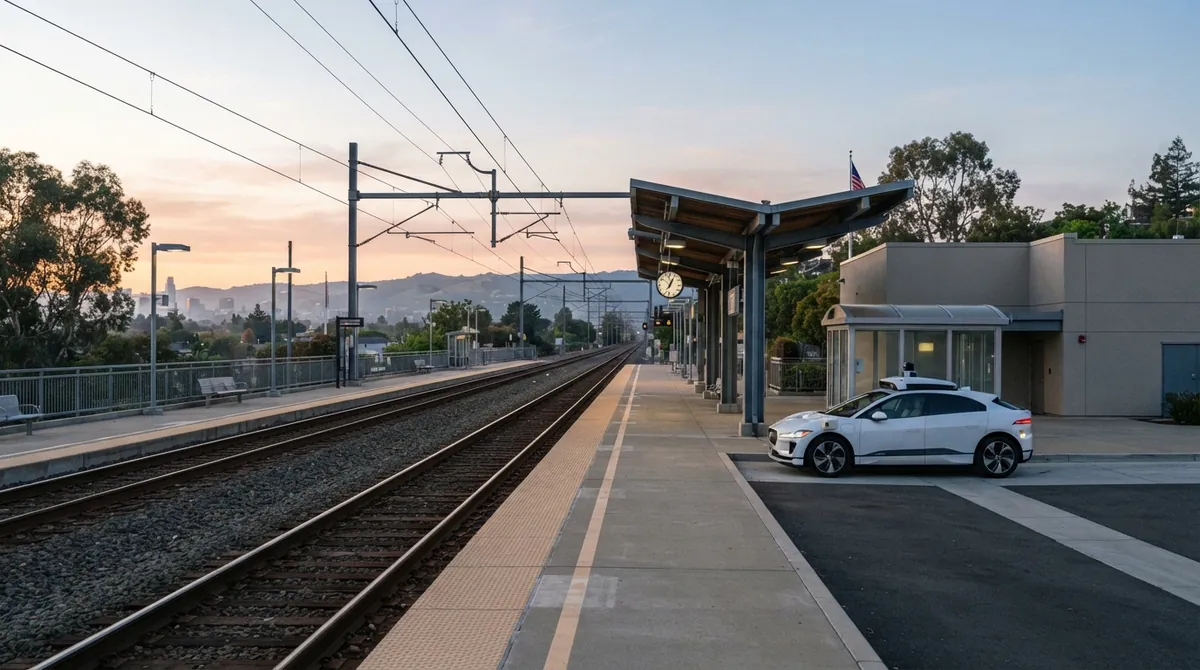
The part of a commute that usually feels disconnected
Picture a weekday trip across the San Francisco Bay Area: an on-demand ride from a neighborhood street to a station, followed by a bus or train across the region. This is a multimodal trip, meaning one journey that uses more than one type of transportation. The difficult part is rarely the map; it is the handoff. One company knows about the car ride, a transit agency knows about the tap, and the rider is left to connect those dots.
On September 22, 2026, Waymo announced a transit rewards program designed to connect those two records. Waymo uses autonomous vehicles, meaning vehicles whose driving systems handle the route without a human driver at the wheel, for app-based rides in the Bay Area. The program begins with employees and is expected to expand to the public in the following weeks. (waymo.com)
What the reward actually does
The rule is concrete. A rider links a Visa card in the Waymo app, uses that card for a Waymo trip and a public-transit trip in the San Francisco Bay Area within two hours of each other, and receives $2.85 in Waymo Cash automatically. The credit is issued through Waymo rather than deducted at the transit reader, so the program rewards the connection instead of changing the transit fare itself. Waymo says the offer covers 27 Bay Area transit agencies that accept contactless Visa tap-to-pay.
The $2.85 amount has a local meaning. San Francisco Municipal Transportation Agency lists $2.85 as the adult single-ride fare when paying with Clipper, MuniMobile, or a credit or debit card. That fare is valid for 120 minutes of travel on Muni, while Waymo’s separate two-hour window determines whether the rider qualifies for the reward. The matching time happens to line up with a familiar transit fare, but the two policies are not the same thing. (sfmta.com)
Why contactless payment is the bridge
The program depends on open payment, a fare system that lets riders pay directly with a bank card or mobile wallet instead of requiring a dedicated transit card. The Bay Area has been moving toward this model through the next generation of Clipper, with contactless cards and mobile wallets becoming part of the regional payment infrastructure. MTC described BART’s contactless bank-card launch as the first step in that wider transition, while Caltrain’s updated system accepts contactless Visa, Mastercard, American Express, and Discover cards. (mtc.ca.gov)
That convenience comes with details that matter to the reward system. Clipper’s guidance says each rider needs an individual card or device, and riders must use the same payment method when a trip requires tapping on and off. A physical card, a phone wallet, and a smartwatch may not be interchangeable for one journey. Contactless bank-card payments also use adult fares; youth, senior, disability, and income-qualified discounts require their corresponding Clipper programs. (clippercard.com)
Under the hood: matching two events
The announcement describes the rider experience, not Waymo’s private service architecture. Still, the eligibility rule can be pictured with a small piece of pseudocode:
if bay_area(waymo_ride) and
 same_card(waymo_ride, transit_tap) and
 time_between(waymo_ride, transit_tap) <= 2 hours:
 issue_waymo_cash(2.85)
Here, an event is a timestamped record produced by a system, such as a completed ride or a transit tap. The hard part is deciding what counts as the same card and when a transit event is final. Payment systems often use a token, a substitute identifier for a card, rather than sharing the full card number with every company. A production integration must also handle delayed fare settlement, duplicate taps, a ride that happens before the train trip, and a rider who switches from a physical card to a phone halfway through the journey.
Those edge cases explain why the employee-first rollout is more than a publicity sequence. It gives Waymo a controlled way to observe real payment combinations and correct confusing cases before the program reaches a much larger audience. The reward sounds like one condition, but the supporting system has to reconcile records from different organizations without exposing more payment information than necessary. (waymo.com)
Caltrain adds a physical connection
Software cannot remove the awkward walk between a drop-off point and a station entrance. Waymo’s Caltrain partnership addresses that physical gap by leasing 40 dedicated station parking spaces where vehicles can be staged. Staging means positioning vehicles near a predictable pickup point so they can serve riders without first traveling in from somewhere else.
Caltrain is a useful test case because its payment flow already supports contactless cards and mobile wallets, with riders tapping before boarding and tapping off at their destination. That creates a clearer digital trail for a system trying to recognize a station connection. The parking spaces, in turn, give the integration a physical presence: the partnership is not only a discount rule inside an app, but also an attempt to make the transfer itself work better. (caltrain.com)
From small pilots to a broader product
Waymo has been approaching this in stages. In October 2024, a San Francisco and Peninsula pilot offered $3 credits for rides connected to eight selected transit stations. In February 2025, an Los Angeles pilot offered $3 credits for connections to eight eligible transit stations, with the credit arriving the following day and applying to later Waymo rides. The new Bay Area program changes the unit of measurement from a short list of stations to a payment-and-time relationship between two transportation systems.
Waymo also says more than half of its riders in its mature San Francisco, Los Angeles, and Phoenix service areas use public transit, based on recent company surveys. That figure helps explain the product strategy: the autonomous ride is not always intended to replace the train or bus. It can cover the first or last mile, the short segment between a home or workplace and a transit station, where fixed routes may be less convenient.
The limits are part of the design
Transit rewards is not a universal transit subsidy. A rider must be in the eligible Bay Area service, link a Visa card, use the same card for both parts of the journey, and connect to an agency that supports the qualifying contactless payment flow. Riders who rely on discounted fare programs may also need to keep using their Clipper discount cards, since contactless bank-card payments generally charge the adult fare.
That makes the program most interesting as a piece of transportation software. Its value comes from coordinating payment identity, time, location, vehicle availability, and transit infrastructure without asking the rider to understand every back-end boundary. The broader idea is modest but useful: let high-capacity public transit handle the long middle of a trip, then use an autonomous vehicle to make the station connection less burdensome. A $2.85 reward is the visible part. The deeper experiment is whether separate mobility systems can behave like parts of one journey.
Comments (0)
No comments yet. Be the first to respond!
Leave a Comment
Your comment will be visible after review.