Total Annihilation, Rebuilt for Modern Computers
 by ahsan
October 11, 2026
5 min read
by ahsan
October 11, 2026
5 min read
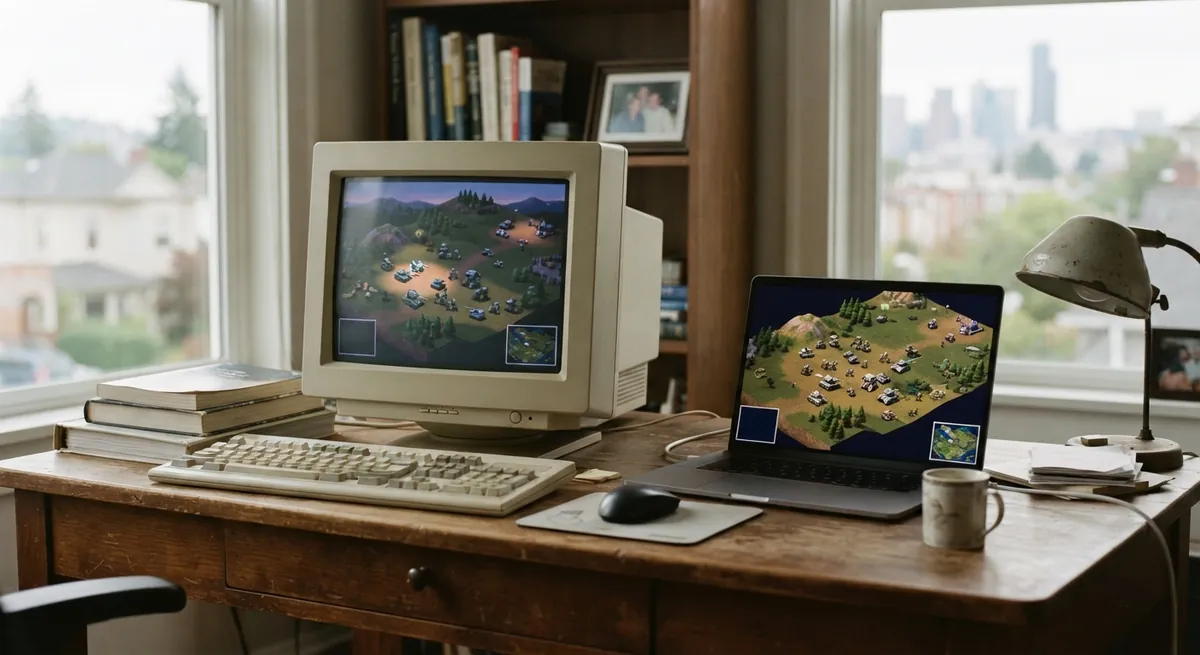
Booting a late-1990s real-time strategy game on a modern laptop can feel like opening a time capsule. The battlefield is still exciting, but the software around it was built for fixed resolutions, older graphics interfaces, and file paths that modern operating systems no longer treat as ordinary. Nanolathe takes a more ambitious route than adding a compatibility patch: it rebuilds the engine—the program that simulates units, reads game data, accepts orders, and draws each frame—while keeping the original content separate.
Can you play Total Annihilation on a modern computer without sanding away its personality? Nanolathe’s answer is an open-source 2.5D real-time strategy engine written in Go, a compiled programming language. Here, 2.5D means three-dimensional unit models and depth placed on a mostly flat, isometric battlefield. A clean-room reimplementation is an independently written version based on observation, tests, and documented behavior rather than copied source code. That makes this project less like a texture pack and more like a replacement machine built around the same old records. (github.com)
The hard part isn’t making it launch
Launching an old game is not the same as reproducing it. A large strategy game is a mesh of small rules: how a constructor chooses a target, when metal arrives, how a projectile finds a unit, how a scripted animation changes a turret, and which wreck appears after an explosion. Change one timing rule and a familiar battle can start to feel wrong even when every model and sound is untouched.
That is why the engine matters more than the window that contains it. Nanolathe’s documentation separates file formats, runtime behavior, interface rules, units, movement, economy, weapons, saves, and replay systems. The goal is not to make a new game that resembles Total Annihilation from a distance. It is to preserve the little interactions that make a base feel alive. (nanolathe.gg)
A renderer that changes the mood, not the battle
A renderer is the part of a game that turns world state into pixels. Nanolathe keeps a Classic CPU renderer—the older, software-oriented drawing path—and a Modern GPU renderer, which uses the graphics processing unit to draw many visual elements in parallel. Switch between them and the simulation should remain the same: if a Jeffy detonates beside a Bulldog on a particular simulation tick, the event is still that event. The modern path changes how the moment reaches your eyes, adding lighting, glow, smoother edges, and a closer camera.
The visual work is more thoughtful than enlarging old pixels. At close range, Nanolathe can synthesize 64×64 terrain tiles from the original 32×32 artwork and build 2× feature sprites locally from installed game data. Anti-aliasing—smoothing jagged diagonal edges—renders model subjects at twice the resolution in each direction before resolving them into the final image. Pull back across the map and the interface shifts toward readable team-colored strategic icons instead of tiny silhouettes.
That separation is the key design choice. The simulation decides what happened; the renderer decides how much atmosphere the explosion carries. It lets a preservation project improve lighting and clarity without quietly rewriting the rules underneath.
The old files are part of the architecture
Full-game play does not arrive as a bundle of replacement assets. The browser demo includes the original three-mission demo, while the native beta reads the Total Annihilation files from a copy you already own. Nanolathe’s code is MIT licensed—a permissive software license that allows people to study, modify, and redistribute code under its conditions—but that license does not transfer ownership of the original art, music, or other game content.
That arrangement also makes the technical work visible. An HPI archive, for example, is a container that groups many files into one game-data package. The project’s reference library currently documents 15 Total Annihilation formats, including archives, 3D models, compiled unit scripts, terrain, interface files, palettes, maps, audio, and video. For a beginner, that list explains why this is not a weekend exercise in loading a few sprites: the original game is a small ecosystem of formats with rules about how those pieces fit together.
How do you rebuild behavior you cannot read?
Clean-room research sounds formal, but the working method is wonderfully concrete. The project describes using video captures, decoded community recordings, generated test data, and controlled geometry inside the original executable. A test scene with a few shapes and carefully chosen colors can reveal how shading, depth, or orientation works more clearly than a normal battle ever could. The documentation keeps evidence labels such as Established, Supported inference, and Unknown, so an unanswered question stays visible instead of being disguised as a confident guess.
This matters because old games are full of behavior nobody wrote down. A unit script may depend on a timing detail that players only notice after thousands of battles. A save file may preserve more state than its name suggests. A replay may be a record of synchronized traffic rather than a neat list of player commands. Treating those details as evidence turns reverse engineering into a research notebook, not a pile of lucky approximations.
From browser demo to native battlefield
The public beta gives the project two entry points. A desktop browser can run the three-mission demo without a game folder; the native build targets Windows, macOS, and Linux and is meant for larger battles with your own data. Developers can also build the engine from source. The current repository documents a Go 1.27.1-or-newer toolchain and a short command-line path.
git clone github.com/nanolathe-gg/nanolathe.git
cd nanolathe
go build -o nanolathe./cmd/nanolathe
./nanolathe
That route is useful even if you never plan to change the code. It shows the project’s boundary clearly: the engine is open, the original game data is supplied separately, and the launcher remembers which installation to use. The same openness extends to play. Current builds support online skirmishes for 2–10 players and Survival games for 2–3, with room codes, computer players, chat, alliances, and replay files; each player still needs their own game files. (nanolathe.gg)
As a beta, it still has rough edges. Compatibility varies by mission or content pack, save compatibility is being refined, and reconnection after a dropped connection remains a future piece. That honesty is part of the appeal: the project presents what is implemented, what is inferred, and what is missing instead of pretending the rebuild is finished.
Why this matters beyond one classic
Preserving Total Annihilation is the immediate story, but the open engine gives the work a longer life. Once the simulation, data readers, renderer, and documentation are available to inspect, the result can become a modding platform, a teaching example, or the foundation for a different real-time strategy game. The MIT license makes that kind of reuse possible for the code, while the separate asset terms keep the line between engine and original game clear.
That is the clever part of Nanolathe. It does not ask you to choose between nostalgia and modern hardware. You can keep the old rules, use the files you already own, switch back to the classic look, and then zoom into an explosion with new light on the armor. The battlefield stays recognizable because the project treats fidelity as the foundation—not the ceiling.
Comments (0)
No comments yet. Be the first to respond!
Leave a Comment
Your comment will be visible after review.