What Claude’s Nine-Loop Physics Result Really Means
 by ahsan
September 25, 2026
6 min read
by ahsan
September 25, 2026
6 min read
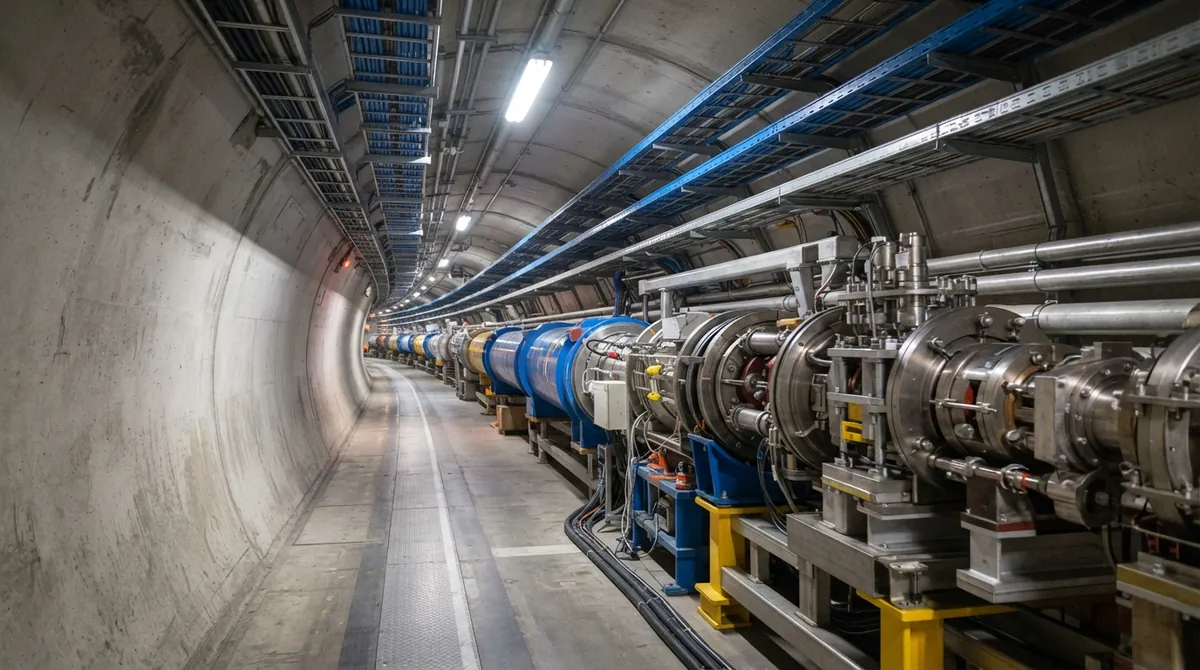
Picture a research computer left running overnight on a calculation that physicists had considered too cumbersome for a small academic project. By the next day, the machine has not produced a vague suggestion or a plausible-looking paragraph. It has assembled a candidate for a nine-loop particle-physics amplitude, checked it through two different routes, and handed the result to an expert for validation.
That is what happened in September 2026, when Anthropic researchers used Claude Fable 5.1 to compute the six-particle maximally helicity-violating amplitude in planar N=4 super Yang-Mills theory. The achievement sounds forbidding, so let’s unpack what the calculation involved—and what it does not prove about artificial intelligence. (anthropic.com)
First, what does a loop mean?
A scattering amplitude is a mathematical quantity that helps physicists calculate the likelihood of one set of particles turning into another. It is not itself a percentage. Instead, it is an ingredient in the larger calculation that connects a theory of particles with measurements from experiments such as the Large Hadron Collider.
Quantum field theory—the framework physicists use to describe particles and forces—builds these predictions in layers. The first layer is the simplest interaction. Higher layers include increasingly complicated virtual processes, represented by diagrams called loops. A loop is not a tiny track that a particle physically travels around; it is a mathematical integration over internal momenta in the calculation.
Each extra loop usually means more variables, more special functions, and more opportunities for a small bookkeeping error to ruin the answer. Physicists therefore often work order by order, stopping when the next correction becomes too expensive to calculate. Nine loops is a long way from the low-order calculations that dominate ordinary practice.
Why use an unrealistic theory?
N=4 super Yang-Mills is not a hidden description of the particles in your kitchen. Yang-Mills theory is the mathematical pattern behind the force theories in the Standard Model, the current framework for known elementary particles. Supersymmetry proposes a relationship between matter fields and force fields, giving each type of particle a richer set of mathematical partners. The N=4 version has an especially large amount of symmetry, which makes it unrealistic but unusually orderly.
That order is useful. Researchers can test ideas in this toy theory before carrying them into messier calculations involving the particles found in nature. The word planar refers to a simplified, leading-color limit in which the important diagrammatic structures can be organized as though they were drawn on a plane without crossings. The target was a six-gluon amplitude in the MHV, or maximally helicity-violating, configuration—a particular arrangement of the particles’ spin directions. (arxiv.org)
The bootstrap turns a huge search into a narrowing one
The calculation used a technique called a bootstrap. Here, bootstrap does not mean starting a company with no funding. It means describing the answer’s possible shape, then eliminating candidates until the surviving expression is forced by the evidence.
Imagine a Sudoku grid before any numbers have been filled in. The grid contains many possibilities, but each rule removes some of them. A scattering-amplitude bootstrap works in a similar way. Physicists first choose a carefully restricted space of allowed mathematical functions. They encode the functions using a specialized alphabet, where each letter represents a possible logarithmic building block. A compact object called a symbol records much of the nested structure without writing out the entire function in its most cumbersome form.
Then the constraints arrive. Symmetries remove possibilities. Limits where particles become nearly aligned remove more. Relations to lower-loop calculations remove still more. The extended Steinmann conditions impose rules on which discontinuities can appear next to one another. By nine loops, the candidate space is enormous—but it is not arbitrary, which is why a systematic search can succeed.
Claude’s role was closer to an overnight research programmer
The Anthropic team ran Fable 5.1 inside Claude Science, a scientific harness: software that gives a language model structured prompts, tools, persistent workspaces, and ways to run code. Claude received the goal of computing the nine-loop amplitude, wrote and repaired Python code, and continued working while its human operators were unavailable.
The direct bootstrap used the Python library SymPy and ran for about a week on 96 CPUs. A CPU, or central processing unit, is a general-purpose processor; the rough scale here was 96 processors working for seven days. Anthropic estimated that the full effort would cost an end user roughly $1,000 to $2,000, with the direct bootstrap consuming about $100 of that budget. Those numbers make the result striking: the computation was substantial, but not an exotic supercomputer project.
Claude also used a second route. A form factor is related to an amplitude, but it describes a process involving an inserted operator rather than ordinary particle scattering. Earlier human work had uncovered an antipodal duality—a surprising mathematical correspondence—between the form factor and a restricted version of the six-particle amplitude. Claude used that relationship as an independent path to the same destination.
How can an AI solve a nine-loop amplitude without inventing a new theory? In this case, it followed a detailed recipe that human researchers had built over years, then supplied persistence, code generation, and enough compute to carry the recipe through its fragile middle steps. (smsharma.io)
Verification mattered more than the headline
A giant output file is not automatically a scientific result. The computation had to survive checks that did not depend on trusting Claude’s explanation. Lance Dixon, one of the physicists who developed the surrounding methods, independently validated the nine-loop result. The released materials include multiple computer-readable representations, a separate direct bootstrap, comparisons between representations, and calculations performed modulo large primes before reconstructing exact fractional coefficients.
That last technique is a practical piece of computational physics. Huge exact integers can become unwieldy, so researchers temporarily perform arithmetic using several large prime moduli. If the independent modular results agree, they can reconstruct the exact rational number. It is a little like checking a long calculation on several different calculators, except the calculators use carefully chosen number systems. The public release describing the result is dated September 16, 2026.
So, did Claude discover new physics?
Not this time. Claude did not invent the bootstrap, the function space, or the antipodal duality. It used known methods, conventional scientific software, and more computing time than researchers had previously devoted to this particular step. A separate human-led group also reported substantial progress with AI assistance.
That caveat does not make the result trivial. These calculations are famously brittle. A mislabeled variable, an incomplete boundary condition, or a small mistake in a symbolic transformation can send a week of computation into a ditch. The important change is that an AI system managed a long chain of code, algebra, tests, and recovery steps with little outside intervention.
The lesson is narrower—and more useful—than saying machines now understand theoretical physics. Some research barriers that look fundamental may actually be a mixture of underused software engineering, available but inconvenient compute, and tedious coordination. For problems with clear constraints and strong automated checks, an AI research agent can push farther than a human working alone.
That does not make every scientific problem AI-friendly. A bootstrap has a defined target and many ways to test failure. Questions about which theory nature uses, or which experiment should be built next, are much less tidy. Still, the nine-loop calculation moves the boundary. The future frontier may depend less on whether a model can write down a clever idea and more on whether it can carry a complicated idea all the way to a result that other experts can check.
Comments (0)
No comments yet. Be the first to respond!
Leave a Comment
Your comment will be visible after review.