When Everyone Gets a Frontier AI
 by ahsan
September 01, 2026
6 min read
by ahsan
September 01, 2026
6 min read
The future arrives as a utility
Imagine waking up in 2040 with a broken irrigation pump and no nearby specialist. You describe the noise in your own language, hold up a phone, and receive a diagnosis, a parts list, and a repair sequence adapted to the tools available in your village.
What happens when everyone has access to a frontier AI? The answer is not 8 billion enormous graphics cards humming in bedrooms. It is a world where computing is routed, compressed, and shared so efficiently that each person experiences something close to a dedicated machine.
That is the interesting part of the GPU World thought experiment. Model capability freezes on September 1, 2026, but hardware and software continue improving until frontier artificial intelligence becomes cheap and widely available. A GPU, or graphics processing unit, is a processor built to perform many mathematical operations in parallel. Those operations are exactly what modern AI systems need.
A large language model, or LLM, is software trained on enormous collections of text and other data so it can generate language, code, and structured answers. A frontier model is one of the strongest generally capable models available at a particular time. Give every person access to one, and the transformation comes less from a sudden burst of intelligence than from removing the waiting line.
A B300 is a yardstick, not a home appliance
The B300 is a useful reference point because it represents the kind of accelerator built for demanding AI work. As of September 1, 2026, NVIDIA’s Blackwell Ultra systems are no longer a purely speculative product category. A DGX B300 system combines eight B300 GPUs, more than two terabytes of high-bandwidth memory, and a maximum power draw listed at 14.5 kilowatts. High-bandwidth memory, or HBM, is fast memory placed close to the processor so the GPU can move model data quickly.
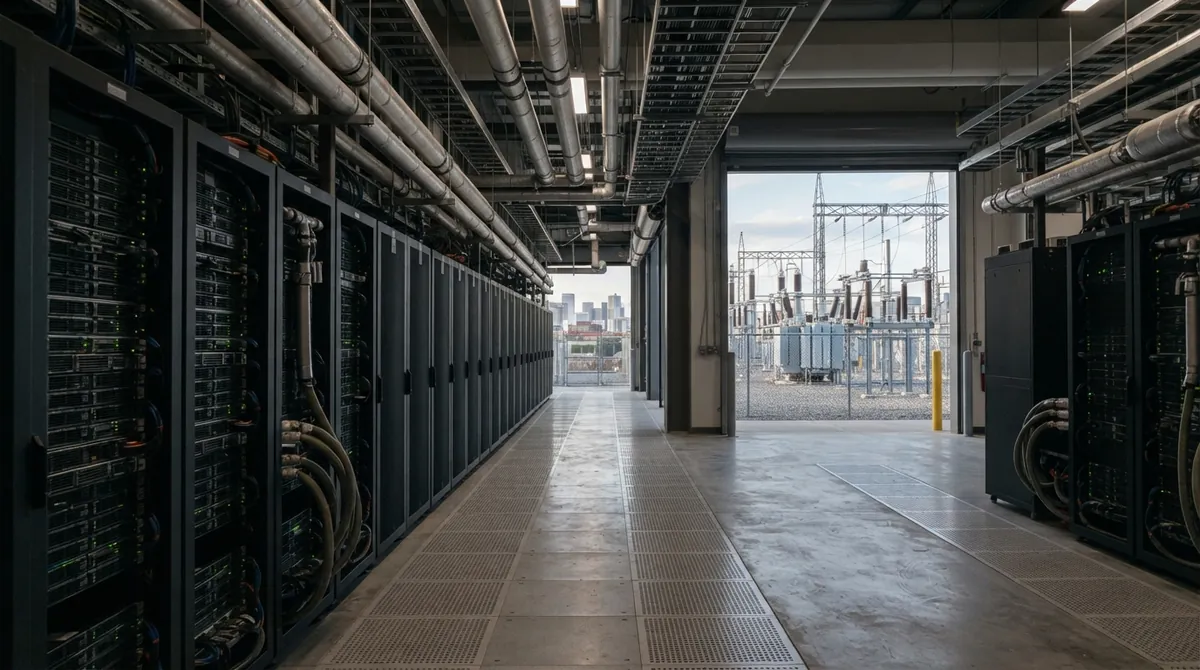
At the larger end, a GB300 NVL72 rack connects 72 GPUs with a high-speed interconnect and uses liquid cooling. The GPUs can work together as one large computing domain, which is necessary for models whose learned parameters do not fit comfortably on one chip. Parameters are the numerical values a model adjusts during training; they are the stored experience that lets it recognize patterns and produce responses.
Those specifications reveal why ‘one B300 equivalent per human’ cannot mean one permanently powered rack in every home. A literal interpretation would require roughly one billion eight-GPU systems. Running that arrangement continuously would consume about 14.5 terawatts and 127,000 terawatt-hours per year, before accounting for buildings, networking, storage, or cooling. A terawatt is a trillion watts; a terawatt-hour measures that amount of power used for one hour.
For comparison, the International Energy Agency’s 2025 base case projected total global data-center electricity consumption at about 945 terawatt-hours in 2030. The arithmetic forces a more useful interpretation: people receive access to the equivalent capacity, not a dedicated accelerator drawing full power around the clock.
The trick is scheduling
Running a trained model is called inference. Training changes the model’s parameters; inference uses the finished model to answer a request. Most people in 2040 will generate inference demand, and the system serving them will decide where each request belongs.
A scheduler can group many requests into a batch, allowing one trip through the model to serve several users. Quantization stores numbers with fewer bits, reducing memory use. Caching reuses repeated information, while speculative decoding lets a smaller model draft text that a larger model checks. Each technique saves a little time or energy. Together, they turn scarce hardware into something that feels abundant.
A rough request router might look like this:
if private_data or no_network:
 run_local_model
elif task_needs_frontier_quality:
 send_to_regional_gpu_pool
else:
 use_cached_or_smaller_model
This is not production code. It describes the shape of the future. A small model on a phone or household computer handles translation, reminders, and private notes. A regional data center handles difficult medical research, engineering, or legal analysis. A global pool absorbs unusual bursts of demand.
Latency, the delay before a response begins, will matter as much as raw intelligence. So will throughput, the amount of work a system completes over time. A slightly weaker model that answers instantly may be more useful than a stronger one that keeps millions of people waiting.
The bottleneck moves from chips to infrastructure
Once accelerators become plentiful, other constraints become impossible to ignore. Models still need memory, fast connections between chips, electricity, cooling equipment, and technicians who can replace failed parts.
Advanced packaging will matter as much as transistor counts. Packaging is the process of assembling chips, memory, and connections into one working module. Technologies such as TSMC’s CoWoS, short for Chip-on-Wafer-on-Substrate, place several components close together to improve bandwidth and reduce the energy spent moving data. At planetary scale, factories producing those packages may be as strategically important as the factories making the GPUs themselves.
Power will shape geography. Data centers may appear beside new solar fields, nuclear plants, hydroelectric projects, or transmission corridors rather than near today’s internet hubs. Liquid cooling will become ordinary for dense installations. Water availability, grid stability, transformer production, and recycling will all influence where AI capacity can grow.
This is why a future with ubiquitous AI still feels physical. Every answer has a path through silicon, memory, fiber, copper, electricity, and cooling pipes.
What people actually notice
Education changes first because tutoring is a repeated, personal task. A student can receive patient explanations in a local dialect, practice at midnight, and ask for the same concept three different ways without embarrassing themselves. Teachers do not disappear, because motivation, judgment, and relationships remain human problems, but their time can shift toward coaching and difficult cases.
Healthcare becomes more capable and more complicated. An always-available system could translate symptoms, summarize records, identify warning signs, and help a rural clinician compare treatment options. It could also sound confident while being wrong. The hard questions become institutional: who is allowed to access a patient’s data, who audits the model, and who carries responsibility when an automated recommendation causes harm?
The developing world may gain the most from systems that cross language and distance barriers. A village does not need a specialist physically present for every crop disease, customs form, or equipment failure. Yet software cannot compensate for unreliable electricity or an absent network. Offline models, local data centers, and affordable connectivity become as important as the model itself.
Surveillance grows in the opposite direction. The same cheap inference used to tutor children can analyze cameras, messages, purchases, and workplace activity. The frightening future does not require a superhuman machine. It only requires ordinary institutions to gain the ability to watch millions of people continuously and cheaply.
The mundane revolution
If model quality stops advancing dramatically after September 1, 2026, society will compete less over who has the cleverest algorithm and more over who has reliable access, trustworthy data, privacy protections, and useful software around the model.
That may be the most important lesson in this imagined GPU World. Intelligence does not need to become magical before it becomes historically powerful. A capable, tireless assistant available in every language, every school, every clinic, and every small business could reshape daily life through repetition alone.
The future arrives not as a single superintelligence, but as millions of ordinary decisions made faster, closer to home, and at a scale humanity has never managed before.
Comments (0)
No comments yet. Be the first to respond!
Leave a Comment
Your comment will be visible after review.