Xiaomi’s Xring O3 Shows Where Phone CPUs Are Heading
 by ahsan
August 24, 2026
6 min read
by ahsan
August 24, 2026
6 min read
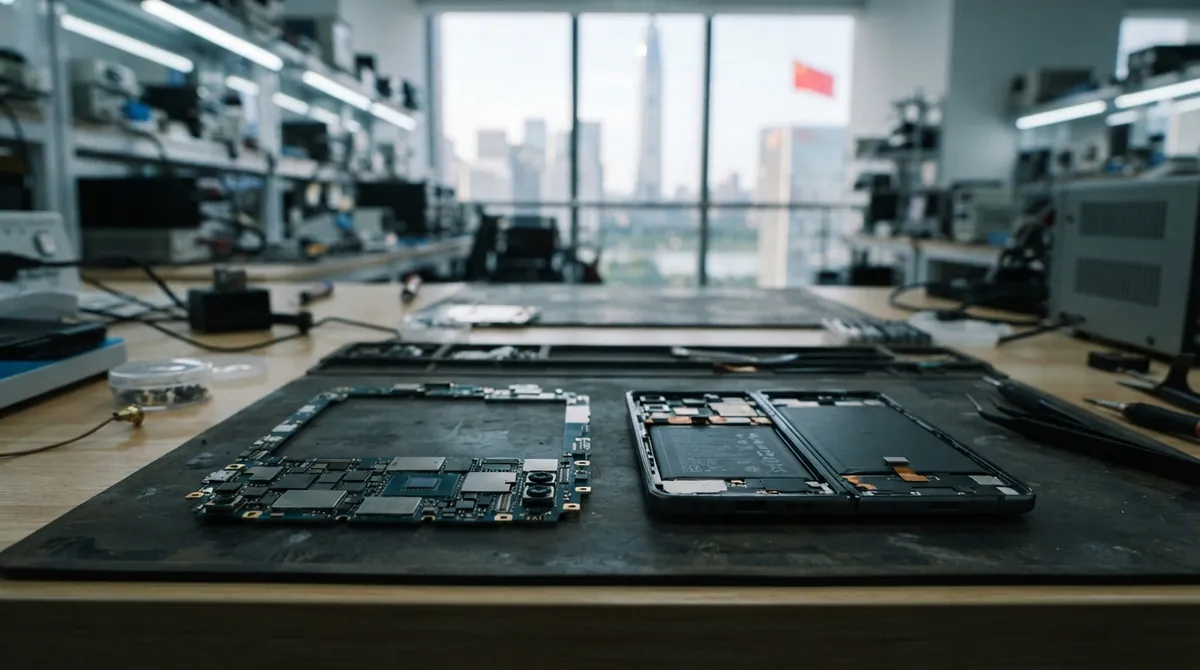
At first glance, Xiaomi’s Xring O3 looks like a benchmark story. On Monday, August 24, 2026, Xiaomi presented an Arm-based mobile system-on-chip (SoC), a package that combines processor cores and other computing blocks, with launch figures of 3,945 in Geekbench 6.5 single-core and 15,221 multi-core. Geekbench is a repeatable test suite: its single-core run stresses one thread, while its multi-core run spreads work across several cores.
Xiaomi’s numbers put the chip near Apple-class single-threaded performance and make a much bolder multi-core claim. The more durable story is architectural: wide cores, a large cache, and dedicated vector and matrix hardware. Xring O3 is slated to debut in the Xiaomi 18 Fold and Xiaomi Pad 9 Pro Max in China in September. (antutu.com)
One benchmark, two kinds of work
A thread is one sequence of instructions being carried out by a processor. A single-threaded task follows one such sequence, which makes this kind of performance important for quick, latency-sensitive work such as responding to taps, running parts of a browser, or executing a program that cannot be split into independent pieces.
A multi-threaded task divides its work among several sequences. Video encoding, photo export, software compilation, and many artificial intelligence workloads can keep multiple cores busy at once. That is why the Xring O3’s 15,221 multi-core result is so eye-catching: its published design contains ten performance-oriented cores, including two C1-Ultra cores reaching up to 4.35 GHz, four C1-Premium cores at up to 3.68 GHz, and four C1-Pro cores at up to 3.15 GHz.
The layout does not include a traditional cluster of tiny efficiency cores. Instead, the operating system scheduler, the part of the software that decides where tasks should run, gets several tiers of relatively powerful cores. That can help sustained multitasking, but ten cores never means ten times the speed. Threads still need to share data, wait for one another, and compete for memory bandwidth.
The core is wide, not merely fast
Clock speed tells you how many cycles a core can perform each second. It does not tell you how much useful work the core can complete in one cycle. Modern processors use out-of-order execution, which means they look ahead for independent operations and work on them in a productive order instead of waiting for every instruction to finish in sequence.
Execution ports are the pathways that send those operations to different functional units, such as integer arithmetic, floating-point math, loads, and stores. The architecture discussion around the C1-Ultra describes a remarkably wide design with 21 execution ports, including six paths capable of 128-bit SIMD work. SIMD, or Single Instruction Multiple Data, lets one instruction operate on several values packed together. (developer.arm.com)
Consider this ordinary C loop:
for (size_t i = 0; i < n; ++i) {
 out[i] = a[i] + b[i];
}
A scalar processor might add one pair of numbers at a time. A 128-bit vector can hold four 32-bit numbers, allowing a vector instruction to perform four additions together when the data is independent and the compiler can safely transform the loop. A wide execution engine gives the processor more places to perform that work in parallel.
There is an important limit, though. Twenty-one ports do not mean every program completes 21 instructions per cycle. A calculation may depend on the result of an earlier calculation. The needed data may miss the cache, a branch may be predicted incorrectly, or the program may spend most of its time waiting on the operating system. Width raises the ceiling; it does not remove every bottleneck.
Cache changes the trip to memory
Why does a phone CPU need 44 MB of cache? Cache is a small amount of very fast memory placed close to the processor. It stores recently used instructions and data so the core does not have to travel all the way out to slower main memory for every value.
Processors normally arrange cache in levels. L1 is tiny and extremely close to a core. L2 is larger, while L3 or a system-level cache can be shared across a group of cores. The Xring O3’s reported 44 MB CPU-side cache is substantial for a phone, although raw cache totals are not a perfect way to compare different architectures because vendors count levels differently. (antutu.com)
Large cache helps most when a program repeatedly touches the same working set, the slice of data it is actively using. Image filters, database-like searches, game logic, and parts of an AI model can benefit from fewer trips to main memory. Cache also consumes chip area and power, and it cannot rescue an algorithm that streams through a dataset too large to reuse.
SVE2 and SME2 bring specialized arithmetic
The C1-Ultra supports SVE2, short for Scalable Vector Extension 2. SVE2 is an Arm instruction set for data-parallel work, where the same operation is repeated across an array of numbers. It can help with media processing, signal processing, cryptography, image manipulation, and other loops that contain many independent values.
SME2, the Scalable Matrix Extension 2, targets a different but related pattern: matrix arithmetic. A matrix is a rectangular arrangement of numbers, and multiplying matrices is one of the main operations inside neural networks. SME2 adds hardware support for handling groups of vectors and matrix tiles, reducing the amount of instruction-by-instruction bookkeeping needed for these workloads.
Xiaomi says the Xring O3 includes two SME2 acceleration units. That matters because on-device artificial intelligence does not always need to run on a separate neural processing unit. A CPU with flexible matrix and vector instructions can handle models, image enhancement, and other tasks while keeping response times low. Arm’s documentation describes SVE2 as scalable across different vector widths, while its SME2 guidance emphasizes matrix operations and multi-vector processing. (developer.arm.com)
A phone still has to survive the benchmark
The difficult part begins after the first impressive score. A phone is a thin, sealed device with a small battery and limited cooling area. A chip can run a core at 4.35 GHz for a short burst, but heat builds quickly when many cores are active. Thermal throttling, the deliberate reduction of clock speed to control temperature, can turn a spectacular peak result into a lower sustained one.
The Xring O3’s launch figures should therefore be treated as a performance ceiling rather than a complete description of a retail phone. Reports around the launch identify the headline results as Xiaomi testing, including a low-temperature laboratory setup, rather than a broad set of independent, sustained device measurements. A meaningful review will measure ten-minute workloads, power draw, surface temperature, battery drain, and performance after the phone becomes warm. (androidpure.com)
Software decides how much of the chip you feel
A ten-core processor is like a kitchen with ten cooks. It helps when the recipe can be divided into independent jobs; it does not help much when every step depends on the previous one. Software also has to arrange data in cache-friendly ways, use multiple threads without excessive synchronization, and call libraries that know how to use SVE2 or SME2.
Compilers can automatically vectorize straightforward loops, and machine-learning libraries can select optimized kernels at runtime. Developers do not need to write every instruction by hand. They still need to profile real applications, because once matrix multiplication becomes faster, data movement, format conversion, or an unoptimized part of the program may become the new bottleneck. Arm’s recent SME2 measurements make that trade-off visible: accelerating the math can leave memory traffic as a larger share of total runtime.
That is also why portable SVE2 code matters. Its scalable design lets software avoid hard-coding one exact vector width, which makes the same approach more useful across different Arm processors. The hardware may be ready before every app is ready to feed it.
Xring O3 matters even if its benchmark ranking changes when Apple, Qualcomm, or MediaTek release newer chips. Xiaomi is spending its transistor budget on more independent execution, more nearby data, and more flexible AI arithmetic instead of chasing clock speed alone. The next contest will not be decided by a launch-day score; it will be decided by how much of that wide silicon a real phone can keep working without overheating.
Comments (0)
No comments yet. Be the first to respond!
Leave a Comment
Your comment will be visible after review.