From “Total Eclipse” to Streaming Analytics: The Audio Engineering Behind a Pop Legend
 by ahsan
July 09, 2026
6 min read
by ahsan
July 09, 2026
6 min read
When the headlines hit, the engineering still lingers
A few minutes after the news broke that Bonnie Tyler—the gravel-voiced Welsh singer behind “Total Eclipse of the Heart”—had died at 75—after emergency intestinal surgery in Portugal—it felt weirdly natural to re-play the song in our heads. (apnews.com)
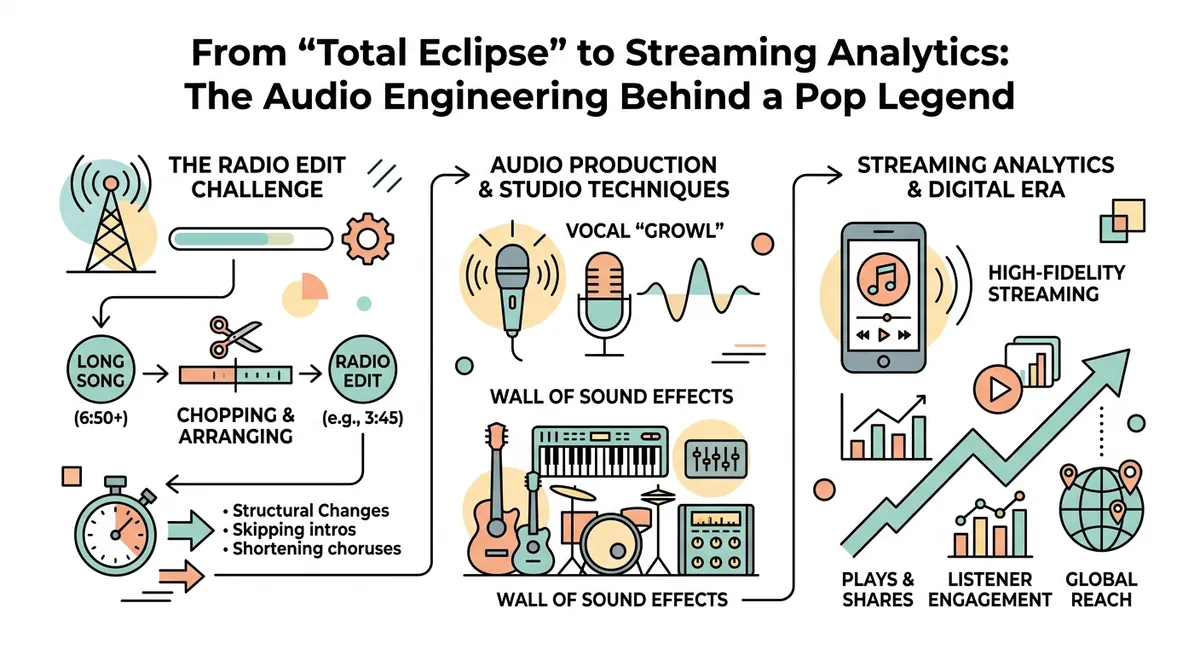
That instinct isn’t about nostalgia alone. It’s also about how much technical craft is packed into a track like this: the tempo and arrangement that build tension like a countdown, the vocal production that turns “husky” into a signature sound, and the edits that let a near-epic-length ballad survive radio playlists and, later, streaming algorithms.
So what does it actually take to turn an 8-minute power ballad into something that can live on for decades? And how do streaming platforms measure that longevity at the scale of billions? Let’s walk through the pipeline—like we’re watching a song go from studio session to global playback.
Situation: a song too big for the radio (and too dramatic to stay short)
Pop listeners often experience songs as a fixed object: you press play and it’s just “the song.” In reality, a track has to pass through editing stages that translate art into constraints.
“Total Eclipse of the Heart” is widely described as having an extended original length and then being shortened for radio play. Sources describe it as reduced to roughly a four-minute radio-friendly version from a much longer original. (en.wikipedia.org)
That shortening isn’t a random haircut. It’s closer to stage direction in a film: keep the emotional landmarks, remove dead air, and maintain the illusion that the story always belonged at this length.
Key engineering goal: preserve structure, not just duration
A power ballad like this typically depends on recognizable sections—intro, verse, pre-chorus, chorus, bridge, final chorus. When you edit length, you must preserve:
- Section order (so listeners don’t feel “lost”)
- The timing of peaks (so the biggest chorus still arrives when it should)
- Crossfade smoothness (so transitions don’t sound like cuts)
Explanation: building the radio edit with real audio tools
When people hear “radio edit,” they imagine a producer trimming the beginning and end. In practice, a good radio edit uses careful timing and sometimes crossfades—overlaps where two audio segments briefly play together so the transition feels continuous.
One common tool for this kind of work is FFmpeg, a command-line program (meaning you run it by typing commands) for manipulating audio/video.
A practical example: trim + crossfade
Below is an illustrative workflow: create a shorter edit by selecting a segment and adding a small crossfade to hide a join.
# 1) Extract the section you want (timestamps are examples)
ffmpeg -i eclipse.wav -ss 00:00:18 -to 00:04:35 -c copy radio_core.wav

# 2) Crossfade the join (example: fade last 0.5s of segment into first 0.5s of next)
# This assumes you have two parts you want to blend.
ffmpeg -i partA.wav -i partB.wav \
  -filter_complex "[0:a][1:a]acrossfade=d=0.5:c1=tri:c2=tri" \
  -c:a pcm_s16le mixed.wav

# 3) Set a consistent output format
ffmpeg -i mixed.wav -ar 48000 -ac 2 -c:a aac -b:a 192k radio_edit.m4a
What the parameters mean (in plain language)
-ssand-to: start time and end time for the extracted audio.acrossfade: overlaps the end of part A with the beginning of part B.d=0.5: fade duration (here, 0.5 seconds). The triangular curves (c1=tri:c2=tri) make the blend rise and fall smoothly.
This is audio engineering in a nutshell: it’s less about removing time and more about keeping the emotional timing intact.
Explanation: why the voice sounds “gravelly” (and how producers can engineer that effect)
A signature sound like Bonnie Tyler’s husky, gravel-leaning timbre isn’t luck. It’s a combination of performance and production.
Vocal production building blocks
The recording chain often includes:
- Microphone choice: microphones respond differently to high frequencies (brightness) and low frequencies (body).
- EQ (equalization): a tool that boosts or cuts frequency ranges. For example, engineers may reduce harshness and emphasize midrange “presence.”
- Compression: a dynamic processor that reduces volume differences so quiet breathiness and loud phrasing stay controlled.
- Saturation / analog-style distortion: a gentle “grit” that can add harmonic richness (extra overtones) and make vocals feel emotionally closer.
Key concept: formants and perceived texture
When we describe a voice as “rough,” we’re usually noticing changes in the spectrum—how energy spreads across frequencies.
Two practical ideas matter for beginners:
1. Texture lives in the mid frequencies. Boosting or shaping the right region can make a voice feel thick and close.
2. Control the peaks. Compression and leveling can prevent the roughness from turning into audible clipping (a distortion that sounds harsh and broken).
From studio craft to streaming reality
Once a song becomes an “always-on” product, engineering shifts from the studio into measurement.
Streaming analytics: what “a billion streams” actually means
When “Total Eclipse of the Heart” is described as hitting 1 billion streams on Spotify, that’s an analytics milestone produced by platform event tracking and aggregation. (yahoo.com)
Similarly, its music video surpassing 1 billion views on YouTube reflects how platforms count playback events and deduplicate repeat refreshes using proprietary rules. (bonnietyler.com)
From a technical perspective, a streaming system needs at least three capabilities:
- Event ingestion: every play generates an event.
- Identity logic: the system decides whether events count as distinct listens.
- Aggregation: events roll up into totals, charts, and “Billions Club” style badges.
A simplified data pipeline (conceptual)
Here’s the mental model most modern music platforms follow:
- Player reports an event (song_id, timestamp, user/session signals)
- Backend validates (schema checks, bot filtering heuristics)
- Deduplication & rules (prevent inflating counts)
- Write to storage (raw events for audit; curated tables for metrics)
- Aggregate (daily/monthly totals, per-region charts)
In databases, deduplication often looks like “keep the latest event per session window” or “collapse events that occur too close together.”
Why the song keeps reappearing: analytics meets real-world moments
One reason this particular track feels unusually persistent is that it links emotionally to the idea of eclipses and spectacle. That means it can resurface whenever real eclipses happen—driving measurable stream and view spikes.
AP’s reporting notes that streaming boosts were associated with real eclipses (citing 2017 and 2024 in the context of the song’s long-running streaming momentum). (apnews.com)
Technically, that’s not magic—it’s demand shaping:
- People search and press play during the moment.
- Recommendation systems detect increased velocity.
- The system reinforces what’s already trending.
DSP still matters—even years later
Even after release, “legacy hits” live inside modern digital signal processing (DSP) workflows:
- Loudness normalization so tracks sound consistent across users’ libraries.
- Codec decoding so audio reconstructs accurately from compressed formats.
- Equalization profiles that target different playback systems (phones vs. speakers).
So the same sort of engineering that helped a power ballad survive radio also helps it survive Bluetooth, earbuds, and algorithmic playlists.
Conclusion: a legend is partly art, partly engineered timing
Bonnie Tyler’s death at 75 closes a chapter, but “Total Eclipse of the Heart” keeps running because it was built like a system: a dramatic vocal character, a structure that can be edited without losing its peak moments, and production choices that translate across playback formats.
When radio edit techniques, vocal processing, and modern streaming analytics all line up, a song doesn’t just endure—it gets re-measured by each new era of technology. That’s why an eight-minute emotional storm can keep finding listeners, one play-event and one carefully shaped transition at a time.
Comments (0)
No comments yet. Be the first to respond!
Leave a Comment
Your comment will be visible after review.