FTC’s Deere Right-to-Repair Settlement Explained (Techy, Not Legalese)
 by ahsan
July 09, 2026
6 min read
by ahsan
July 09, 2026
6 min read
The moment your tractor won’t start, and the “fix” isn’t on-site
Picture this: it’s harvest season, the weather window is shrinking, and your John Deere equipment throws an error code you can’t clear. You can swap parts, check wiring, and inspect connections—but when the problem lives in software settings inside the machine, the repair becomes something more than wrench work.
That’s the core tech problem behind the FTC’s new “right to repair” settlement involving Deere & Company. It’s not a law that magically turns every broken tractor into a DIY project. Instead, it targets a specific choke point in modern agriculture equipment: the diagnostic and configuration tools—plus the software capabilities—that let repairs actually take effect.
Why does a tractor need software to be repaired? Because many repairs today involve electronic control units and configuration steps that require authorized diagnostic tooling. The settlement is intended to open that tooling to farmers and independent repair providers for certain electronic repair tasks.
What “right to repair” means in practice (for equipment, not phones)
In everyday terms, “right to repair” means owners shouldn’t be locked out of fixing what they own. Technically, for computer-controlled machines, it usually boils down to whether independent repair shops (or the owner) can:
- Identify what’s wrong (diagnosis)
- Change the machine’s electronic configuration (repair action)
- Verify the repair (fault-code clearing, test steps, and restart behavior)
For Deere equipment, the dispute centered on the fact that the most capable diagnostic and repair tooling had been made available only to authorized dealers—while customers and independent shops lacked the full software capability to handle electronic repairs.
The electronic heart of the issue: fault codes and “pairing”
Modern equipment isn’t just metal and hydraulics; it’s also packed with electronics that monitor sensors, run control logic, and enforce safety/emissions behavior.
Here are a few technical terms that matter because they show up directly in what the settlement requires Deere to make available:
Electronic fault codes (the machine’s “error messages”)
An electronic fault code is a standardized identifier reported by the equipment when a sensor or subsystem behaves outside expected limits. Clearing or resetting these codes often requires more than pulling a fuse—it can involve letting the controller confirm the fault condition is resolved.
Reprogramming and configuration changes
Reprogramming electronic components means updating how electronics behave—often by writing calibration data or software configuration back into a controller.
This is where repairs can become “software repairs.” Even if the hardware part is installed correctly, the machine may need its electronic modules updated to accept the new part’s role.
“Pairing” newly installed electronic parts
Pairing (in this context) is the process of registering a newly installed electronic component with the rest of the machine so the controllers recognize it as the intended part.
If pairing doesn’t happen, the machine can refuse to operate normally, or it may continue to report faults.
Limp mode after an emissions shutdown
Limp mode (as described in the settlement) is an emissions-related protective state where the machine limits performance after detecting an emissions fault.
Restarting properly after that kind of shutdown can require guided procedures that clear the condition and restore normal operation.
The settlement’s technical promise: “same resources as dealers”
What the FTC settlement is trying to change is access—not ownership. The key requirement is that Deere must provide farmers and independent repair providers with repair resources equivalent to those Deere provides to authorized dealers, including the relevant software capabilities.
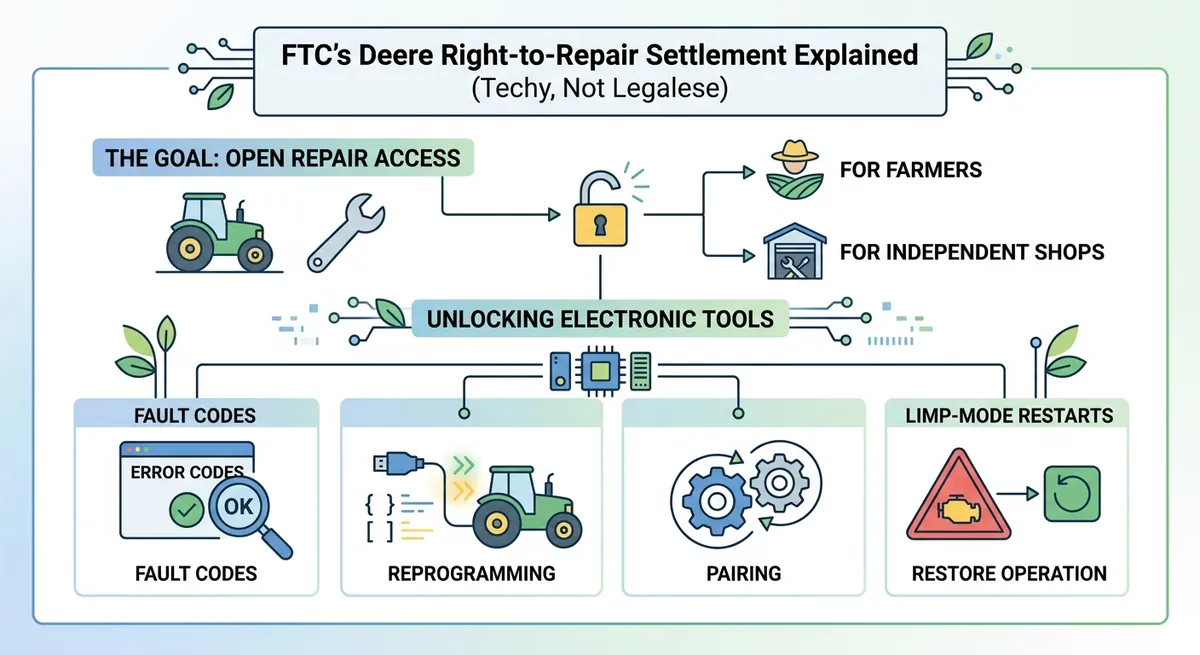
In particular, Deere is required to make available repair resources that cover tasks like:
- Reading, clearing, and resetting electronic fault codes
- Reprogramming electronic components, including pairing new parts with the equipment
- Restarting the machine following emissions-related shutdown (limp mode)
- Viewing and searching technical manuals and troubleshooting guidance (including troubleshooting solutions and related repair documentation)
That last bullet—technical manuals and troubleshooting guidance—is often where repairs become slower for independents. Access to the right steps can be the difference between guessing and following a proven procedure.
A simple demo: what a “fault code workflow” looks like
To make the idea concrete, here’s a beginner-friendly example of the kind of workflow a diagnostic tool enables. This is not Deere-specific code—just a generic model of what “reading and clearing fault codes” usually supports.
# Example: a toy fault-code workflow

FAULT_CODE_MAP = {
    "E101": "Low voltage detected",
    "E202": "Sensor calibration out of range",
    "E303": "Emissions control fault",
}

def interpret_fault(code):
    return FAULT_CODE_MAP.get(code, "Unknown fault code")

# Imagine a scan tool pulled these codes from a controller
faults = ["E202", "E303"]

for code in faults:
    print(code, "->", interpret_fault(code))

# Next steps (conceptually):
# 1) Find the troubleshooting steps in technical docs
# 2) Perform hardware repair
# 3) Reprogram/pair if a component was replaced
# 4) Clear/reset codes
# 5) Restart and verify the fault stays cleared
In the real world, the diagnostic software is what connects the dots between:
1) what the electronics reported,
2) what the manufacturer expects you to do next, and
3) how the machine confirms the repair.
The settlement targets precisely that ability to perform electronic repair steps, not only to observe error output.
“Fair and reasonable” access, plus anti-retaliation
A big question for owners and shops is: will Deere still make access inconvenient or punish attempts to repair outside dealer channels?
The settlement includes requirements aimed at addressing that:
- Access must be provided on fair and reasonable terms
- Deere must instruct authorized dealers to promote availability of the repair resources
- Dealers must not discriminate or retaliate against owners or independent repair providers for choosing to use those resources instead of dealer repair services
Think of it like getting the same keys to the same building—not just permission to look at the door.
The timeline and oversight: 10 years, strict compliance reporting
This is where right-to-repair stops being a slogan and becomes an implementation plan.
The FTC described the order as lasting 10 years, with the FTC and the plaintiff states supervising compliance through reporting and oversight requirements. The settlement also calls for future repair resources to be provided when Deere makes similar resources available to a large portion of its authorized dealer network.
In other words, the agreement is designed to keep pace with evolving electronic repair tooling rather than fixing one tool and leaving the next generation locked.
Don’t miss the bigger picture: this is part of a broader “repair lock” battle
This Deere settlement matters because it treats repair as an ecosystem problem.
Deere has also faced a separate consumer-facing class action settlement—reported as a $99 million deal announced in April 2026—which focused on compensating owners who paid for repairs and on additional injunctive relief tied to access to repair resources.
Taken together, these actions reflect a consistent theme across modern “locked repair” disputes: when the most important repair steps require manufacturer software access, repair becomes a vendor-controlled workflow.
Conclusion: the tech change is access to electronic repair capability
At the technical level, the FTC’s Deere right-to-repair settlement is about enabling electronic repairs that depend on manufacturer diagnostic and configuration tooling. It targets tasks like fault-code handling, component reprogramming, pairing new electronic parts, and restoring operation after emissions-related limp mode—plus access to the manuals and troubleshooting guidance that make those steps repeatable.
For beginners, the key takeaway is simple: tractors and other equipment today run on electronics, and many “repairs” are really electronic diagnosis and configuration steps. This settlement aims to ensure owners and independent repair providers can perform those steps using equivalent resources, not only authorized dealer workflows.
Comments (0)
No comments yet. Be the first to respond!
Leave a Comment
Your comment will be visible after review.