GPT-5.6: Tokens, Ultra Agents, and Programmatic Tool Calling
 by ahsan
July 09, 2026
8 min read
by ahsan
July 09, 2026
8 min read
The moment your “helper” has to become an operator
Picture this: you’re mid-incident—an app is failing, a deadline is looming, and the fix isn’t one clean step. You need to read logs, search documentation, modify code, run checks, and summarize what you found for everyone else. Most chat experiences stop at “here’s an idea.” But modern engineering work often requires an actual workflow: repeated tool use, careful sequencing, and fewer wasted cycles.
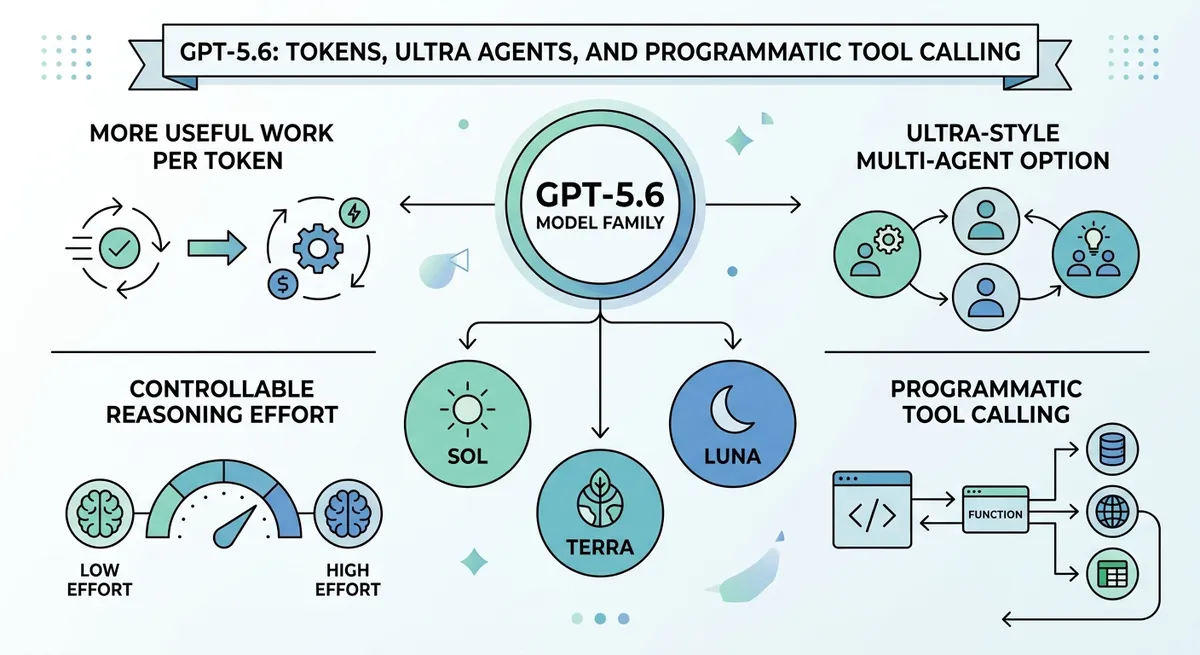
That’s the story behind GPT‑5.6: a model family designed to produce more useful work per token, while giving you a path from “efficient by default” up to “maximum performance on demand.” And the key shift isn’t only model size—it’s how the model coordinates reasoning, tools, and parallel work.
In plain terms, what does “more intelligence from every token” mean in practice? It means GPT‑5.6 tries to reach the same (or better) result using fewer model round trips and less intermediate clutter, so you get higher performance per dollar.
GPT‑5.6 is a family: Sol, Terra, and Luna
OpenAI didn’t ship a single model under the name GPT‑5.6; it shipped a family designed for different priorities. On July 9, 2026, GPT‑5.6 moved into general availability after a limited preview.
- GPT‑5.6 Sol: the flagship model for highest capability.
- GPT‑5.6 Terra: a balanced option for everyday work.
- GPT‑5.6 Luna: the most cost-efficient model, aimed at high-volume usage.
There’s also an alias model name, gpt-5.6, that routes to Sol. Think of the family as choosing a team member:
- Sol is the senior engineer who can handle the hardest parts.
- Terra is the reliable generalist.
- Luna is the fast, budget-friendly worker for tasks that still need to be good.
The “token” idea that drives everything
To understand why GPT‑5.6 focuses on efficiency, you need one beginner-friendly concept: tokens.
A token is an “atomic unit” of text that models process—often a word, part of a word, or punctuation. Every token you send and every token you receive can affect cost and latency.
GPT‑5.6’s design goal is to reduce waste in the middle of a workflow:
- fewer unnecessary output tokens (less filler)
- fewer tool round trips (fewer “ask → receive → ask again” cycles)
- better selection of what intermediate information actually matters
In real engineering terms, you feel this when the model finishes faster, asks for fewer clarifications, and produces outputs that are closer to “ready to use” rather than “drafts that require heavy cleanup.”
Reasoning effort: dialing how hard the model thinks
LLM developers often talk about “thinking harder,” but GPT‑5.6 makes that controllable through reasoning effort.
Reasoning effort is a setting that changes how much compute the model spends exploring possibilities, checking itself, and refining its approach. Higher effort can improve quality, but it may increase latency and usage.
GPT‑5.6 supports these reasoning effort levels:
nonelowmediumhighxhighmax
A practical mental model: use medium to start, then move up only when quality gains matter. Reserve max for the hardest, quality-first workloads—especially ones that benefit from deeper verification.
A simple configuration concept
This is a conceptual example of how teams typically wire the idea in the Responses API (the exact request shape can vary by SDK/language):
{
  "model": "gpt-5.6-sol",
  "reasoning": { "effort": "max" },
  "input": [{ "role": "user", "content": [{ "type": "input_text", "text": "Fix the failing build and explain the root cause." }] }]
}
Ultra and multi-agent: parallel workstreams that finish earlier
When tasks get complicated, a single agent often becomes a bottleneck. That’s where multi-agent comes in.
A multi-agent system is a setup where one “root” agent coordinates several smaller “subagents” that work in parallel on bounded parts of the problem. Each subagent gets its own focused context, so they don’t trample each other with unrelated intermediate thoughts.
OpenAI describes multi-agent as a beta feature in the Responses API with GPT‑5.6 models, and it’s especially useful for workflows that can be split into independent workstreams like:
- exploring different parts of a big codebase
- researching multiple sources at once
- drafting and reviewing different components concurrently
- running multiple test suites or validation paths in parallel
What Ultra changes
GPT‑5.6 introduces ultra as its highest-capability setting, intended to accelerate the most demanding work by coordinating multiple agents across parallel workstreams.
In the GPT‑5.6 launch messaging, ultra is described as coordinating four agents in parallel by default. The engineering intuition is straightforward: parallelism can reduce wall-clock time when the work breaks cleanly into independent chunks.
What multi-agent looks like at a high level
Conceptually, you enable multi-agent in your API call, and the system handles spawning and coordination:
{
  "model": "gpt-5.6-sol",
  "reasoning": { "effort": "high" },
  "multi_agent": { "enabled": true },
  "input": [{ "role": "user", "content": [{ "type": "input_text", "text": "Investigate, patch, and validate this regression." }] }]
}
The important takeaway isn’t the exact JSON—it’s the shift in orchestration responsibility. You let the platform coordinate parallel subagents instead of manually writing complicated control flow.
Programmatic Tool Calling: stop drowning in intermediate tool output
Multi-agent speeds up work. But many workflows still get stuck on tool plumbing.
Here’s the classic problem with “tool calling” in chat-based systems:
- The model requests a tool call.
- The tool returns a large blob of raw output.
- That blob often gets injected back into the model’s context.
- Now the model pays tokens (and time) to wade through content that isn’t needed.
Programmatic Tool Calling changes that by letting the model write and run JavaScript that orchestrates tool calls.
What it is (in plain language)
Programmatic Tool Calling is a feature where the model:
- generates a small program (JavaScript)
- uses that program to call tools in a controlled way
- keeps intermediate results inside the hosted runtime
- returns a smaller, structured final result to the model context
OpenAI’s documentation emphasizes that each generated program runs in a fresh, isolated V8 runtime (a JavaScript engine). That runtime supports JavaScript with top-level await, but it does not provide general system access like persistent state, arbitrary network access, or direct filesystem usage.
This isolation matters: it turns “tool orchestration” into a controlled execution phase rather than mixing messy tool output into the model’s conversational brain.
Why it reduces tokens
If your workflow needs several related tool calls—like fetching many records, filtering them, aggregating them, and validating assumptions—Programmatic Tool Calling can avoid sending every intermediate detail back into the model.
OpenAI also notes a useful routing guideline:
- Use Programmatic Tool Calling when code can predict control flow and return a smaller structured result.
- Use direct tool calling when each tool result should influence fresh model judgment, or when you need clearer authorization boundaries.
A small illustrative example
Conceptually, you enable Programmatic Tool Calling by adding a special hosted tool type to the request and marking eligible tools as callable by the generated program.
{
  "tools": [
    {
      "type": "function",
      "name": "get_inventory",
      "description": "Return inventory for a SKU.",
      "parameters": {
        "type": "object",
        "properties": { "sku": { "type": "string" } },
        "required": ["sku"],
        "additionalProperties": false
      },
      "output_schema": {
        "type": "object",
        "properties": {
          "sku": { "type": "string" },
          "available_units": { "type": "number" }
        },
        "required": ["sku", "available_units"],
        "additionalProperties": false
      },
      "allowed_callers": ["programmatic"]
    },
    { "type": "programmatic_tool_calling" }
  ]
}
The key idea is not the exact fields—it’s the separation of concerns: the model generates orchestration code, and the system executes it to handle intermediate steps efficiently.
How this shows up in coding workflows
GPT‑5.6’s launch materials emphasize that it can write and run lightweight programs that coordinate tools, process intermediate results, monitor progress, and choose the next action as work unfolds.
That’s a big deal for engineering teams because many “coding tasks” are really workflow tasks:
- inspect a repository
- run tests
- reproduce an error
- apply a patch
- validate that the patch actually fixes the issue
- produce a clear summary for reviewers
When a model can coordinate tool use more selectively, it can reduce token churn and avoid repeatedly re-learning the same intermediate state.
In the GPT‑5.6 messaging, Sol is positioned as the strongest coding model, while Terra and Luna aim for strong results at lower cost and faster execution—exactly the combination teams want when they scale from experimentation to production usage.
Safeguards: capable systems need layered controls
As models become more capable, misuse pressure increases. GPT‑5.6 launches with safeguards designed to be robust against determined and adaptive misuse without broadly blocking legitimate work.
OpenAI describes a layered approach that includes:
- human red teaming and large-scale automated testing prior to general availability
- real-time checks and monitoring during generation
- safeguards that can sometimes pause generation mid-stream to review outputs
This is especially relevant in dual-use domains—areas where defensive and offensive activity can initially look similar (for example, certain cybersecurity workflows). The engineering implication is that applications using GPT‑5.6 should expect occasional refusals or delays even when the user request is legitimate.
Closing the loop: from efficient-by-default to maximum performance
GPT‑5.6 is best understood as a control system for complex work:
- Token efficiency targets fewer wasted cycles.
- Reasoning effort gives you a dial from fast to deeply verified.
- Multi-agent (Ultra) accelerates hard tasks by running parallel subagents.
- Programmatic Tool Calling reduces “tool plumbing” overhead by executing orchestration code in an isolated runtime.
- Layered safeguards keep the system resilient under adversarial conditions while preserving access to legitimate workflows.
Together, these ideas shift LLMs from “chatty assistants” toward scalable operators—systems that can inspect, plan, coordinate tools, validate results, and deliver outputs that are closer to production-ready work from the start.
Comments (0)
No comments yet. Be the first to respond!
Leave a Comment
Your comment will be visible after review.