How “Mission Need” Planning Can Cost Nuclear Cleanup More
 by ahsan
July 08, 2026
6 min read
by ahsan
July 08, 2026
6 min read
The moment the “right” answer sneaks into the plan
Picture a cleanup project as a long road trip. Before you buy plane tickets, you need to agree on where you’re going and why—yet you don’t want to secretly choose a car model as soon as the GPS app opens.
A new GAO report argues that the U.S. Department of Energy (DOE), through its Office of Environmental Management (EM), has sometimes made that road-trip mistake in nuclear waste cleanup planning. When DOE’s early planning document—the mission need statement—leans toward a specific treatment facility or technology, cheaper alternatives can quietly get crowded out later, even if they are technically sound. (gao.gov)
That matters because EM’s cleanup work is expensive and getting more so. DOE estimates it will cost more than half a trillion dollars as of fiscal year 2025 to finish cleaning up contaminated sites, and EM had 33 active capital asset projects across six sites with a combined estimated cost of about $44 billion as of March 2026. (gao.gov)
The mission need statement: why it should name the problem, not the solution
To understand the critique, you need to know what a mission need statement (MNS) is.
In DOE project management, the mission need statement is the cornerstone document for initiating the process of exploring options to satisfy a capability gap—the mismatch between what the agency can do today and what it needs to do to achieve its mission. Put differently: the MNS should describe the “ability shortfall,” not a particular technology purchase. (energy.gov)
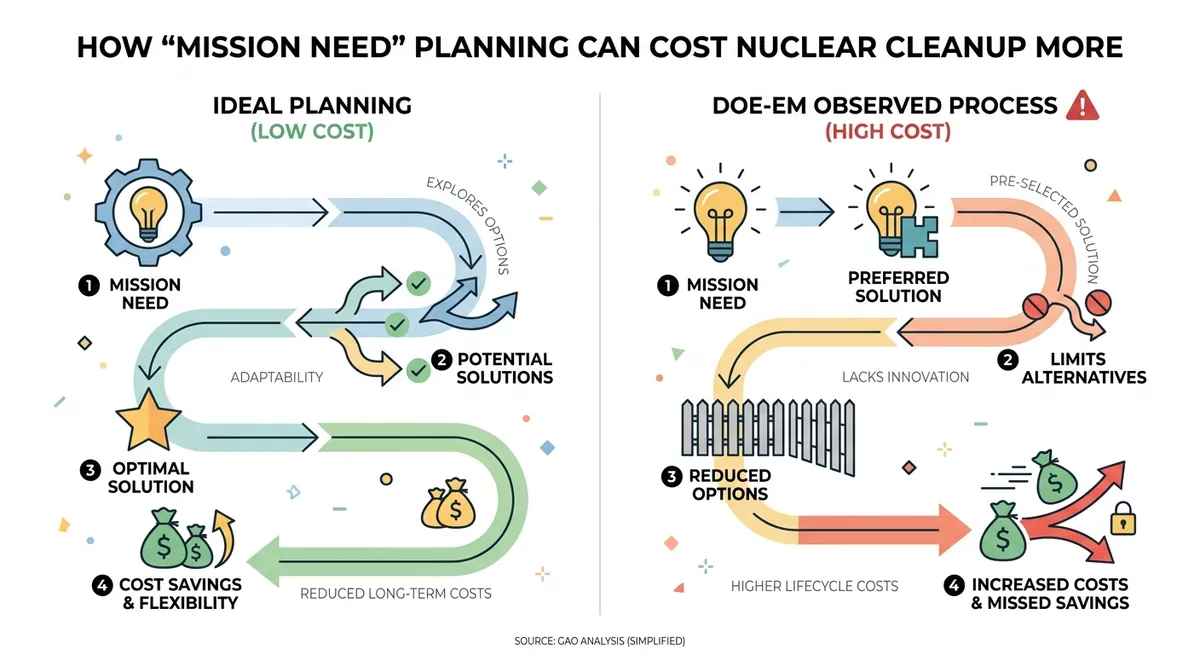
GAO’s underlying point is straightforward: DOE standards expect the mission need statement to be independent of a particular solution, because the whole purpose of the early stage is to keep the option set wide. If the MNS already implies “we need this facility,” then downstream analyses can inherit that bias. (gao.gov)
And that’s where the story gets uncomfortable: GAO found that the majority of mission need statements it reviewed for large EM projects identified a particular solution rather than staying purely problem-focused. (gao.gov)
A concrete example: Outfall 200 and the “new facility” framing
One of GAO’s examples involves the Outfall 200 Mercury Treatment Facility at the Oak Ridge Reservation. In that case, the mission need statement proposed “a new mercury treatment facility.” GAO reports that EM officials believed this was acceptable because other approaches would be explored later. (gao.gov)
In practice, GAO describes a recurring pattern: once a preferred approach appears in the mission need stage, EM may not fully reconsider it as planning continues. That matters because the cost-saving opportunity often lives precisely in those later trade studies—where you compare multiple viable treatment options under constraints like throughput, chemistry, safety, regulatory approval timelines, and lifecycle cost. If the option set narrows early, the later process has less room to find “less expensive but technically sound” paths. (gao.gov)
The second pressure: regulators and agreements that shrink the solution space
Even when agencies want to consider alternatives, legal and regulatory constraints can steer them toward a subset of options. GAO highlights this factor explicitly.
In one discussion-group example, GAO reports that EM did not pursue a cheaper yet technically sound treatment for a waste type at the Idaho National Laboratory because of an existing agreement with regulators. GAO notes that EM then spent taxpayer money over many years pursuing a solution it later deemed suboptimal and ultimately suspended. (gao.gov)
This is the real-world complication behind the report’s theme: the MNS stage is not happening in a vacuum. By the time regulators are involved, the “feasible” set of technologies can narrow—sometimes for reasons that are hard to undo once momentum, paperwork, and stakeholder commitments accumulate.
So the question becomes sharper: What happens when the planning stage quietly locks in a preferred cleanup approach before the full range of options is truly evaluated? GAO argues that it can lead to higher costs and slower correction of course. (gao.gov)
Why “internal review” may not be enough: the missing independent perspective
GAO doesn’t claim DOE is careless. Instead, it argues the review structure can be biased by who is in the room.
According to GAO, EM follows internal review steps before approving mission need for large projects, but those reviews do not include independent experts. “Independent experts” means subject-matter reviewers who have relevant technical knowledge yet are not directly involved in the same legal/regulatory agreements that can constrain decisions.
GAO’s recommendation is essentially governance design: incorporate independent members with relevant expertise into the mission need review stage for future large projects, before agreeing to a solution with regulators. (gao.gov)
That matters for a simple reason. Internal reviewers may be well-intentioned, but they can be incentivized—consciously or not—to defend what has already been negotiated or planned. Independent experts can challenge assumptions early, including whether less costly options were truly evaluated. (gao.gov)
The report’s scale: planning scrutiny for large capital asset projects
GAO’s findings aren’t a one-off complaint; the report looks at a defined population.
GAO analyzed 21 mission need statements for large projects—using a threshold of estimated cost of at least $100 million—to assess whether they identified a particular solution. It also drew on qualitative input from three expert discussion groups, with 12 experts participating across academia, national laboratories, and the private sector, and it interviewed EM headquarters and field staff. (gao.gov)
The report also connects the issue to DOE’s long-running acquisition management vulnerabilities. GAO notes DOE acquisition management has been on GAO’s High Risk List for decades due to fraud, waste, and abuse risk—context that helps explain why outsiders keep returning to procurement and planning practices rather than just blaming project teams for single decisions. (gao.gov)
The recommendations: keep the MNS solution-neutral—and bring outsiders in early
GAO makes two core recommendations for future large projects. DOE concurred with both.
First, DOE should ensure mission need is revised if it includes a predetermined solution—so the MNS starts cleanly focused on the capability gap and not a technology commitment. (gao.gov)
Second, DOE should incorporate independent experts outside of DOE into mission need review before agreeing to a solution with regulators. GAO frames this as a way to avoid narrowing potential solutions because of legal/regulatory constraints, contractor influence, or existing project relationships. (gao.gov)
GAO’s mention of a “critical decision process” points to DOE governance checkpoints. In that context, the mission need stage is a gate: it shapes what options are explored, how alternatives are framed, and what evidence gets considered before commitments become harder to reverse. (gao.gov)
Why this is more than paperwork
At first glance, a mission need statement can feel like documentation bureaucracy—forms, sections, approvals, and terminology.
But in large capital asset projects, the MNS effectively sets the problem definition that later work tries to solve. That means it can determine what counts as a “reasonable alternative,” how procurement and permitting arguments are structured, and whether cost-saving approaches stay on the board long enough to earn serious analysis.
GAO’s central message is that DOE’s nuclear waste cleanup costs can rise when early planning documents behave like they’re already halfway through design selection. The cure is not to delay action endlessly; it’s to preserve option diversity at the beginning—especially when regulators, agreements, and contractor roles make the solution space vulnerable to early narrowing. (gao.gov)
Conclusion: keep the problem clear, then broaden the solution
The lesson from GAO-26-108193 is that nuclear waste cleanup planning is only as good as the decision quality baked into its earliest documents. A mission need statement should define a capability gap without predetermining a specific solution, because early commitments can reduce the chance of finding less expensive, technically viable options. (gao.gov)
GAO also argues that independent expertise should enter the mission need review stage—before regulatory agreements lock the project into a narrower path. When the early problem framing stays solution-neutral and oversight includes impartial technical judgment, the project has a better chance to optimize costs without sacrificing cleanup effectiveness.
Comments (0)
No comments yet. Be the first to respond!
Leave a Comment
Your comment will be visible after review.