Ant: A Tiny JavaScript Runtime That Wants to Be Your Fast Default
 by ahsan
July 12, 2026
6 min read
by ahsan
July 12, 2026
6 min read
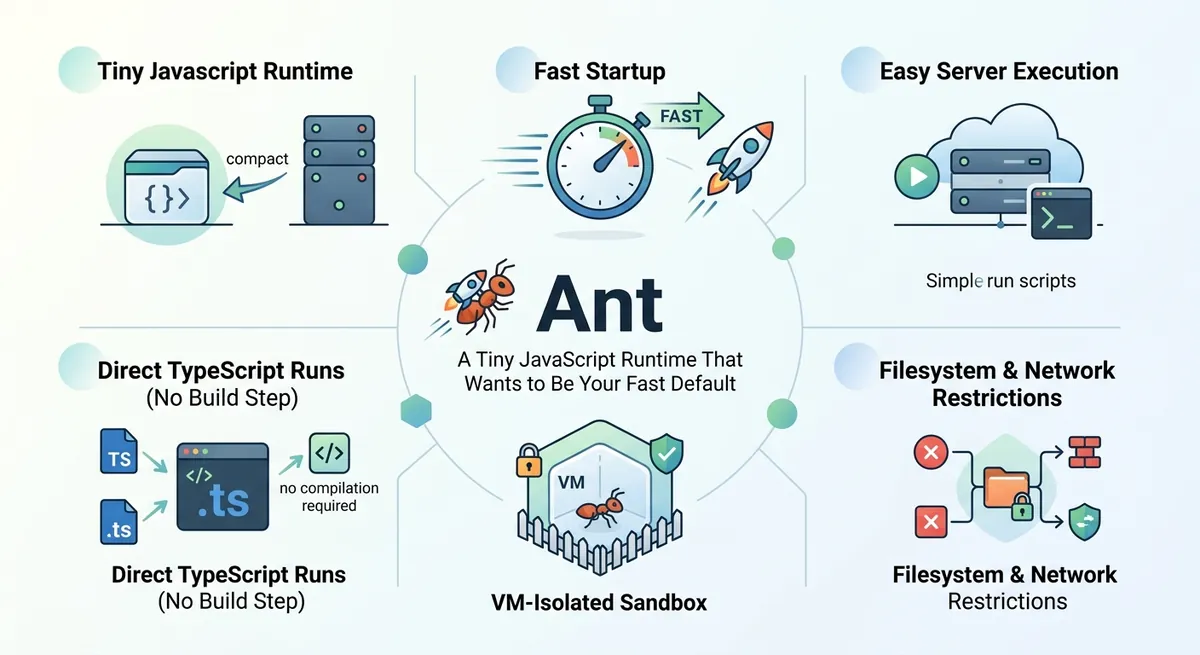
The day “just start Node” felt like too much
Most web backends start the same way: install Node.js, scaffold a server, then spend a surprising amount of time fighting startup overhead and tooling friction. When a project is small, those minutes feel absurd—especially in serverless or local “run it once” workflows.
Ant is a JavaScript runtime (a program that can execute JavaScript code outside a browser) designed to feel lightweight and fast. It’s built around a simple idea: load your code, resolve your modules, and—when needed—spin up an HTTP server without forcing a bundler or an adapter layer.
Ant also tries to treat security as a first-class feature. Instead of “permission prompts,” it offers a sandbox for code you don’t fully trust, with filesystem and network restrictions enforced inside an isolated VM.
What Ant actually is (and what “runtime” means)
A JavaScript runtime is the engine + system glue that turns JavaScript modules into a running program. In Node.js, that glue includes package resolution, networking primitives, process management, and an event loop.
Ant aims to provide those familiar capabilities—async/await, modules, HTTP servers, and common APIs—inside a compact binary. The project describes itself as a “JavaScript runtime that fits in your pocket,” with support for modules and HTTP serving as part of its core design.
That matters because runtime design affects startup behavior. A “cold start” is the moment you launch a runtime from scratch, before any caches or warm state exist. Ant’s positioning is that cold start should be low enough to matter in real workflows.
Cold start and module loading: performance you feel
When developers benchmark runtimes, they often measure throughput. Ant’s more interesting claim is about initialization overhead—specifically how quickly it can load an ecosystem of modules.
In the Ant cold-start example, the test imports a real framework (“Hono”), registers a couple routes, and then exits. No HTTP server stays running—so the number reflects module resolution and initialization overhead rather than request handling.
The reported results place Ant at the low end of the comparison, with times on the order of single-digit milliseconds in repeated runs. Even if your exact number varies by CPU, OS, and dependency graph, the takeaway stays the same: Ant is tuned for “load quickly, do work, exit.”
“From zero to a server” without adapters
A common frustration for backend frameworks is portability. Many frameworks assume a specific runtime environment, so you end up writing glue code (adapters) that translate between runtime APIs.
Ant’s approach is to make server usage feel like “run a file.” The runtime provides a default fetch-compatible server surface, so frameworks like Hono can work without custom adapters.
Here’s the kind of server you can write:
import { Hono } from 'hono'

const app = new Hono()
app.get('/', (c) => c.text('Hello from Ant'))

export default app
Then you run:
ant server.js
Ant starts listening and uses the exported handler as the application. Under the hood, an HTTP server is still doing the real work (accepting TCP connections, parsing requests, sending responses), but you don’t have to negotiate a new runtime interface for each framework.
TypeScript without a build step
TypeScript is JavaScript with types (static type annotations). The tricky part is that TypeScript usually needs a build step: compiling .ts files into .js so a runtime can execute them.
Ant takes a different route: it runs TypeScript directly by stripping types during execution, without requiring a separate tsconfig-heavy pipeline or a dist/ folder.
In the project’s documentation, Ant describes TypeScript support as “built-in TypeScript type stripping,” and it notes that the runtime strips type annotations at parse time rather than performing full type-checking.
That trade-off is important:
- No type-checking at runtime means you get fewer safety guarantees while executing.
- No separate compilation output means fewer build artifacts and less time spent on toolchain setup.
A typical flow becomes:
ant app.ts
…instead of the classic:
tsc && node dist/app.js
If your team relies on type-checking as a quality gate, you’d still run tsc in CI or your editor. Ant just removes the mandatory “compile before every run” loop.
Run code you don’t trust (without trusting it)
Sandboxing is where Ant separates itself from “permission prompts.” A permission prompt can be a UI affordance; sandboxing is a containment strategy that enforces limits on what code is allowed to do.
Ant’s sandbox API is designed to execute untrusted JavaScript in an isolated VM (Virtual Machine). A VM is a fully isolated execution environment that behaves like its own machine. The implementation is described as hardware-isolated using VM backends such as KVM on Linux and Hypervisor.framework on macOS.
The sandbox configuration shown in the Ant materials focuses on three practical controls:
- Filesystem mounts: mount your workspace as read-only, so the untrusted code can’t persist changes.
- Network deny-by-default: deny all network access unless you explicitly forward the ports you name.
- Hard boundaries: execute untrusted code behind a hard boundary, rather than letting it run in-process.
Here’s the shape of the code:
import { Sandbox } from 'ant:sandbox'

const box = new Sandbox(({ mount: '.:/workspace' }))
await box.run('untrusted.js')
await box.close()
Even without digging into every parameter, the mental model is clear: the sandbox is an environment with explicitly granted capabilities. In real systems, that reduces the risk that “untrusted JavaScript” quietly reaches for secrets, modifies your repo, or exfiltrates data.
A registry for the ecosystem: ants.land
A runtime is only useful if you can share and install packages. Ant’s ecosystem includes an open package registry at ants.land, positioned as npm-compatible.
npm-compatible means the registry speaks the same protocol expectations as npm so tools can install by package name and version. Ant’s registry flow is also open-ended: both humans and automated agents can register accounts and publish packages.
Ant materials describe a config where the registry endpoint is served over an npm-style install interface. On ants.land, the publishing guide explains that the registry endpoint is exposed at an npm-compatible URL (and that publishing uses standard npm tooling once authentication is configured).
The publishing workflow in the Ant materials looks like:
ant land login
ant land publish @you/[email protected]
The important ecosystem detail is compatibility metadata. Ant packages can declare supported runtimes in package metadata (for example, listing which environments the package is expected to run in). That helps users and automated tooling avoid installing code that only works on one specific runtime family.
Why all of this matters: a different development loop
Ant’s design choices point toward a specific developer experience.
- Fast startup makes “run a script” feel like a first-class workflow.
- No build step for TypeScript reduces friction for quick iteration.
- Framework-friendly serving reduces adapter code and portability overhead.
- Hardware-isolated sandboxing provides a real story for running untrusted JavaScript.
That combination can be especially compelling for:
- prototype backends
- CLI-style utilities with optional HTTP endpoints
- multi-runtime experimentation where adapters are costly
- systems that execute third-party scripts
At the same time, the TypeScript strategy (type stripping without type-checking) is a reminder that “developer speed” trades off against “runtime safety rails.” Ant’s sandbox is the stronger safety story, but quality gates like type-checking still belong in your development process.
Closing thought: Ant treats the runtime as product
Ant isn’t trying to be “Node, but smaller” in a superficial way. It treats cold start, module resolution, server ergonomics, and sandbox isolation as core runtime responsibilities.
If you’ve felt the loop friction of traditional Node setups—build steps for every run, adapter glue for frameworks, and security story that lives mostly in docs—Ant’s approach is designed to be felt immediately. It’s a compact runtime with an ecosystem that aims to keep both performance and containment in the conversation.
Comments (0)
No comments yet. Be the first to respond!
Leave a Comment
Your comment will be visible after review.