Chat Control 1.0 explained: what “message scanning” really means
 by ahsan
July 10, 2026
6 min read
by ahsan
July 10, 2026
6 min read
Imagine waking up to a headline about “Chat Control 1.0” and wondering what it actually changes for everyday life—your DMs, your privacy, your encrypted chats, and the way platforms handle suspicious content.
At a high level, Chat Control 1.0 is about a temporary legal permission (a derogation) that lets certain online services detect and report child sexual abuse material in private communications. In the EU, that debate has always been as much about how detection is implemented as it is about the moral urgency of protecting children.
This post walks through the core idea, the technical mechanisms often discussed in this context, and why the policy choice still sparks fierce disagreement around encryption and due process.
The practical problem: how can abuse be stopped inside private chats?
Most child sexual abuse online happens out of public view—inside private messages, in small groups, and in “off-platform” conversations. That privacy is a feature (especially for journalists, activists, and ordinary people), but it also makes monitoring harder.
So the EU’s interim approach centers on a familiar tension:
- Investigators want evidence fast enough to stop harm.
- Privacy advocates want strong limits on scanning, especially when messages are encrypted.
The legal mechanism behind this interim approach is tied to the EU’s e-Privacy rules, which protect the confidentiality of communications. Chat Control 1.0 operates as a temporary carve-out from those rules, intended to “bridge” the gap until a longer-term legal framework is agreed.
As of 2026, the EU institutions moved to reinstate the interim measure until 3 April 2028, aiming to avoid a prolonged legal gap while negotiations continue. (consilium.europa.eu)
What “Chat Control 1.0” is (and what it is not)
The term “Chat Control 1.0” is a public label for the EU’s interim regulation on combating online child sexual abuse material. The underlying legal text is Regulation (EU) 2021/1232, adopted in 2021 as a temporary derogation. (eur-lex.europa.eu)
Under this interim regime, the focus is on allowing providers to use technology to detect, report, and remove child sexual abuse material and grooming signals in relevant services.
The key distinction: interim “scanning permissions” vs. longer-term “detection orders”
A lot of the policy argument is really about power and process.
- Under the interim regime, the emphasis is on enabling voluntary detection mechanisms by providers under the temporary legal cover.
- In the permanent framework discussed alongside this, detection is meant to become more structured and accountable—commonly described as case-by-case obligations triggered by a detection order.
EU Commission explanations for the longer-term approach emphasize that detection obligations should be ordered by a judge or an independent administrative authority and be limited to what is necessary to retrieve and remove clearly illegal content. (home-affairs.ec.europa.eu)
Even so, critics argue the interim approach normalizes broad technical surveillance, creating political momentum that can delay stronger structural reform.
The “how”: what scanning technologies are supposed to do
It helps to translate the slogans into concrete engineering patterns.
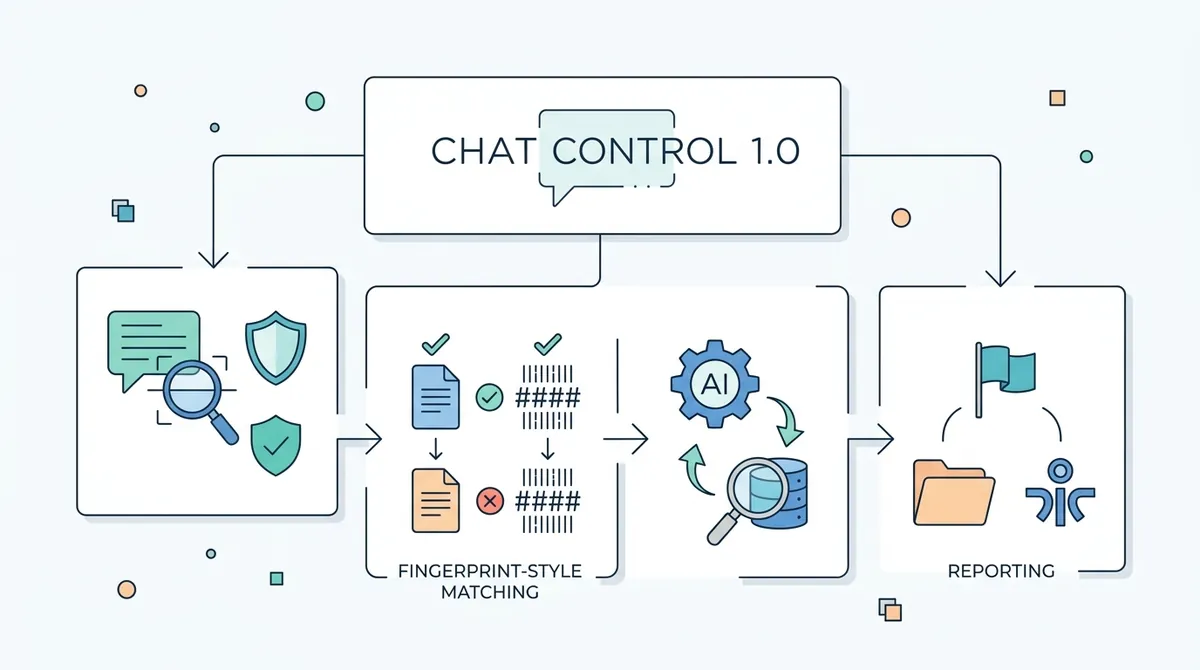
In the EU’s own technical description, detection and reporting are supported by two main categories of approaches: known-material matching and new-material / grooming classification. (home-affairs.ec.europa.eu)
1) Matching known material with PhotoDNA-style “fingerprints”
For known child sexual abuse material, the EU Commission describes a technology conceptually similar to PhotoDNA: it converts a previously flagged image into a unique identifier that is designed to be non-recoverable—think of it as turning a photo into a one-way “digital fingerprint.” (home-affairs.ec.europa.eu)
That matters technically:
- A hash (a “fingerprint” value derived from data) can be used to detect exact matches without storing the original content.
- If implemented carefully, the provider only compares identifiers against a database of known fingerprints.
This is the core reason supporters argue it is “privacy preserving”: the system is meant to avoid understanding the whole message content.
2) Detecting new material and grooming with AI classifiers
For new child sexual abuse material and grooming, the Commission describes the use of artificial intelligence (AI) classifiers trained on databases of known material and confirmed grooming conversations. (home-affairs.ec.europa.eu)
Here the trade-off becomes harder:
- AI classification depends on statistical models that can produce false positives (flagging benign content) and false negatives (missing actual abuse).
- The risk of error drives the need for strict safeguards, auditing, and review.
Even the Commission’s framing acknowledges the need to limit the error rate and control how matching happens. (home-affairs.ec.europa.eu)
Where encryption enters the debate: end-to-end encryption vs. “where the check happens”
The phrase “chat control” becomes emotionally charged because of end-to-end encryption (E2EE).
- End-to-end encryption means that only the communicating users can read message content; intermediaries (like the service provider) can’t decrypt the messages in the usual design.
So when people hear “mass scanning,” they often picture a world where providers decrypt everything.
Supporters of interim rules counter that the scanning is intended to occur in a way that does not require the provider to understand the conversational content—using “least privacy intrusive” methods and deleting data quickly under defined purposes. (home-affairs.ec.europa.eu)
Critics respond that the architecture still changes:
- Even without full decryption, detection often requires a foothold inside the communication pipeline.
- That foothold can become a policy precedent: once scanning is permitted temporarily, it can harden into permanent expectation.
And that’s why the EU’s independent data-protection watchdog (the EDPS) explicitly warns about the need to prevent “generalised, indiscriminate scanning” and to improve legal certainty and safeguards. (edps.europa.eu)
Why the EU keeps extending interim rules (and why opponents see a problem)
The EU’s stated goal is to avoid a legal gap: if the interim authority expires and a longer-term law isn’t ready, providers may lose the legal basis to run these detection mechanisms. The Council described reinstatement as a way to bridge negotiations on the longer-term legal framework. (consilium.europa.eu)
But opponents argue that this “bridge strategy” can backfire. The longer the interim period lasts, the less urgency there is for a fundamentally different approach.
In a technically grounded sense, this means the system keeps shipping with the same detection paradigm—continually extended—while stakeholders argue about what “targeted detection” should mean in practice.
There is also a governance angle: the EDPS’s opinion highlights the compliance complexity of proving that scanning systems have a stable, lawful foundation aligned with data protection requirements (including GDPR). (edps.europa.eu)
That’s not a minor legal footnote—it shapes what engineering designs are allowed, audited, and deployed.
So what changes after Chat Control 1.0 is extended?
From a user’s perspective, the most tangible “change” is not always a visible UI toggle. It’s the underlying promise: platforms in scope are again able to use detection and reporting tools under the temporary legal cover.
From a technical perspective, the important change is that detection workflows—hash-based matching for known material, AI classification for new material and grooming, and reporting / removal procedures—remain operational under a defined EU legal basis until 3 April 2028. (consilium.europa.eu)
From a rights-and-systems perspective, the open question remains the same: where does scanning occur, what data is processed, how narrow the obligation is, and how strongly the process protects innocent people against errors.
That’s the question lurking behind the headlines: What is “message scanning” if you care about encryption, due process, and false positives?
Closing thought: protection needs engineering, not slogans
Chat Control 1.0 is best understood as a legal permission layer for a specific class of child-safety detection technologies—fingerprints for known material and AI-based classifiers for new material and grooming—linked to reporting and removal mechanisms. (home-affairs.ec.europa.eu)
The technical heart of the controversy is not whether detection is possible; it is how much power is granted, how indiscriminate the tools become in practice, and how reliably safeguards prevent overreach—especially in the presence of end-to-end encryption. The EDPS’s warnings make clear that safeguards and legal certainty are not optional add-ons; they are part of the system design. (edps.europa.eu)
In the end, the debate isn’t about whether protecting children matters. It’s about whether the chosen technical route can deliver protection without turning privacy and encryption into negotiation chips.
Comments (0)
No comments yet. Be the first to respond!
Leave a Comment
Your comment will be visible after review.