Mesh LLM on iroh: distributed LLM inference without vendor lock-in
 by ahsan
July 12, 2026
6 min read
by ahsan
July 12, 2026
6 min read
The “who owns the GPUs?” problem
Picture this: you’re building an agent that needs fast, reliable language model inference—yet every time usage spikes, your costs spike too. More importantly, the model you tested isn’t guaranteed to be the model you’ll get next month, and your prompts travel through an external provider’s infrastructure.
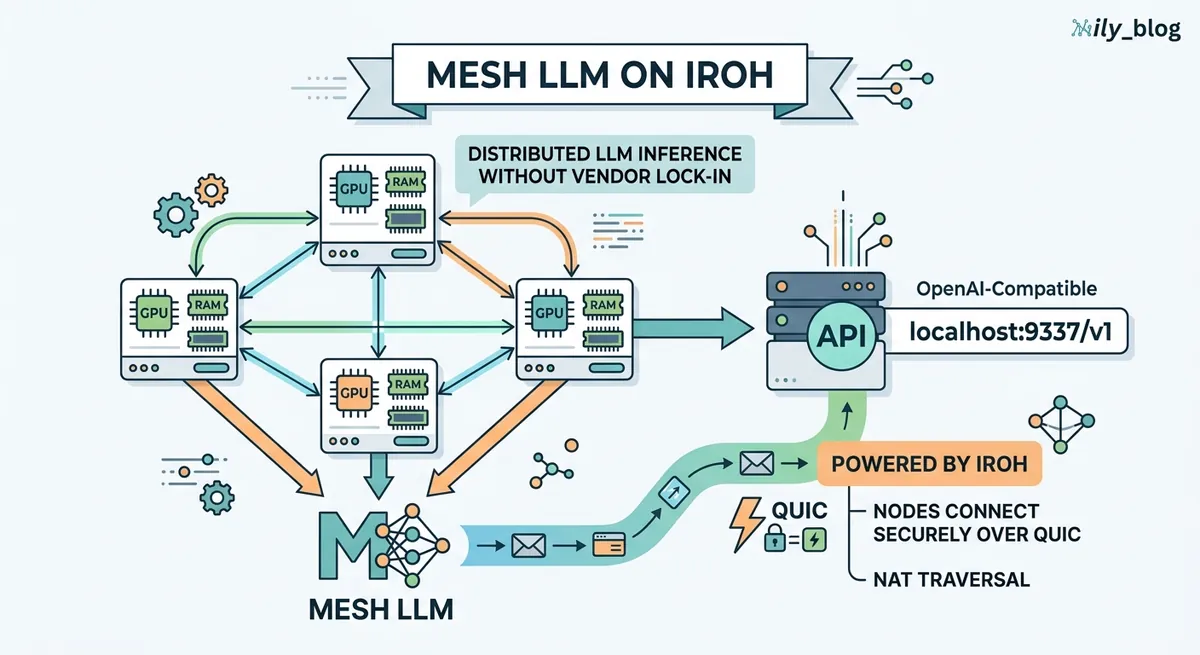
Mesh LLM and iroh aim to flip that story. Instead of sending prompts to a black-box data center, you pool compute from the machines you already have—laptops, workstations, mini PCs, and servers—and expose the result as a familiar OpenAI-compatible API running locally. (github.com)
So the core question becomes: how do we make GPUs in different rooms act like one cluster? Mesh LLM answers by combining a distributed inference system (Mesh LLM) with a peer-to-peer networking layer (iroh) that focuses on “dialing devices” instead of “managing IPs.” (github.com)
Mesh LLM in one sentence
Mesh LLM turns many machines into a single LLM-serving mesh, and it listens on localhost:9337/v1 like an OpenAI server. Start one node, add more later, and let the mesh decide whether to run locally, forward to a peer, or split the model across machines. (github.com)
That one sentence hides a lot of engineering work, so let’s unpack it carefully—because the “distributed” part is where beginners usually get stuck.
Three ways a request can be served
When an LLM request enters the mesh, Mesh LLM can satisfy it in three different ways:
- Local execution: the node runs the model on its own GPU(s).
- Peer routing: if another node already has the right model loaded, the request is proxied to that peer.
- Distributed pipeline (“Skippy” splits): if a model is too large for one machine, the model runs as a pipeline across multiple machines.
From a client perspective, none of this is visible—you still talk to localhost using the OpenAI-shaped request format. (github.com)
Why pipeline splitting matters
Large language models (LLMs) often don’t fail because they’re “slow,” but because they don’t fit in a single machine’s memory. Here, “memory” means the GPU/host RAM where model weights and runtime data must live for inference to happen.
In pipeline splitting, the model is divided into stages (for example, layer ranges). Each stage runs on a different machine. The output from one stage becomes the activations for the next stage. Activations are the intermediate tensors (numbers) produced while the network processes the input tokens; they’re the “working state” passed along the pipeline.
It’s a bit like assembling furniture on a conveyor line: one station cuts boards, the next screws parts together, and a later station finishes and polishes. Each station can be smaller than the whole factory would need to be.
Where iroh fits: networking as a reusable primitive
Mesh LLM could try to invent its own distributed networking. Instead, it uses iroh, which is designed to make peer-to-peer connectivity feel like “dialing an endpoint,” not “negotiating a network.”
iroh endpoints: dial keys, not IPs
Traditional networking relies on IP addresses—numbers that identify where something lives on the network. But IPs can change, be blocked by firewalls, or be meaningless across NATs.
iroh’s abstraction is to identify peers using cryptographic keys: you dial the device’s identity, not its IP. The iroh team describes this as “Dial keys. Not IPs,” emphasizing that keys are stable and controlled by you. (iroh.computer)
QUIC under the hood (and why it matters)
At the transport layer, iroh uses QUIC over UDP by default. QUIC is a modern networking protocol that supports multiple independent data streams inside one connection and runs with built-in encryption/authentication.
Concretely, iroh’s QUIC implementation is built on noq, includes multipath support and QUIC NAT traversal, and encrypts/authenticates connections using TLS 1.3. (docs.iroh.computer)
This is crucial for distributed inference because pipeline splitting is latency-sensitive: every stage needs timely activations, and every peer hop needs reliable transport.
NAT traversal and relay fallback
Most home networks sit behind NAT (Network Address Translation), which rewrites addresses so internal devices can share one public IP. NAT traversal is the art of getting two devices to communicate directly even when both are hidden behind similar translation rules.
iroh handles NAT traversal automatically and can fall back to relays when direct connectivity isn’t possible. (docs.iroh.computer)
So Mesh LLM can focus on inference routing and model execution, rather than building and debugging a labyrinth of NAT/connection strategies.
Multiplexing protocols with ALPN
A subtle but powerful detail is how iroh supports multiple “logical protocols” over QUIC. QUIC is organized around connections and application-layer protocol negotiation.
iroh discusses using ALPN (Application-Layer Protocol Negotiation) such that when two endpoints talk multiple protocols, they effectively open multiple QUIC connections—because a QUIC connection is tied to one ALPN at a time. (iroh.computer)
Mesh LLM leverages this idea conceptually: it separates traffic types (for example, gossip/routing/management vs. latency-sensitive activation transport). Even if you never touch these details, the benefit is practical: the system can prioritize the “right” traffic patterns for inference.
A pluggable Mesh Runtime (models are capabilities)
Beyond routing and transport, Mesh LLM is built around a pluggable architecture: plugins declare what they provide using a manifest, and the runtime starts, routes, and exposes those capabilities.
Mesh LLM describes this runtime as exposing capabilities over multiple interfaces such as MCP and HTTP, along with inference and mesh events. (meshllm.cloud)
This design matters because it keeps the distributed inference engine from becoming a monolith. Different model backends (or different serving styles) can slot in as plugins as long as they match the declared capability contract.
Control planes vs. public mesh data
When peers join an open network, you still need operational safety: configuration syncing, ownership decisions, and compatibility rules.
The Mesh LLM repository notes an “owner-control plane” concept implemented as an additive control lane (referred to as mesh-llm-control/1), while public mesh behavior (like join, gossip, routing, inference) remains on the public mesh plane for mixed-version compatibility. (github.com)
Even if you never operate a large deployment, this separation is a key reason the system can scale beyond a toy demo.
What “getting started” feels like
Mesh LLM is designed to be operationally approachable: install a lightweight node, serve locally, and let the mesh extend your capacity.
From the project README, the workflow includes installing the executable via a script, running setup, then starting a node in “serve” mode with auto-discovery. The local API stays at port 9337, so OpenAI-compatible clients can send requests to localhost. (github.com)
A concrete way to think about it is this: your application code doesn’t care whether tokens are generated by a laptop GPU, a workstation GPU, or a multi-stage pipeline. All that complexity is “somewhere else,” inside the mesh.
Why this approach changes the economics of inference
Traditional hosted APIs concentrate cost and control in someone else’s infrastructure: you pay per request or per token, and you inherit their upgrade cadence.
With Mesh LLM on iroh, you can regain leverage:
- Cost control: your compute is yours (or at least yours to coordinate across your peers).
- Model control: you choose when to add models and which model backends run.
- Privacy posture: prompts can remain inside a deployment boundary if you choose a private mesh.
And importantly, “distributed” doesn’t have to mean “complicated.” When iroh provides authenticated, NAT-traversing QUIC links, and Mesh LLM builds inference routing and pipeline execution on top, the system can treat peer-to-peer communication as a reusable primitive—so the networking doesn’t become the product you struggle with every day. (docs.iroh.computer)
Conclusion: a mesh that looks like one local server
Mesh LLM changes the LLM deployment shape from “rent a black box” into “coordinate compute you already have.” It keeps the developer experience simple by exposing an OpenAI-compatible endpoint on localhost, while it dynamically chooses local execution, peer routing, or pipeline splitting for models that don’t fit on a single machine. (github.com)
Underneath, iroh provides the missing networking foundation: secure QUIC connectivity with TLS 1.3, NAT traversal, and relay fallback, keyed by stable device identities rather than fragile IP assumptions. (docs.iroh.computer)
The result is distributed AI computing that feels less like cluster management and more like plugging more capacity into your own neighborhood of machines.
Comments (0)
No comments yet. Be the first to respond!
Leave a Comment
Your comment will be visible after review.