Networking and the Internet, from First Principles
 by ahsan
July 11, 2026
6 min read
by ahsan
July 11, 2026
6 min read
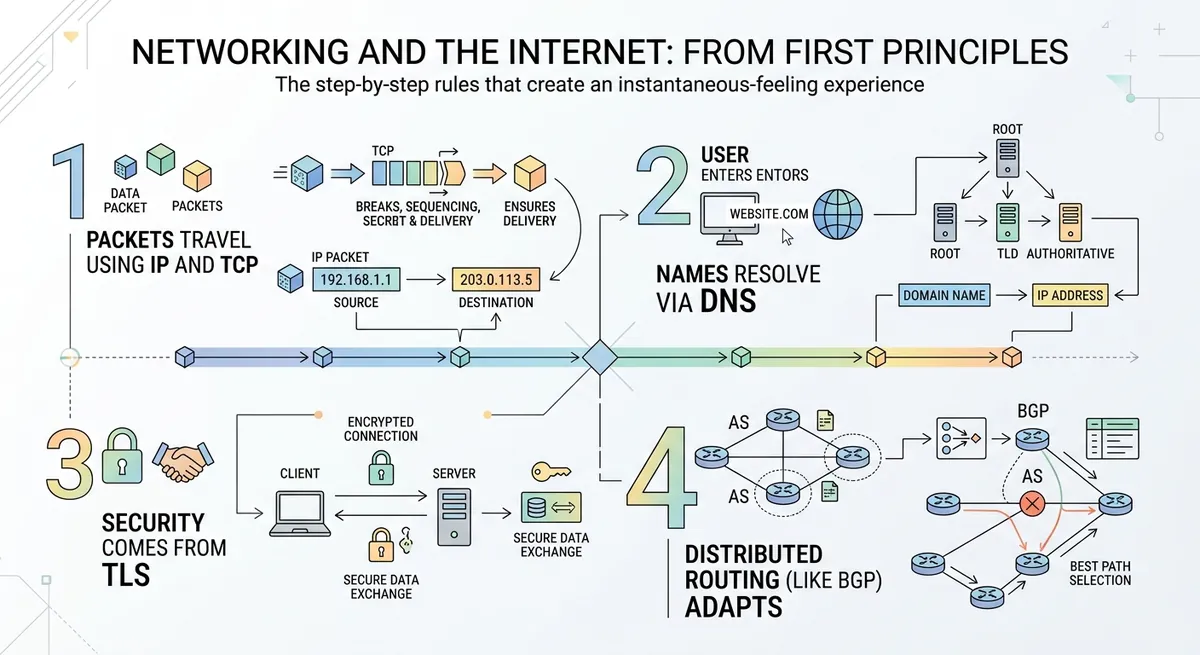
The “instant” reply that isn’t instant
You tap send on your phone, and somehow—despite the ocean, the distance, and the sheer number of companies involved—the reply arrives like your friend is sitting next to you. That feeling is the magic trick the internet performs for us every day.
But underneath the magic trick is something surprisingly physical and surprisingly procedural. Your app turns your voice or text into data (measurable chunks of information), then the networking stack turns those chunks into packets—small envelopes with addresses and bookkeeping. Across the network, those packets ride through copper, Wi‑Fi radio, and sometimes fiber-optic light, guided by routing rules. Finally, at the other end, the receiver turns packet arrivals back into the stream your app expects.
So what actually makes this work? The short answer is: the internet succeeds because it’s built from protocols—shared rules—that let independent machines cooperate without anyone needing a global conductor.
From strings and relays to digital symbols
Before we had computers, we still had networks. The core idea was always the same: connect two places, change something at one end, measure it at the other, and repeat across the route.
The problem was distance. Real signals lose strength and accumulate noise. That’s why the telegraph’s breakthrough mattered. Samuel Morse’s system didn’t send a continuous waveform like an analog radio broadcast; it sent discrete symbols—clear “short/long” pulses that represent specific characters.
This discreteness enabled a crucial trick: regeneration. A relay doesn’t need to faithfully pass a degraded wave; it can detect whether a pulse exists, decide what symbol it represents, then recreate a clean version for the next segment. That prevents the noise from snowballing.
And notice what had to be agreed upon in advance: the mapping from pulses to characters, plus conventions like “received” acknowledgments and retransmission behavior. That agreement is a protocol: a formal specification of message formats and how communication proceeds.
Once you see that, the internet stops being mysterious. It becomes a modern extension of the telegraph’s logic: use shared rules to move discrete information across imperfect links.
Packet switching: why “envelopes” beat “everything at once”
Now imagine sending a long story, not just a short telegraph message. If we tried to push it as one giant continuous stream, one slow hop or one bad moment could derail everything.
Packet switching solves that by chopping data into smaller pieces. Each piece includes:
- A destination (where it should go)
- Some way to identify the stream (so the receiver can put pieces back together)
- Integrity checks (so the receiver can detect corruption)
Packets then move independently. One packet may take one route, another may take a different route, and the receiver reassembles them.
This sounds chaotic, but it’s actually a controlled chaos—like shipping letters using addresses rather than carrying one suitcase across the entire world by a single uninterrupted train.
A tiny mental simulation
Here’s a beginner-friendly picture of packetization and reassembly. It’s not the exact internet format, but it captures the idea behind packet switching.
# Split a message into packets (chunks)
message = "MEET AT DAWN"
packet_size = 4
packets = []

for i in range(0, len(message), packet_size):
    seq = len(packets)              # sequence number (ordering label)
    chunk = message[i:i+packet_size]
    packets.append((seq, chunk))

# Receiver side: put chunks back in order
packets_reordered = sorted(packets, key=lambda x: x[0])
reassembled = "".join(chunk for seq, chunk in packets_reordered)

print(reassembled)
The key lesson is this: packets let the network keep moving even when conditions change. The “put it back together” job happens at the receiver (with help from the transport protocol).
The internet’s layered plan: IP, TCP, DNS, TLS
At this point, a common question appears: why are there so many protocols? The answer is that each protocol exists because it fixed a particular limitation.
IP: the Internet Protocol (routing with addresses)
IP (Internet Protocol) is the protocol that gives packets their inter-network addresses and defines how routers forward them.
Think of IP as the postal system’s addressing rules plus “how to hand a letter to the next sorting office.” IP doesn’t guarantee that packets arrive, in order, without loss.
That “make it reliable” responsibility is handed to a higher layer.
TCP: the Transport Control Protocol (reliability on top of IP)
TCP (Transmission Control Protocol) adds the reliability features many applications expect from a connection-oriented stream. In plain terms, TCP helps with:
- ordering (so bytes are reassembled correctly)
- detecting loss (so missing data doesn’t silently corrupt the stream)
- retransmission (so lost pieces can be resent)
So when a video call stutters, it often isn’t because the physics are failing—it’s because some part of this chain (loss, delay, buffering, or retransmission pressure) is colliding with real-time expectations.
DNS: the Domain Name System (names to IP addresses)
When you type a name like example.com, your computer doesn’t natively know how to route to that name.
DNS (Domain Name System) is the protocol that translates human-readable names into IP addresses by consulting distributed name databases. This is another “independent companies, shared rules” story: DNS servers collaborate through caching and queries, but there’s no single master DNS brain steering every request.
TLS: encryption and authentication for the “padlock”
Finally comes security.
TLS (Transport Layer Security) is the protocol that creates an encrypted, authenticated channel between your device and the server. In practice, it’s why your browser can show a lock icon and why attackers can’t casually read or rewrite the traffic in transit.
This matters because networking protocols mostly focus on moving packets, not on keeping their contents secret. TLS is what turns the same network infrastructure into a trustworthy communication channel.
“Nobody is in charge”—so how does routing work?
The internet’s reliability comes from distributed decision-making.
Instead of a single central computer directing every conversation, networks use routing protocols so that routers can share reachability information. One of the most important is BGP (Border Gateway Protocol), which enables routers belonging to different networks (like different ISPs) to coordinate about which routes are reachable.
Here’s the feel of the mechanism: each router doesn’t need to know the entire world’s map in perfect detail. It needs enough information to choose a good next hop toward the destination.
And when conditions change—like a submarine cable getting damaged—some routes become less available. Routing protocols converge on alternatives. That’s why your data can “reroute around a failing undersea cable”: the network doesn’t predict failures perfectly; it adapts.
A protocol timeline you can keep in your head
The internet didn’t launch fully formed; it accumulated patches and improvements over decades. A handful of key milestones helps anchor the mental model:
- ARPANET first message: October 29, 1969 (darpa.mil)
- IP (RFC 791): September 1981 (rfc-editor.org)
- TCP (RFC 793): September 1981 (rfc-editor.org)
- DNS concepts and facilities (RFC 882) / implementation spec (RFC 883): November 1983 (rfc-editor.org)
- BGP (RFC 1105): June 1989 (datatracker.ietf.org)
- TLS 1.3 (RFC 8446): August 2018 (rfc-editor.org)
Putting it all together: the coherent “first principles” picture
Once you assemble the pieces, the everyday mysteries become less spooky.
- Your message becomes packets because networks prefer small, independently routed chunks.
- Routers don’t need a master controller because routing protocols let them make local forwarding decisions that collectively produce global behavior.
- TCP exists because “best effort delivery” (IP’s nature) is not enough for many applications.
- DNS exists because humans use names, but routers use addresses.
- TLS exists because moving packets isn’t the same thing as protecting them.
And when a call stutters or a page buffers, the most likely story isn’t “the internet stopped working.” It’s that one layer’s assumptions are colliding with reality—congestion, loss, increased latency, or resource limits—triggering retries, reordering, or buffering.
Conclusion
The internet can feel like instantaneous magic, but it’s really engineered cooperation. Packet switching breaks communication into manageable chunks. IP and TCP define how those chunks are addressed and delivered reliably. DNS turns names into routes. TLS keeps the contents protected. And distributed routing protocols like BGP let the system adapt when parts of the world stop behaving nicely.
In other words: the internet works because it’s not a single machine. It’s a society of machines, following shared rules, passing envelopes forward until the story gets reconstructed at the end.
Comments (0)
No comments yet. Be the first to respond!
Leave a Comment
Your comment will be visible after review.