Relativity Meets Chemistry: Why Triple Bonds Fail in Heavy Elements
 by ahsan
July 11, 2026
6 min read
by ahsan
July 11, 2026
6 min read
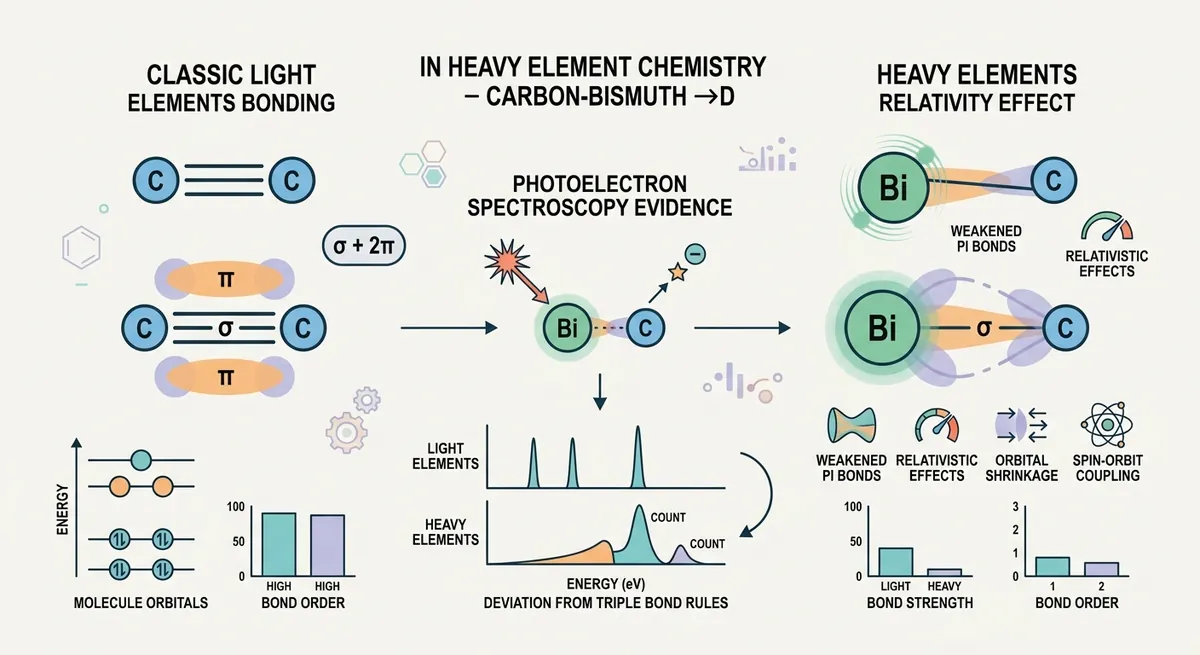
The moment the “triple bond” picture breaks
Picture learning chemistry the way most of us do: a triple bond is a neat, textbook-perfect arrangement. You draw one σ (sigma) bond—a strong, head-on bond—and two π (pi) bonds—two weaker, side-by-side bonds wrapping around that sigma connection. For lighter elements, that mental model works well enough to predict shapes and reactivity.
Now imagine staring at a spectrum from a real, heavy-element molecule and realizing the electrons don’t respect the tidy sigma-versus-pi separation. That’s the surprise at the heart of new research from Brown University, reported in Science on July 9, 2026: when the bonding partners include a sufficiently heavy nucleus—like bismuth—relativistic effects reshape how the electrons organize themselves, and the classic triple-bond blueprint becomes blurred.
This isn’t relativity as a distant cosmic idea. It’s relativity showing up in ordinary chemical bonds.
A refresher: what σ and π bonds actually mean
Chemists describe bonding using the shapes of molecular orbitals—regions where electrons are likely to be found in a molecule. When two atoms bond, their orbitals overlap, and the overlap creates bonding orbitals with lower energy.
A sigma (σ) bond forms from “direct overlap” along the internuclear axis (think: straight between the two nuclei). A pi (π) bond forms from side-by-side overlap in two perpendicular directions, producing two lobes of electron density above and below the axis.
In the textbook world, a triple bond is one σ + two π. That separation is a modeling convenience: it assumes the electronic structure is organized in a way where “along the axis” and “around the axis” are distinct.
The new result says that for heavy elements, that clean separation doesn’t hold up.
What changes with heavy nuclei: electrons enter the relativistic regime
Relativity matters most when electrons move fast enough that Einstein’s corrections become noticeable. In atoms with high nuclear charge (the heavier elements), electrons feel an intense electric attraction.
When the nucleus is heavy, the inner electrons and valence electrons can move at a significant fraction of the speed of light, pushing chemistry into what researchers call the relativistic regime. That regime is where non-relativistic quantum chemistry—treating electron motion with older approximations—can miss key details.
But the crucial player here isn’t just “fast electrons.” It’s how fast motion couples to spin.
Spin-orbit coupling: the mechanism behind the “smeared” bond picture
Every electron has a property called spin, which you can picture as an intrinsic, quantum “internal compass” rather than literal spinning like a planet. The electron’s spin acts like a tiny magnetic moment.
In atoms, the electron is moving through the electric field produced by the positively charged nucleus. In relativistic quantum mechanics, that motion and the electron’s spin become linked. The resulting interaction is called spin-orbit coupling—the coupling between the electron’s spin and the way it moves in an orbital.
This matters for bonding because bonding classifications like σ vs π rely on an assumption: orbital direction and electron spin can be treated as largely independent. Under strong spin-orbit coupling, that assumption weakens.
The result is conceptual: the “boundary” between a sigma bond (axis-aligned) and pi bonds (side-on) becomes hybridized—mixed together by relativistic physics.
So what happens to a triple bond when the heavy atom is one of the ends? The study’s interpretation is that the triple-bond structure doesn’t remain “one σ + two π” in the relativistic limit.
How you can measure bonding without guessing: photoelectron spectroscopy
The experimental breakthrough uses photoelectron spectroscopy (PES), a technique that probes bonding by measuring the energies of electrons inside a material or molecule.
Here’s the core idea, stated in plain terms: a laser (or photon source) supplies energy, and that energy can eject an electron from the molecule. PES measures the ejected electron’s kinetic energy (its “speed-and-energy after it leaves”). Using the conservation of energy, researchers convert kinetic energy into the electron’s binding energy—the energy cost to remove that electron from its original molecular orbital.
In practice, the spectrum is a pattern of peaks. Each peak corresponds to electrons in different occupied orbitals. Because orbital energies and shapes depend on bonding, PES becomes a fingerprint for the molecule’s bonding structure.
The Brown team prepared molecules built from carbon and bismuth, cooled them to extremely low temperatures (near absolute zero to stabilize the species), and then used photoelectron spectroscopy to obtain the binding-energy signature associated with those carbon–bismuth bonds.
The key observation: the spectrum doesn’t match “one σ + two π”
Once the PES data arrived, the central test was straightforward in concept: does the observed bonding signature align with the classic triple-bond model (one σ bond plus two π bonds), or does it resemble a different internal electronic arrangement?
The reported result points to the latter. The carbon–bismuth bonding signature did not fit the traditional picture. Instead, it looked more like a structure where the three bonding interactions don’t separate cleanly into one σ and two π.
In the interpretation, the bonding is consistent with one π bond and two hybrid σ–π bonds—meaning parts of what we’d normally label sigma and pi are mixed together by the relativistic, spin-orbit-driven changes in the electron structure.
That’s where the “textbook rewrite” language comes from. The experiment provides direct spectroscopic evidence that, for heavy elements like bismuth, the sigma/pi distinction within a triple bond becomes smeared.
Why this matters beyond one molecule
At first glance, this could seem like a niche detail: chemistry textbooks are full of idealized models, and real molecules often deviate from them. But heavy-element chemistry is exactly where those deviations become technologically important.
Relativistic effects can change what “bond strength” even means
Traditional bonding models often try to map energy, length, and reactivity to the neat categories of σ and π. When relativistic effects and spin-orbit coupling blend these categories, the “labels” remain useful as a starting point, but the underlying physics shifts.
That shift changes how theorists build computational models and how experimentalists interpret spectra.
Bismuth is already on the materials roadmap
The study also connects to applications for bismuth. Bismuth is being investigated as a potential alternative to toxic lead in next-generation solar cells, and it’s also prominent in research on quantum materials—areas where relativistic electronic structure can produce unusual electronic behavior.
For quantum-focused systems, bonding geometry is part of the hardware
In emerging fields like quantum computing and quantum materials, the electronic structure of a molecule or solid isn’t just chemistry trivia—it can influence how quantum states behave. If heavy-element bonding is governed by relativistic structure mixing, then the “design rules” for those systems may need to account for it more explicitly.
The bigger lesson: models survive until the regime changes
The most comforting part of this story is that it doesn’t happen because chemists were careless—it happens because nature shifts regimes. For lighter elements, the sigma/pie picture is a practical approximation. For heavier elements, relativistic effects alter electron motion and tie it to electron spin through spin-orbit coupling, and the approximation stops being reliable.
So the experiment doesn’t just correct a diagram. It shows how to think scientifically about bonding: the “rules” are not universal truths; they are accurate summaries of a particular physical regime.
And in this new regime—heavy elements like bismuth—photoelectron spectroscopy gives us a direct window into how electrons actually organize themselves.
Conclusion: the triple bond’s identity depends on relativity
A triple bond isn’t always one σ and two π when the bonding partner is a heavy atom. New evidence using photoelectron spectroscopy indicates that for carbon–bismuth molecules, relativistic physics disrupts the usual separation, producing a more hybrid bonding picture consistent with one π bond and two mixed σ–π components.
In short: when electrons move through heavy-element environments at relativistic speeds, spin-orbit coupling reshapes the electronic structure, and chemical bonds stop behaving like the textbook model.
Comments (0)
No comments yet. Be the first to respond!
Leave a Comment
Your comment will be visible after review.